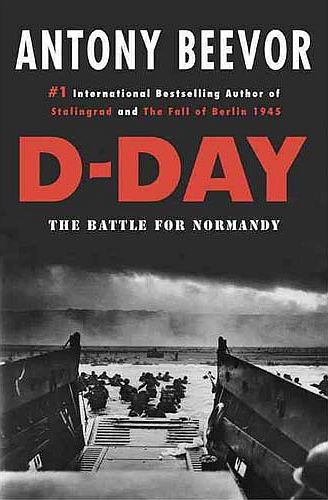
The book has many interesting tit bits that enrich our knowledge of the time. For westerners D-Day was a story of stuff that makes legends. Ask a Russian about D-Day and he will laugh derisively. Anyway Beevor tells us many things that we don't know in his book. Worth reading.
Omaha Beach. Americans count the losses
Antony Beevor's books are always must-reads. Whether it be Stalingrad or Downfall, Berlin. He tells us history in a honest manner which few western historians dare to do.
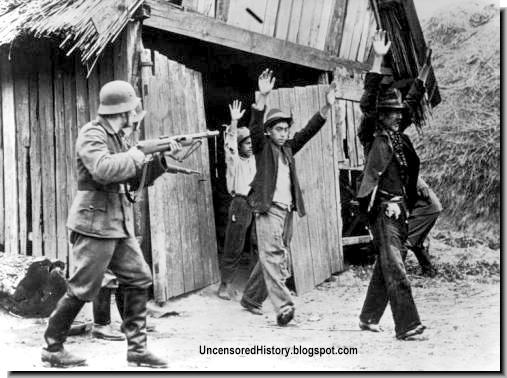
His book D-Day is not another flowery eulogy of western soldiers and their bravery during D-Day. Instead it is a honest history of the time. Beevor tells us many things that are news to many of us. That American soldiers like the Germans many times took no prisoners. And to hell with the Geneva Conventions.
The battlefield myth of female snipers spread with astonishing rapidity through 'latrinerumours', as they were known. But stories of young Frenchwomen staying with their German boyfriends were almost certainly true. Just inland from Omaha beach, a sergeant in the 6th Engineer Special Brigade recounted, 'we saw in the ditches French girls lying alongside their German soldiers. These girls had gone along with the [German] army as they retreated and they were killed by our planes and they were found lying side by side.'
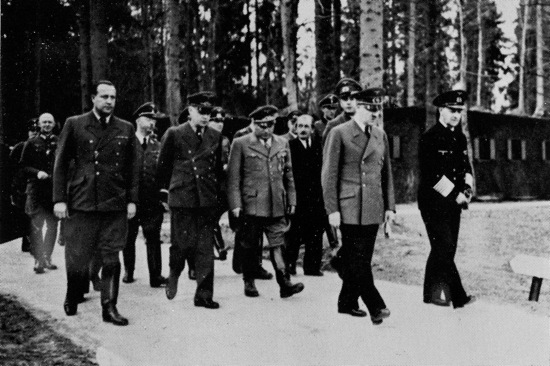
What Hitler thought of the imminent D-Day
Hitler was in a confident mood. He longed for the enemy to come, certain that an Allied invasion would be smashed on the Atlantic Wall. The Reich propaganda minister, Joseph Goebbels, even implied that the Allies would not dare to cross the Channel. His great slogan at the time was: 'They are supposed to be coming. Why don't they come?'Hitler had convinced himself that defeating the invasion would knock the British and Americans out of the war. Then he could concentrate all his armies on the eastern front against Stalin. The casualties the German armies in France would suffer in this great defensive battle did not concern him.
Before June 6, 1944. German soldiers scatter as allied planes roar above the French coast
Rommel and D-Day
Increasingly convinced that the Allies might well land in Normandy after all, Rommel visited the coastal defences there frequently. He thought that the long curving bay which the Allies had designated as Omaha beach was similar to Salerno, where they had landed in Italy. Certain that the outcome would be decided in the first two days, Rommel was tireless in his efforts. Turrets from French tanks captured in 1940werefixedtoconcretebunkers.Theywereknownas'Tobrouks', from the battle in North
Africa. French labourers and Italian prisoners of war were drafted in to erect large posts to thwart glider landings on the most likely sites identified by German paratroop officers. These forests of stakes were nicknamed 'Rommel asparagus'.
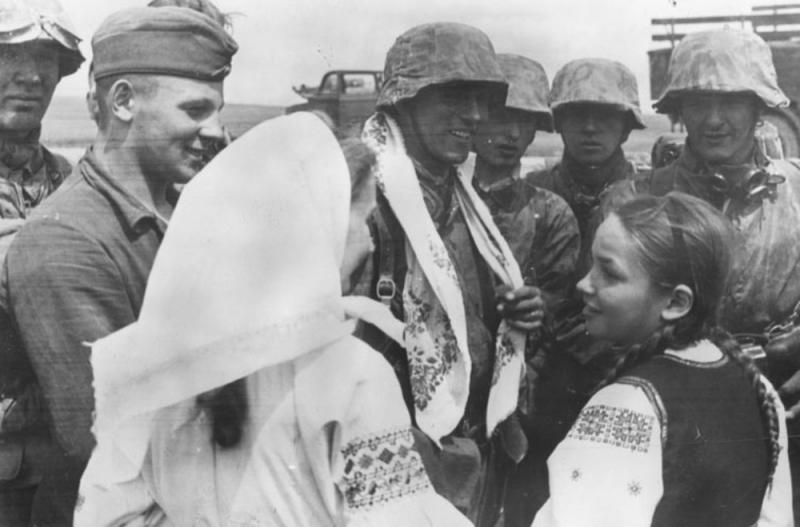
German soldiers in occupied France before D-Day
Many German officers and soldiers had struck up liaisons with young Frenchwomen in the provinces as well as in Paris, and for those without a girlfriend there was an army brothel in Bayeux. This had been established in the quiet little town along with an army cinema, a military dental practice and other facilities attached to the Maison de la Wehrmacht. German soldiers in France, especially those quartered amid the rich farmlands of Normandy, availed themselves of another advantage. Those going home on leave went back with wooden boxes packed with meat and dairy produce for families having to survive on ever-diminishing rations. As Allied air attacks against rail communications intensified in the spring of 1944, Norman farmers had found it increasingly difficult to market their produce. Ordinary German soldiers known as'Landser' and NCOs were able to swap their cigarette ration for butter and cheese, which they would then send back to Germany. The only problem was that the air attacks on transport also made the Feldpost less reliable.
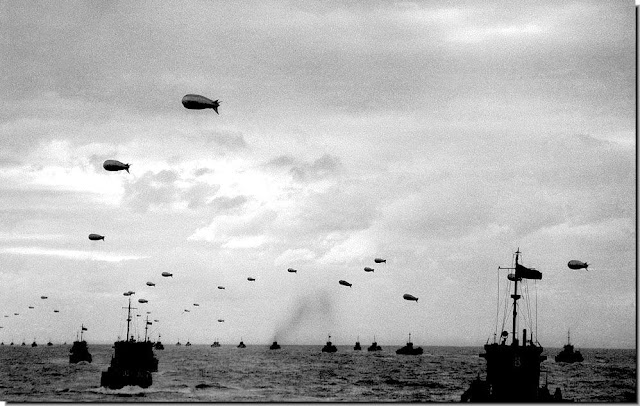
Allied armada heads towards France
American soldiers air-dropped into France before D-Day
The fighting became pitiless on both sides; in fact that night probably saw the most vicious fighting of the whole war on the western front. One German soldier, justifying the annihilation of an American platoon which landed on his battalion's heavy-weapons company, said later, 'They didn't come down to give us candies, you know. They came down to kill us, to fight.' German soldiers had certainly been lectured by their officers about the 'criminals' recruited to the US Airborne forces and their fears were transformed into violence. But it is hard to establish the accuracy of horror stories about German soldiers mutilating paratroopers caught in trees.
Brutal American airborne soldiers
Whether or not these accounts were true, American paratroopers sought revenge. There seem to have been a number of cases of soldiers shooting the prisoners taken by others.Apparently, a Jewish sergeant and a corporal took a captured German officer and non-com from a farmyard. Those present heard a burst of automatic fire and, when the sergeant returned, 'nobody said a thing'. It was also said of another Jewish paratrooper that 'you didn't dare trust him with a PoW out of sight'. A soldier in the 101st recounted how, after they had come across two dead paratroopers 'with their privates cut off and stuck into their mouth', the captain with them gave the order, 'Don't you guys dare take any prisoners! Shoot the bastards!'
Moments before the landing. German machine gun fire hits and a grenade explodes in a landing craft
I
ncident on Omaha Beach
Although there is no confirmation of this incident in any of the American accounts, there were cases of illegal killings, mainly prompted by the violence of repressed fear and a desire for revenge after so many fellow soldiers had been killed. 'There was a German, I don't know what his rank was, who was dying,' wrote a reporter with the Baltimore Sun who came across this scene late in the day. 'He was completely unconscious at the time but I remember a bunch of GIs standing around watching this guy and finally one guy just picked up his carbine and put a bullet in his head and said, "That'll take care of the bastard", and of course it did.'
--------
A soldier in the 8th Infantry Regiment recorded that their officers had ordered them to shoot any SS soldiers they captured on the grounds that 'they could not be trusted' and might be concealing a bomb or grenade. Another stated that 'during the briefings, we were informed that all civilians found along the beach area and for a certain distance inland were to be dealt with as enemy soldiers, shot or rounded up'
-------
It was just a piece of luck that they didn't all get killed.' He then went on to tell how they captured a small hill with the support of tank fire. 'It was pretty rough. And those guys[the Germans] were baffled and they were crazy. There were quite a few of them still in their foxholes. Then I saw quite a few of them shot right in the foxholes. We didn't take prisoners and there was nothing to do but kill them, and we did, and I had never shot one like that. Even our lieutenant did and some of the Non Coms.
-------
French Girls and German boyfriends
The battlefield myth of female snipers spread with astonishing rapidity through 'latrinerumours', as they were known. But stories of young Frenchwomen staying with their German boyfriends were almost certainly true. Just inland from Omaha beach, a sergeant in the 6th Engineer Special Brigade recounted, 'we saw in the ditches French girls lying alongside their German soldiers. These girls had gone along with the [German] army as they retreated and they were killed by our planes and they were found lying side by side.'
------------
Brutal revenge by Das Reich
On 8 June, the Das Reich began its long journey north from Montauban. Some of its units reached Tulle the following day. They hanged ninety-nine citizens of the town from trees in the streets. Another 200 were deported to Germany. On 10 June, the 3rdCompany of the division's Führer Regiment surrounded the village of Oradour-sur-Glane, fourteen miles north-east of Limoges. Its officers and soldiers shot the male inhabitants and herded the women and children into the church, which they set on fire.The village also was burned to the ground. Altogether, 642 people died in this massacre.Some of the victims were not even locals, but refugee children from Paris and passengers from a train halted nearby. None of them were members of the Resistance.The SS had even chosen the wrong Oradour. The company commander, whose death they were avenging, had in fact been killed in Oradour-sur-Vayres, fifteen miles away.The Führer Regiment was almost certainly responsible for another massacre of sixty-seven people at Argenton in the Indre département. The Vichy French authorities were also alarmed by reports of 'regions where a hideous civil war is breaking out', as some Resistance groups began a settling of accounts against political enemies. But even loyal Pétainists were appalled by the brutal reprisals of the Das Reich Division
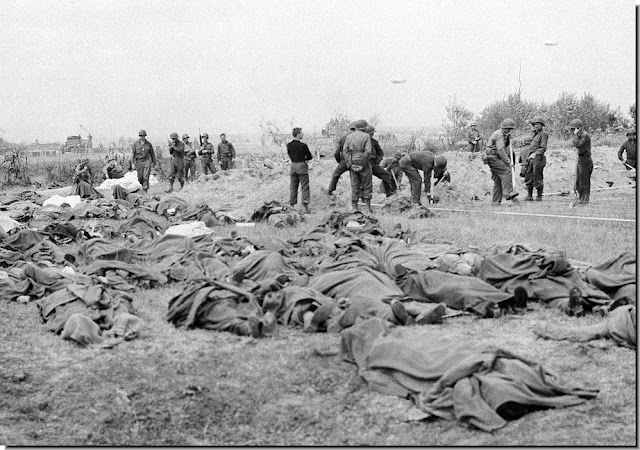
June 20,1944. American dead on a French field
--------------
Hitlerjugend and the Canadians
The Hitler Jugend was probably the most indoctrinated of all Waffen-SS divisions.Many of its key commanders came from the 1st SS Panzer-Division Leibstandarte Adolf Hitler. They had been formed in the Rassenkrieg, or 'race war', of the eastern front. The worst appears to have been the reconnaissance battalion, whose commander, Bremer,was known within the division as a 'dare-devil'. Panzer Meyer himself had shot fifty Jews near Modlin in Poland in 1939. Later, during the invasion of the Soviet Union, he had ordered a village near Kharkov to be burned to the ground. All its inhabitants were murdered. Nazi propaganda and fighting on the eastern front had brutalized them, and
they saw the war in the west as no different. Killing Allied prisoners was considered their revenge for the 'terror bombing' of German cities. In any case, bitterness between Canadians and soldiers of the Hitler Jugend became a vicious circle throughout the battle for Normandy.
--------------------
More On Hitler Jugend
Another event which shook everyone in the Bon Sauveur occurred after a café owner
was brought in with a bullet wound in the thigh. It transpired that, when drunk, he had shot at some soldiers from the Hitler Jugend who had been pillaging his café, a common event. While a surgeon was operating on him, an SS officer appeared armed with a sub-machine gun. The SS officer began hitting him as he lay on the operating table, asking whether he had fired at the soldiers. The café owner was speechless and did not reply.The SS officer fired a burst from his gun into his chest, killing him right there in front of all the medical staff.
American soldiers march in Paris. August 24, 1944. Numbers and larger resources win wars.
-------
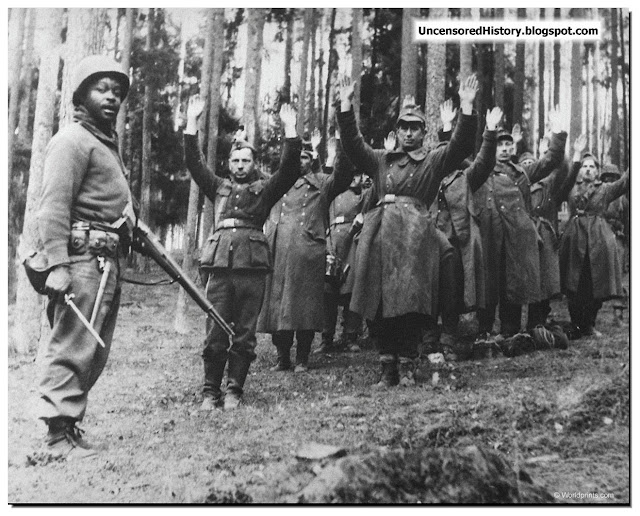
German POWs had it
On the beach, a sergeant in the 6th Engineer Special Brigade recounted how, when they
were escorting some prisoners to a stockade, paratroopers from the 101st Airborne started to yell, 'Turn those prisoners over to us. Turn them over to us! We know what to do with them!' A member of a naval combat demolition unit saw the same or a similar incident. 'Those wounded paratroopers were trying to do anything they could to get to those German prisoners. I guess they had been mistreated very badly in the rear or something. Bloody or not they were still ready to do more fighting if they could have gotten to those Germans.
'Unfortunately, wounded American airborne troops were evacuated on the same vessels as prisoners. An officer on LST 134 recorded, 'We had an incident where we had some paratroop soldiers and prisoners aboard, and I don't know what happened but I understand one or two Germans got killed.' On LST 44, a pharmacist's mate experienced a similarly tense encounter: 'One of our ship's officers started to herd these prisoners into the same area where I was helping tend some shell-shocked and wounded American soldiers. The immediate reaction of our troops was frightening and fierce. The situation was explosive. For the first and only time, I refused entry and demanded our officer stop sending the captured troops into this area. Our lieutenant looked surprised and extremely angry, but grudgingly complied.
-----------------
The wounded German soldier
'The LSTs were specially equipped for bringing wounded back to base hospitals in England. 'There were stretchers placed on brackets on the bulkheads of the tank deck,'noted the same pharmacist's mate, 'and they were several tiers high.' Some of the wounded prisoners of war were in a terrible state. 'A German prisoner brought aboard on a stretcher had a body cast extending from his ankles to his chest. He was pleading with me and our ship's doctor for help. He called us, "Comrade, comrade." Our ship's doctor,with my assistance, opened the cast, only to find this pitiful human being was being eaten by hordes of maggots. We removed the cast, cleaned him, bathed him, gave him pain killers. We were too late. He died peacefully that evening.
------------
Hitler and Rommel
Once down there, Rommel outlined the wider picture, with Germany isolated, the western front about to collapse and the Wehrmacht facing defeat in Italy as well as on the eastern front. He urged Hitler to bring the war to an end as soon as possible. Hitler was furious. His Luftwaffe adjutant later observed, 'That was the last thing Hitler wanted to hear from the mouth of a field marshal.' He retorted that the Allies would not negotiate. In this he was right and Rommel and the July plotters hopelessly optimistic.But Hitler went on to insist that the destruction of Germany had been agreed upon. So everything would depend on a "fanatical resistance"'. As he dismissed Rommel, Hitler said, 'Do not concern yourself with the conduct of the war, but concentrate on the invasion front.
---------------
French Civilians Suffered
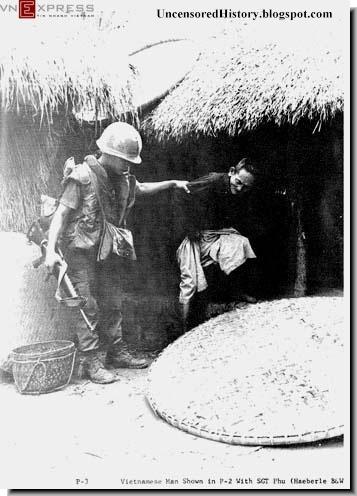
One soldier's account was particularly revealing. 'French people, of course, lived there,' he recounted. 'Us being there was as big a surprise as anything in the world to those people. They didn't really know how to take us, I guess. One man started to run, and we hollered for him to halt. He didn't halt, and one of our men shot him and left him there. I remember one house a couple of us went into and hollered, trying to tell them to come out. We didn't know any French. Nobody came out. We took a rifle butt and knocked the door in. I threw a grenade in the door, stepped back and waited until it exploded. Then we went on in. There was a man, three or four women and two or three kids in that room. The only damage that was done was the old man had a cut on his cheek. It was just a piece of luck that they didn't all get killed.'
-----------------------
Amorous American Soldiers
Moral confusion, if not outright hypocrisy, existed on the Allied side too. At his airfield near Bayeux, Jock Colville found it ironic when Montgomery ordered all brothels to be closed. 'Military police were posted to ensure that the order was obeyed. Undeterred and unabashed, several of the deprived ladies presented themselves in a field adjoining our orchard. Lines of airmen, including, I regret to say, the worthy Roman Catholic French Canadians, queued for their services, clutching such articles as tins of sardines for payment.' The French, meanwhile, were shocked by the attitude of American soldiers, who seemed to think that when it came to young French women 'everything can be bought'. After an evening's drinking, they would knock on farmhouse doors asking if there was a 'Mademoiselle' there for them.
--------------------
Blood-Thirsty French Mobs Lynched German Soldiers
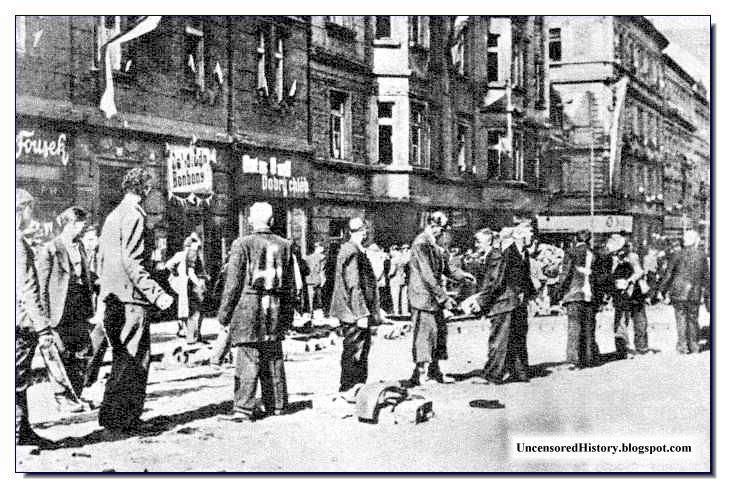
Near the Arc de Triomphe, as Langlade's column advanced, a crowd including the actor Yves Montand and the singer Edith Piaf gathered to watch the surrender of the Germans in the Hôtel Majestic on the Avenue Kléber. They cheered as the prisoners were led out, but the head of the Protestant church in France, Pasteur Boegner, then looked on in horror when four bareheaded German soldiers, with their field-grey tunics unbuttoned, were dragged off to be shot. Edith Piaf managed to stop a young Fifi from throwing a grenade into a truck full of German prisoners
-------------------
American Paratroopers Shot As They Landed
Several platoons of the 82nd Airborne dropped in and around Sainte-Mère-Eglise as planned. One paratrooper's chute caught on the church tower, where he hung helplessly, pretending to be dead while the bells deafened him. They were ringing in alarm because a house on the square by the church had caught fire and the townsfolk were passing buckets of water in a human chain. The scene below was chaotic. Soldiers from the local anti-aircraft unit under the command of an Austrian officer were firing in all directions as paratroopers dropped. Many Americans were riddled with bullets before they reached the ground. Those caught in trees stood little chance. One paratrooper dropped straight on to the blazing house. But with great determination, other rapidly formed groups who had landed outside the town began to advance towards its centre, dashing from cover to cover. Within an hour they had forced the Germans to withdraw. Sainte-Mère-Eglise was thus the first town in France to be liberated.