Showing posts with label Allied war Crimes. Show all posts

The Allies Mistreated Captured German Soldiers When WW2 Ended

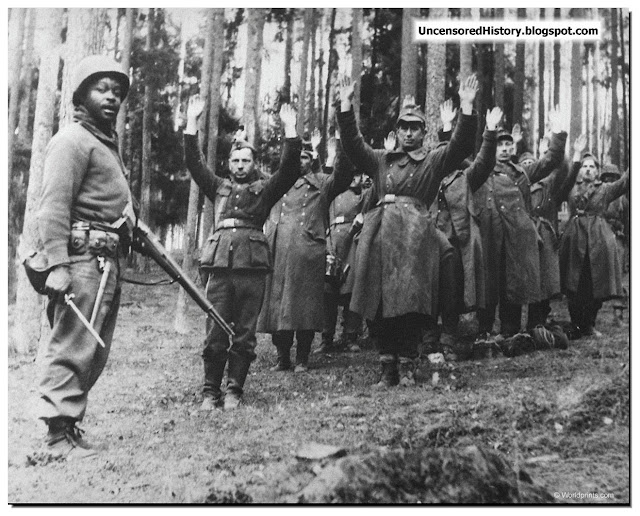
Soviet soldier German captured soldiers WW2
The Red Army treated captured German soldiers in the worst possible manner when WW2 ended

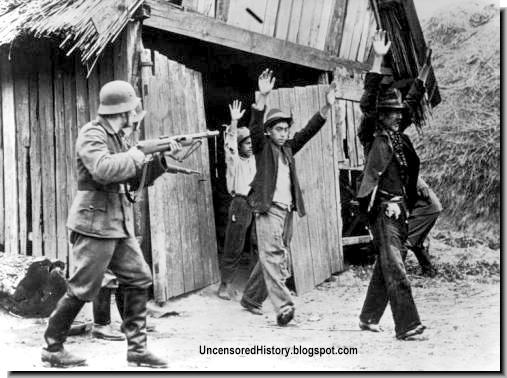
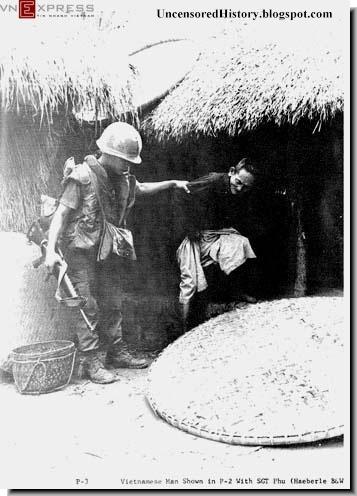
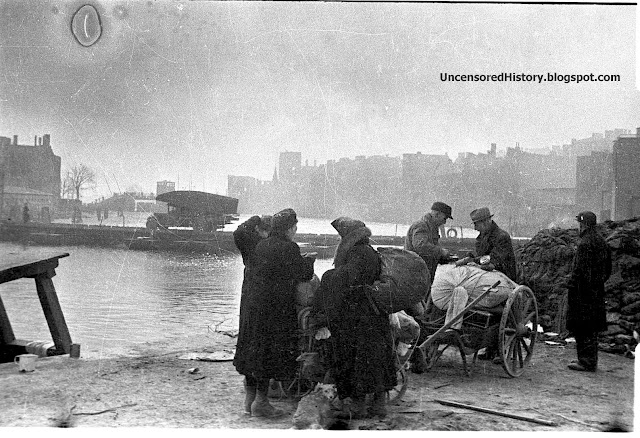
If the German Army acted with absolute disregard for the Geneva Conventions of 1929 pertaining to prisoner of war (POW), the Allies, Soviet Russia, America and British acted little better. German POW after the Second World War were treated harshly, to say the least.


Most Western historical literature says the real villains were Stalin's Red Army soldiers who brutalised captured Wehrmacht prisoners, killed outright men from the Waffen SS (After torturing them of course) and what not. The fact is the American, British and Free French armies were no less culpable.

And the savage mentality started from the very top. At the Teheran Conference of the "Big Three" in 1943, Stalin at a dinner on the second day, suggested a toast to eliminating 50,000 men from the German staff. Churchill was aghast at this. Roosevelt, in a humorous tone, suggested killing 49,000 men. His son Elliott chipped in by saying that when the Red Army, American and British rolled into Germany, they would not only wipe out top German soldiers but also thousands of Nazis. The most humane of all, Churchill walked out of the room in anger.

Now if the top leaders harbored such vengeful feelings towards the Germans, such a message that "kill Germans and get away with it" was bound to percolate down to lowest levels of the Allied armies. The Geneva Conventions of 1929 which protected disarmed soldiers were thrown out of the window by all, including the "virtuous" allies.

The Allies captured nearly 11 million German soldiers by the end of the Second World War. Since  the bulk of the German army was fighting on the Eastern Front one would expect that the Russians would have taken in most POWs. But surprisingly the Red Army had only 3.1 million POW. The Americans had 3.8 million, the British 3.7 million and even the puny, late comer French had a quarter of a million German prisoners.

It is not surprising that the Russians had lower numbers. Firstly because the Red Army soldiers were killing off all Waffen SS prisoners and even regular German soldiers too were polished off most of the time. Secondly, the German soldiers knew what lay in store for them if captured by the Russians, so before the war ended most rushed off and surrendered to the Americans and the British army.

Among many American units, “take no prisoners” was the motto. For those members of the SS, Wehrmacht and Volkssturm lucky enough to survive capture, death often awaited behind the lines. In the transit from front to rear, hundreds of prisoners were allowed to suffocate, starve or freeze to death in railroad cars. 
American soldier German POW WW2 end
The Americans herded German POW into a barbed wire fenced in enclosure in millions

AMERICAN CAMPS

But they hardly got a better deal in the hands of the Americans. They were herded in open roofless enclosures called 'Rhineland meadow camps'. The Germans called them Rheinwiesenlager. 

These camps were over crowded and feeding them was hardly a top priority for the Americans. This is surprising given the fact that it had enough resources. The German POWs were perhaps purposefully starved. The vengeful feeling that Roosevelt harbored towards Germans had seeped down to lower levels.

According to a personal account of a German prisoner...

During the heat I crawl into a hollow in the ground. I wear a coat and boots, with my forage-cap pulled down over my ears; my field bag, in which I have a silver spoon and fork, serves as my pillow. During a thunderstorm one wall of my hollow falls in on me. My coat and socks are wet through and through … How long will we have to be without shelter, without blankets or tents? Every German soldier once had shelter from the weather. Even a dog has a doghouse to crawl into when it rains. Our only wish is finally after six weeks to get a roof over our heads. Even a savage is better housed

According to another German POW...

We would drink our own urine. It tasted terrible, but what could we do? Some men got down on the ground and licked the ground to get some moisture. I was so weak I was already on my knees, when finally we got a little water to drink. I think I would have died without that water. But the Rhine was just outside the wire

The British, though starved of resources, treated German prisoners much better. The Americans and French treated them lousy. The death rate in American camps was four times that of British camps. In the French camps it was 20 times compared to the British.
French ill treated German prisoners WW2
The mortality rate of German POW in French camps was high

SOVIET CAMPS

The German POW had a bad time in Soviet captivity. More than a third of them died.

This is mainly because of three reasons. First. The prisoners were made to walk. No luxury of transport by train or trucks. These were called "death walks". Considering the distances and harsh climate of Russia, the weakened, disheartened Germans simply collapsed and died. Second. The Russians had little food to feed themselves. Why worry about the bad Germans? Third. The ingrained hatred for Germans in Russian minds.  No one care a hoot whether German prisoners lived or died.

Red Army shot Waffen SS captured soldiers
THE RED ARMY TOOK NO WAFFEN SS PRISONERS. THEY WERE KILLED OUTRIGHT.
The hatred had been born after the ruthless way the German invaders had behaved in occupied Soviet Union in earlier stages of WW2. And had been fed more by the vitriolic writings by Ilya Ehrenberg which was printed and reprinted in Soviet newspapers. Every Red Army soldiers knew them by heart.

Here is an example.....

The Germans are not human beings. From now on the word ‘German’ is for us the worst imaginable curse. From now on the word ‘German’ strikes us to the quick. We shall not get excited. We shall kill. If you have not killed at least one German a day, you have wasted that day … If you cannot kill your German with a bullet, kill him with your bayonet. If there is calm on your part of the front, or if you are waiting for the fighting, kill a German in the meantime … If you kill one German, kill another – there is nothing more joyful than a heap of German corpses.

Poems by Alexei Surkov called "I hate" and by Konstantin Simonov called "Kill him" added fuel to the fire.

No wonder that surrendered German soldiers were often shot casually. Passing German POW columns were fired upon by drunk Red Army soldiers. They were robbed of all their personal possessions on capture and marched off to Gulags. Those hardy enough to survive fed on rats as the Soviet captors starved them deliberately.

Most remained in the Soviet Union for years and the those who survived were released only after Khrushchev came to power in 1953. They returned to Germany as broken men.
Share this PostPin ThisShare on TumblrShare on Google PlusEmail This

Dark Side Of History: The British Torture Of Rudolf Hoess

Nazi leader Rudolf Hoess captured
Rudolph Hoess was not a nice guy. Far from it. But the way the  British dealt with him after the war to extract confessions hardly put a halo on their heads.....

Rudolf Hoess was the Allies' most important witness to the "Holocaust." His affidavit and his testimony were quoted extensively both by the prosecution and in the judgment of the IMT at Nuremberg, as well as by the press. It was his testimony which laid the foundation and validated the claim of the ". . . extermination of millions of people by gas at Auschwitz." Hoess's "confession" is heavily relied upon by historians like Raul Hilberg and others as a primary documentary source to this day.

It is true that Hoess witnessed at Nuremberg to horrendous "atrocities," and he also confirmed the "truth" under oath of an affidavit which he agreed to sign for the prosecution. In it, he confessed to having given orders for the gassing of millions of victims. The affidavit, by the way, was in English, a language he did not speak or understand, according to family members.

We now know from the book "Legions of Death" that Rudolf Hoess was beaten almost to death by Jewish members of the British Field Police Force upon capture and badly mistreated thereafter until he gave this very devastating "testimony" and "affidavit" used by the Allies propagandists ever since. You be the judge. Here is an excerpt from this book by Rupert Butler, published by Hamlyn Paperbacks, page 235:
At 5 PM on 11 March 1946, Frau Hoess opened her front door to six intelligence specialists in British uniform, most of them tall and menacing and all of them practiced in the more sophisticated techniques of sustained and merciless investigation.

No physical violence was used on the family: it was scarcely necessary. Wife and children were separated and guarded. Clarke's tone was deliberately low-key and conversational.

He began mildly: "I understand your husband came to see you as recently as last night."

Frau Hoess merely replied: "I haven't seen him since he absconded months ago"

Clarke tried once more, saying gently but with a tone of reproach: "You know that isn't true." Then all at once his manner had changed and he was shouting: "If you don't tell us, we'll turn you over to the Russians and they'll put you before a firing squad. Your son will go to Siberia."

It proved more than enough. Eventually, a broken Frau Hoess betrayed the whereabouts of the former Auschwitz Kommandant, the man who now called himself Franz Lang. Suitable intimidation of the son and daughter produced precisely identical information.

When they found Hoess, here is how the capture played out. Clarke, one of the participants, recalls it vividly:

"He was lying on top of a three-tier bunker wearing a new pair of silk pyjamas. We discovered later that he had lost the cyanide pill most of them carried. Not that he would have had much chance to use it because we had rammed a torch (flashlight) into his mouth."

Hoess screamed in terror at the mere sight of the British uniforms.

Clarke yelled: "What is your name?"

With each answer of "Franz Lang," Clarke's hand crashed into the face of the prisoner. The fourth time that happened, Hoess broke and admitted who he was.

The admission suddenly unleashed the loathing of the Jewish sergeants in the arresting party whose parents had died in Auschwitz following an order signed by Hoess.

The prisoner was torn from the top bunk, the pyjama ripped from his body. He was then dragged naked to one of the slaughter tables, where it seemed to Clarke the blows and screams were endless.

Eventually, the Medical Officer urged the Captain: "Call them off, unless you want to take back a corpse."

A blanket was thrown over Hoess and he was dragged to Clarke's car, where the sergeant poured a substantial slug of whiskey down his throat. Then Hoess tried to sleep.

Clarke thrust his service stick under the man's eyelids and ordered in German: "Keep your pig eyes open, you swine." . . .

The party arrived back at Heide around three in the morning. The snow was swirling still, but the blanket was torn from Hoess and he was made to walk completely nude through the prison yard to his cell. It took three days to get a coherent statement out of him.
This statement, tortured and terrorized out of him, was the one we are all familiar with--the "proof" for the so-called "gassing of the Jews."

Historians today are finally admitting that Hoess is a totally unreliable witness--and is it any wonder? He spoke of a concentration camp "Wolzek" which does not even exist. He swore that 2,500,000 people were gassed and burned at Auschwitz and a further half million died of disease, for a total dead of three million. The Toronto Sun of July 18, 1990 claimed 1.5 million. The Washington Post, on the same date, also mentioned 1.5 million.

Share this PostPin ThisShare on TumblrShare on Google PlusEmail This

American Soldiers Hated To Take Japanese Prisoners

American soldiers hated Japanese WW2 Yellow bastards
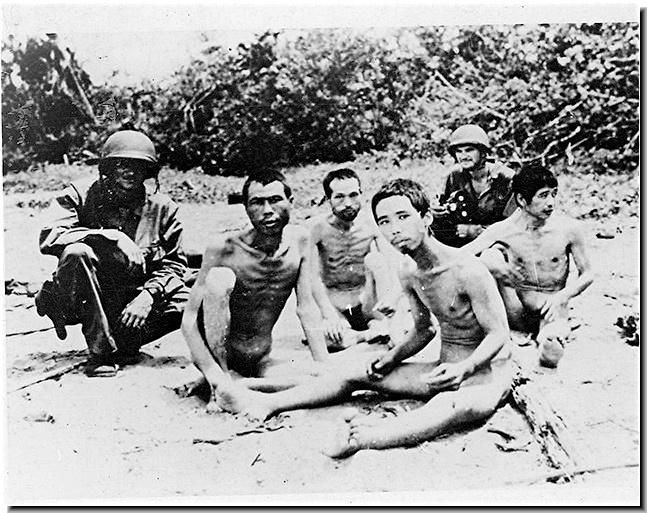
Japanese POW's on a beach.The four unclothed men in the picture were Japanese soldiers captured by the U.S. Army in New Guinea.

American soldiers in the Pacific often deliberately killed Japanese soldiers who had surrendered. According to Richard Aldrich, who has published a study of the diaries kept by United States and Australian soldiers, they sometimes massacred prisoners of war. Dower states that in "many instances ... Japanese who did become prisoners were killed on the spot or en route to prison compounds." According to Aldrich it was common practice for U.S. troops not to take prisoners. This analysis is supported by British historian Niall Ferguson,who also says that, in 1943, "a secret [U. S.] intelligence report noted that only the promise of ice cream and three days leave would ... induce American troops not to kill surrendering Japanese."

"We have this stereotypical idea that the Japanese were all cruel and robotic while the Allied forces were tough but fair in their treatment of the enemy. But I was very surprised by much of what I found and had to rethink all those stereotypes."
 "Oh, we could take more if we wanted to," one of the officers replied. "But our boys don't like to take prisoners.

U. S. historian James J. Weingartner attributes the very low number of Japanese in U.S. POW compounds to two important factors, a Japanese reluctance to surrender and a widespread American "conviction that the Japanese were "animals" or "subhuman'" and unworthy of the normal treatment accorded to POWs. The latter reason is supported by Ferguson, who says that "Allied troops often saw the Japanese in the same way that Germans regarded Russians—as Untermenschen."

U.S. Marines inspect bodies three Japanese soldiers killed  invasion Peleliu island Palau group  September 16, 1944.
U.S. Marines inspect the bodies of three Japanese soldiers killed in the invasion at Peleliu island at the Palau group, September 16, 1944. (AP Photo/Joe Rosenthal)

1943 diary of Eddie Stanton, an Australian posted to Goodenough Island off Papua New Guinea. 
"Japanese are still being shot all over the place," he wrote. "The necessity for capturing them has ceased to worry anyone. Nippo soldiers are just so much machine-gun practice. Too many of our soldiers are tied up guarding them."

Memoir of a New Zealand soldier working with a Fijian regiment who came across the bodies of two native women, pegged out on an earthen mound. They had been "raped to death" by Japanese soldiers. Then they found a dead American soldier who had stakes driven through each shoulder and his hands cut off. "As we moved away again, one of my corporals said to me: "No more prisoners, turaga[sir]." I agreed with him.''

Dead Japanese Soldier Surrounded by American Soldiers
A Dead Japanese Soldier Surrounded by American Soldiers

Ulrich Straus, a U.S. Japanologist, suggests that frontline troops intensely hated Japanese military personnel and were "not easily persuaded" to take or protect prisoners, as they believed that Allied personnel who surrendered, got "no mercy" from the Japanese. Allied soldiers believed that Japanese soldiers were inclined to feign surrender, in order to make surprise attacks. Therefore, according to Straus, "[s]enior officers opposed the taking of prisoners, on the grounds that it needlessly exposed American troops to risks..."When prisoners nevertheless were taken at Gualdacanal, interrogator Army Captain Burden noted that many times these were shot during transport because "it was too much bother to take him in".

References

Richard Aldrich: The Faraway War

Ben Fenton, "American troops 'murdered Japanese PoWs'" Daily Telegraph (UK), 06/08/2005)


John W. Dower, 1986, War Without Mercy

Niall Ferguson, "Prisoner Taking and Prisoner Killing in the Age of Total War: Towards a Political Economy of Military Defeat", War in History, 2004,

Ulrich Straus, The Anguish Of Surrender: Japanese POWs of World War II (excerpts) (Seattle: University of Washington Press, 2003 

Share this PostPin ThisShare on TumblrShare on Google PlusEmail This

INGLORIOUS ALLIES DURING WW2: Terror Bombing German Cities


After the war Robert Saunby, Deputy Air Marshal at Bomber Command, commented on the bombing of Dresden. 

The bombing of Dresden was a great tragedy none can deny. It is not so much this or the other means of making war that is immoral or inhumane. What is immoral is war itself. Once full-scale war has broken out it can never be humanized or civilized, and if one side attempted to do so it would be most likely to be defeated. That to me is the lesson of Dresden. 


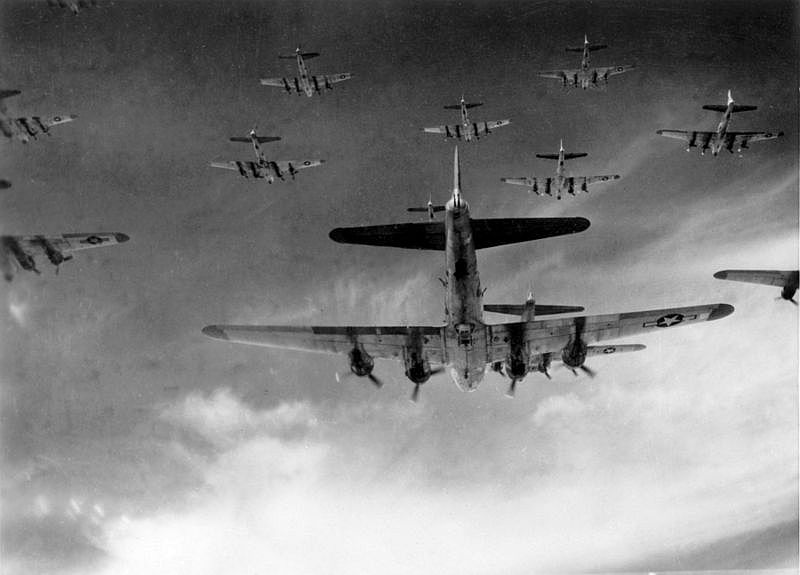
American B-17  bomb German cities
American B-17 roar in the skies on the way to bomb German cities
In some 50 cities that were primary targets of the air attack, the proportion of destroyed or heavily damaged dwelling units is about 40 percent. The result of all these attacks was to render homeless some 7.500.000 German civilians.

Source;
-US Strategic Bombing Survey 1940-1945 


In Europe, the American Eighth Air Force conducted its raids in daylight. USAAF leaders firmly held to the claim of "precision" bombing of military targets for much of the war, and dismissed claims they were simply bombing cities. However the Eighth received the first H2X radar sets in December 1943. Within two weeks of the arrival of these first six sets, the Eighth command gave permission for them to area bomb a city using H2X and would continue to authorize, on average, about one such attack a week until the end of the war in Europe.

In reality, the day bombing was "precision bombing" only in the sense that most bombs fell somewhere near a specific designated target such as a railway yard. Conventionally, the air forces designated as "the target area" a circle having a radius of 1000 feet around the aiming point of attack. Survey studies show, In the fall of 1944, only seven per cent of all bombs dropped by the Eighth Air Force hit within 1,000 feet of their aim point.

Allied bombing German cities WW2 Statistics
-----------------------
WAS THE ALLIED BOMBING OF GERMANY SUCCESSFUL?

'There was always at the briefing some military reason given for our attack. It was either a steel-producing town or there was a lot of small industry making precision instruments. But the policy was the destruction of towns. You destroy a town, you hinder the war effort in many ways, and that in itself was the justification. The big mistake was to think that by breaking German morale it would end the war. The morale of the German population was utterly and completely broken, but this had no effect on the hierarchy, the people who were actually directing the war. In the Third Reich the popular voice could not have any influence.
Peter Hinchliffe OBE
Bomber Command
-----------------------------


Source;
-Richard G Davis American Bombardment Policy against Germany, 1942-1945, Air Power Review, Volume 6 Number 3, pp. 49–62. (see p. 54 (PDF 63). http://www.raf.mod.uk/rafcms/mediafi...62250E094B.pdf
-United States Strategic Bombing Survey


During the Second World War, the Allied aerial forces performed air raids civilian populations in Europe and over Japan. These actions were not only defined crimes in retrospect, but were also viewed as such by the leaders of the Axis Powers during the war itself, despite the fact they themselves did likewise. On June 6, 1944, at a conference of top Nazi leaders in Klessheim, the German Minister of Foreign Affairs Joachim von Ribbentrop tried to introduce a resolution to define air raids on civilians as acts of terror, but his motion was rejected.

Source; Trial of German Major War Criminals, vol. 10, pp. 382-383.

Nearing the end of the War, shelter accommodation was available for only about eight million German people. The remainder sheltered in basements, and casualties in these places of refuge were heavy. 


BOMBING OF DRESDEN

The Bombing of Dresden was a military bombing by the United States Army Air Force (USAAF) & the British Royal Air Force (RAF) as part of the allied forces, between 13 February and 15 February 1945 in the Second World War. In four raids, 1,300 heavy bombers dropped more than 3,900 tons of high-explosive bombs and incendiary devices on the city, the Baroque capital of the German state of Saxony. The resulting firestorm destroyed 15 square miles (39 square kilometres) of the city centre.


Dresden after  American British bombimg
Dresden after the American and British bombers had done their job

As the flames subsided, the residents of Dresden discovered that 24,866 out of the 28,410 houses in the inner city were destroyed - an area of total destruction extending over eleven square miles. As for the death toll, German authorities gave up trying to work out the precise total after some 35,000 bodies had been recognized, labeled, and buried while hundreds of cellars and air raid shelters remained unopened. 

There was far too great a risk for the spread of disease to allow the proper identification of the dead. So, a massive funeral pyre was constructed in the Altmarkt where thousands more were burned.


Mass cremation German civilians killed
Mass cremation of German civilians killed
---------------------
'Bomber Command was the only weapon we possessed. Bomber Command was available and had to be used every day and every night, weather permitting. Had that force been available and Churchill had got up and said, in the House of Commons, "Well, we have this large bomber force available, but I'm afraid we mustn't use it because as it operates at night we can't be sure of hitting specific targets, and women and children may get killed", the British people would have been outraged and they would have said, "Not attack them because civilians might get killed? Have you gone mad? Hitler's been killing civilians all over Europe, including England." If Churchill had said that he wouldn't have survived as Prime Minister. Morality is a thing you can indulge in an environment of peace and security, but you can't make moral judgements in war, when it's a question of national survival.'

Charles Patterson,
Bomber Command pilot
-------------------------------

Charred remains Dresden people killed fire bombing
This is what remained of the people of Dresden
With such a large amount of undocumented refugees in the city, coupled with the number of people who were outright incinerated or ripped apart by the violent winds, it is impossible to come up with an exact casualty figure. Some scholars have claimed that approximately 30,000 perished, but this estimate is far too low. Even the German authorities who, a few days after the attack, put the total somewhere between 120,000 and 150,000 could have underestimated the final amount. By way of clarification, on the night of the raid, there were approximately 1,250,000 people in the city. After the fire storm subsided, there were just under 370,000. Certainly, the majority of the 800,000 refugees were successful in fleeing Dresden? However, it is entirely justifiable to assume that approximately one quarter of these individuals actually perished in the flames. Therefore, an amount which was closer to reality, which according to American historians was mere propaganda, was provided by Dr. Goebbels -- 260,000. 

Stars & Stripes
London Edition, Saturday, May 5, 1945, Vol. 5, No. 156 

Air Raid on Dresden Killed More Than 300,000 
by Dan Regan
Stars and Stripes Staff Writer 

With the 1st Army, May 3 (Delayed) -- The Allied air raid on Dresden on Feb. 13-14 killed 300,000 persons, according to a report by Dresden police to a group of 600 -- British and French -- prisoners who were given passes by the Germans to enter the American lines. 

Nine British PWs were working in Dresden during the raid and said the horror and devastation caused by the Anglo-American 14-hour raid was beyond human comprehension unless one could see for himself. 

One British sergeant said,

"Reports from Dresden police that 300,000 died as a result of the bombing didn't include deaths among 1,000,000 evacuees from the Breslau area trying to escape from the Russians. There were no records on them. 

"After seeing the results of the bombing, I believe these figures are correct."

"They had to pitchfork shriveled bodies onto trucks and wagons and cart them to shallow graves on the outskirts of the city. But after two weeks if work the job became too much to cope with and they found other means to gather up the dead." 

"They burned bodies in a great heap in the center of the city, but the most effective way, for sanitary reasons, was to take flamethrowers and burn the dead as they lay in the ruins. They would just turn the flamethrowers into the houses, burn the dead and then close off the entire area. The whole city is flattened. They were unable to clean up the dead lying beside roads for several weeks," the sergeant added.


THE BOMBING OF HAMBURG

The attack during the last week of July, 1943, Operation Gomorrah, created one of the greatest firestorms raised by the RAF and United States Army Air Force in WWII, killing 42,600 civilians and wounding 37,000 in Hamburg and practically destroying the entire city. The unusually warm weather and good conditions meant that the bombing was unusually concentrated around the intended targets and also created a vortex and whirling updraft of super-heated air which created a 1,500-foot-high tornado of fire, a totally unexpected effect. Various other previously used techniques and devices were instrumental as well, such as area bombing, Pathfinders, and H2S radar, which came together to work particularly effectively. 'Window' was successfully used for the first time - clouds of shredded tinfoil dropped by Pathfinders as well as the initial bomber stream - in order to completely cloud German radar. The raids inflicted severe damage to German armaments production in Hamburg.

Hamburg ruins after Allied bombings
This is what remained of Hamburg after the bombing
Bombing of Pforzheim in World War II

During the latter stages of World War II, Pforzheim, a town in southwestern Germany, was bombed a number of times. The largest raid, and one of the most devastating area bombardments of the war was carried out by the Royal Air Force (RAF) on the evening of February 23, 1945. 31,4% of the town's population, up to 17,600 people, were killed in the air raid. About 83% of the town's buildings were destroyed, two-thirds of the complete area of Pforzheim and between 80 and 100% of the inner city.


The Bombing of Kassel.

In 2003 A ceremony was been held in the central German town of Kassel, marking the 60th anniversary of an allied bombing raid that claimed more than 10,000 lives in a single night. The event, at which eye-witnesses relived the horror of that night, with a book been published with shocking photographs of German air raid victims which have never been seen before. Mr Friedrich collected the photos from town archives across Germany while touring the country last year presenting a book about the Allied bombing. 


-------------------
War is horrible; war is immoral. But you fight it the way you can. Look what happens to innocent civilians when armies roll across great territories and take cities. How many civilians died at Stalingrad? Outside Moscow? Or Leningrad? We were fighting one of the most immoral entities on the planet, and we had to fight it the best way we could. I just cannot and will never accept that bombing Germany was immoral.'
Air Marshal Sir John Curtiss KCB KBE
Bomber Command navigator
-------------------------------

Share this PostPin ThisShare on TumblrShare on Google PlusEmail This

Inglorious American Soldiers: KILLING OF GERMAN POW AT JUNGHOLZHAUSEN

German pow killed by American soldiers at Jungholzhausen
He was one of the lucky ones to survive. Heimrich Weber shows the place where his comrades were killed

According to the Geneva Convention Prisoners of war, who have surrendered are not permitted to be tortured, plundered and especially not to be killed.

Inglorious America WW2
The murder of defenseless prisoners is rightly considered to be a war crime. Nevertheless, the Allies have repeatedly committed this crime, especially toward the end of the war when they no  longer needed to fear reprisals. Several cases in point have already been reported . Another well documented mass murder happened in April at Langenburg in Hohenlohe .

On Sunday, April 15 1945  in the early evening  heavy fighting took place in and around the village, which ended victoriously for the Americans, who took many Germans prisoner, Pioneers and men of the SS. The victors quartered on the premises of the mayor, Baumann, whose family had fled into the cellar for safety.
----------------
“Americans don't do such things.”
----------------

From the window of the cellar, in the evening of the 15th April, the 15-year old Jörg Baumann sees  with his own eyes how the GI 's  murdered the German prisoners of war in the street of the village. Jörg Baumann: “The Americans forced the Germans to walk in front of them with  raised hands in groups of four. Then they shot the prisoners from behind with their guns with shots to their heads.” Bauman can never forget these war crimes . “I have not exaggerated anything”, declares the honest farmer emphatically, “I want to say: that is how it was.

The next day there are dead bodies strewn throughout the entire town. “Nobody carried  weapons. All had been shot from behind,” reports Pauline Baumann (1929, the daughter of the mayor). The Americans ordered mayor Baumann to divide up the male population in order to collect the dead bodies.

“They all go into a mass-grave”, was the next decision. For this, a site for a mass grave  was already allocated. But a US officer waves his hands. “Nix mass grave, they all get transported away.”

“The bodies are being loaded onto a truck and taken to Bensheim. The estimate of the dead bodies is between  30-33 (Blumenstock) and as many as 60, as reported in the village”.

At least one of the murder victims was an ambulance man and wore the  clearly marked Red Cross.

After the crime, as reported here, remained  unreported for decades before the newspaper “Haller Tagesblatt” wrote about the case in a special edition . The retired US lieutenant Major George Finley was deeply shocked and informed the “highest” places in Washington about it . Following this, in autumn 1996 officers of the department for the American criminal police in Stuttgart, (CID)- Criminal Investigation Devision, investigated the case .

They listened to the eye witness reports of two survivors of the massacre– Pioneers- of which one,  Herbert Heßler, hid for three days in an oven and then, disguised by some of the local people was able to make his way to his hometown. The other one, Heinrich Weber, had the presence of mind to fall to the ground and, injured in his hip, played dead. After dark he made his way to the front lines of the German troops near Wolpertshausen. At first nobody wanted to believe his story, because everyone was of the opinion: “Americans don't do such things.”

The not yet (1997) completed investigations showed that of the total of the 63 Germans killed at least 13, or even as many as 48 of them had surrendered and were disarmed, when they were shot by the Americans in the evening of that day. “There are no doubts at all, that in regards to the shootings on 15th April 1945 members of the “K” company of the 254 US-Infantry Regiments were responsible”.

The CID officers obtained copies of the wartime diary, which described the occupation of the village in this way “....The unit penetrated to Jungholzhausen, arrived there at 18:25 and took the town after heavy fighting with about 70 troops of the Weapons SS. After the fighting there was counted a toll of 65 dead...(all on the German side?!) It has been reported that on 15th April 1945 the commander of the company changed. At what time exactly this happened is not known. Lieutenant Major Harvey H. Carrow, 0554141, followed Major  James R Hyde, 01315173....”
Share this PostPin ThisShare on TumblrShare on Google PlusEmail This

Inglorious American Soldiers: MASSACRE AT LIPPACH

Graves slain German soldier prisoner American hands  Lippach
The graves of the slain German soldiers at Lippach
At the end of WW2, when it came to brutality and committing of war crimes, the Russians and Americans were mirror images of Germans. Below is an account of the little known show of American brutality at Lippach, a little village in Germany. 36 German soldiers who surrendered were brutally killed and 20 German women from the village were raped.

From the series, “Corrections to the history of our Time – “The Great Wendig”,  Volume 2, page 252.  Published by Grabert Verlag, D-72066. Tübingen, PO.Box 1629, Germany


Inglorious America WW2
In the last days of the war in the year 1945, the little village of Lippach, to the north-east  of Lauchheim (approximately 10 km. eastward of the district centre of Aalen in Eastern Baden- Württemberg) happened to get between the grind-stones of war. The retreating German troops took up quarters here for a short time, but then moved southward. On the 21. April the last rearguard arrived, a 300 strong unit of SS fighters, who took up their positions of defense on the outskirts of the village and in the surrounding terrain. These were mainly young soldiers between the ages 16 and 18 years.

On Sunday 22 April, American tanks, coming from the north rolled in and began firing at  the village. The defending German soldiers saw the futility of their endeavors, to resist against the might of tanks and the troops retreated southward. The chronicler wrote that in this retreat 36 soldiers ''fell''. The word ''fell'' does not correctly describe the true circumstances, as most of them were murdered by the American soldiers as was evidenced later.

Eyewitnesses from Lippach reported that around 13 o'clock the Americans penetrated into  the village and not all German soldiers managed to retreat in time. Some of the German soldiers tried to escape via the gardens, in which only a few succeeded. One of these men was shot dead while fleeing, another was taken prisoner. The following events were observed by the inhabitants of the village: the soldier was brutally beaten at his being taken prisoner, so that he collapsed several times.  When he could no longer get up, his skull was smashed with a rifle butt and afterward a side gun was shot through his breast with such force that it went right through his body and lodged into the soil.

In the afternoon, at 16 o'clock, about 20 to 25 drunken black soldiers drove six young  German soldiers in front of them, with howling and music accompaniment. They were chased with raised hands through the village street toward the cemetery. An eyewitness wrote, that they were occasionally driven into the ditches by the side of the streets, from which they lifted themselves with great effort, bashed and bloodied. Where the cemetery reaches the place where the roads cross, the Americans fired several times into the air and smashed the skull of the six German soldiers. The dead were secured the next day. They each had a smashed-in skull, but no shotgun wounds.

In house no. 51, belonging to a farmer two captured soldiers were led into the farmer's  barn by the drunken soldiers. They were placed on top of the table of the circular saw with the intention to saw them asunder while alive. They did not succeed in this because of electrical failure, so the guards simply shot the two Germans to pieces. One of them died a few hours later, the other was thought to be dead and was thrown behind the hedge of the building. He was found there several hours later, with many shotgun wounds to his body and was patched up scantily. According to the eye-witness of a woman in Lippach, a black American officer caused the severely wounded man to be transported to a hospital the following day.

Around evening the US troops left the village, except for a few soldiers, including the  already mentioned officer. This officer caused the dead to be gathered up and buried. On the sheep meadow were found another 10 German soldiers, none of whom carried a weapon, but half of them were shot down with a shot to the head. At the exit of the village, at the road to Baldern, were another four unarmed German soldiers were found in a field, many meters distance from their defense positions. Their weapons were still in place, the soldiers had been shot from behind.

To give the complete picture, it has to be reported, that on this Sunday, 22 April 1945,  about 20 women between the ages of 17 and 40 were raped by the members of the US troops. Some of them were even pregnant women. These rapes, together with the thirty six dead German soldiers, some of whom were brutally murdered, were hushed up for most of several decades.

The above mentioned happening had an aftermath: „Pershing-General Haddock visits  massacre- grave“ said the local headlines in August 1986. This general, commander of the US-Pershing unit in Europe had heard of this case and had researched into it in the USA. The facts are without a doubt correct, yet a court case against the US soldiers never took place“, (Frankfurter Rundschau“, 16. August 1986). General Haddock expressed his regret about the events in 1945. These kinds of excesses did unfortunately take place in every  war, the mis-deeds regrettably could not be reversed. But he could only, past the graves, beg for friendship.

So far so good – if it had been German soldiers they would have received the death  penalty by the Allied's „revenge justice“; American soldiers were and are not taken to account. And the German Television shows by and large only Germans to be the criminals, even when historical truth needs to be twisted.

Source: http://www.thenewsturmer.com/CorrectiontoWWIIhistory/The_massacre_of_Lippach.htm
Share this PostPin ThisShare on TumblrShare on Google PlusEmail This

Allied War Crimes During WW2: Atrocities By The French

The record of the French is hardly any better: the Resistance and partisan war, which no clauses of The Hague protected; innumerable assassinations of German soldiers, stabbed in the back by invisible enemies; even massacres of prisoners who were protected by the Geneva Convention, such as the one that took place at Annecy (Savoy) on August 18th, 1944, and others in French camps after 1945, to such an extent that the International .Red Cross was so disturbed that it even roused President Eisenhower himself.


On September 2, 1944, 80 German POW were massacred by the French forces at Annecy.


Members of French Forces of the Interior execute collaborators
Members of French Forces of the Interior carry out the death sentence of six young frenchmen convicted of collaborating with the Germans"

Massacre at Andelot. 12th September 1944. The third Battalion of the French regiment "Marche du Tchad" Leclerc at the village of Chaumont, in Haute Marne Andelot. About 500 German prisoners of war were gathered in a barn. A tank commander gave the order to the tank to shoot into the crowd. Limbs flew through the air. Those not yet dead, was massacred with machine guns.

40 German soldiers killed brutally in Tulle on 8 June 1944 by the French Maquis Resistance Movement. The small German garrison at Tulle on the 7th June 1944 was attacked by Bolshevik partisans. Even after the fighting ended, the French maquisards then shot captured German soldiers. The "Partisans-Francs-tireurs" knew exactly what they were doing. Among them were Polish, Spanish Reds, and also four-uniformed Soviet Bolsheviks. After completion of the fighting, they shot more than 12 German prisoners below the cemetery, after this the Chateau Lorraine Abbot had granted absolution. Another mass execution took place in the woods, where another priest  before the execution of about 20 German prisoners granted absolution. A total of about 120 unarmed German soldiers were shot after their capture. The bodies were been mutilated in an inhuman way.


Brutal French Resistance Maquis fighters with American soldiers

Agony of Freudenstadt. In April 1945 the city was severely affected by bombing and artillery shelling by French troops under General Jean de Lattre de Tassigny . German troops in advance had set up a roadblock in the Murg Valley, and shot some French tanks. Freudenstadt was pounded by about 16 hours of artillery. It was also hit by American bombers. The main water line broke and there was not enough  water available to clear the many fires that broke out. Approximately 600 buildings, 95% of the total core city were on the night of 16th to 17th April 1945 by direct or indirect influence destroyed and 1,400 families rendered homeless.

During the subsequent invasion by the French troops, there was considerable violence, rape and abuse. Many of the buildings that had been spared were claimed by the French occupiers. Many families lived in makeshift basement. Freudenstadt is just one example of the serious mistreatment of the civilian population by the colonial troops of the British and French. Götz Aly pointed out, that "every village in southwest Germany would report rape by black soldiersm" They were "no different than the Russians"

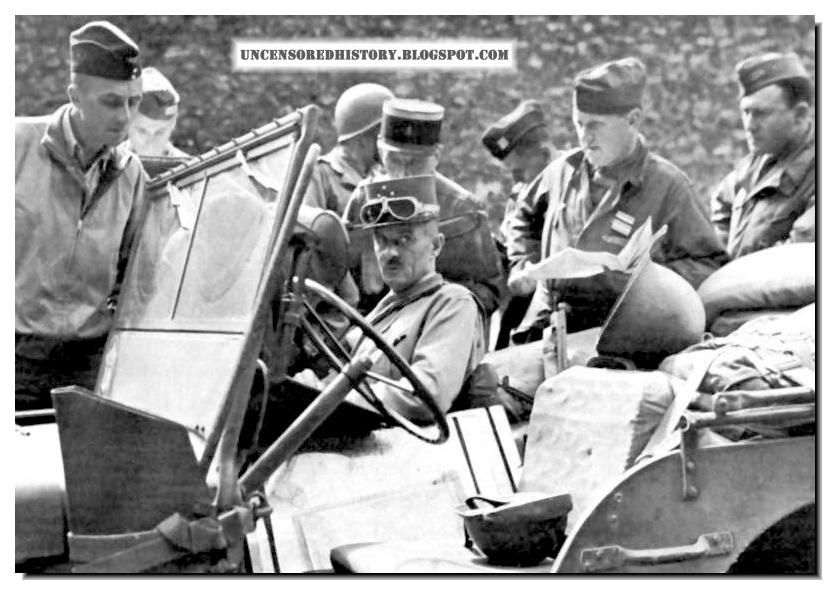
General Leclerc on May 8, 1945 in Bad Reichenhall had twelve French volunteers of the 33rd Waffen-SS Division "Charlemagne" shot "without trial.


French General Leclerc: Hero or Villain?


General Leclerc during the liberation of Paris 1944
Leclerc during the liberation of Paris.1944

It is well known that the French General Leclere, on 8 May 1945, the date of the surrender of the German Wehrmacht, shot twelve French soldiers in Bad Reichenhall, they belonged to the Waffen-SS Division "Charlemagne," they were shot without trial - a war crime. Later it was known that Leclerc’s division, on the road from Normandy to German Brechtesgarden had committed many war-crimes. None of these war-crimes were ever brought to court. Contrary General Leclerc became a hero in France after WWII.

French historian Daniel Guérain investigated into what happened. During his investigation he interviewed witnesses and visited the German and French sites of the fighting. He wrote down his findings in the book "the other side of the legend, history of liberation" . The historian reports of eye witnesses, also reflected in the French Division. They tell of numerous, often gruesome murders of German prisoners, especially members of the Waffen-SS. They said that, for example, soldiers of the Division Leclerc doused German prisoners of wars with gasoline and watched them burning. At the airport, Le Bourget, near Paris, there had been a massacre of hundreds of German prisoners of war who were crushed by Leclerc tanks  .

Lieutenant Robert Galley was particularly brutal while this happened. The French soldier Albert Bisson describes what happened at Andelot (Haute-Marne), during violent struggles between French and German troops. . The French suffered losses, but then broke the German resistance. … A large number of "Boches" as the soldier called themselves surrendered As they approach another 500 prisoners of war. Lieutenant Galley said "Wait!" ... Feuer!.“ He drove the Germans in a barn, over his microphone and commands: "Turn to the left. Stop! Hand grenade! Fire!. " The grenade exploded in the middle of the ... the Boches. The splinters tear their bodies, body parts stuck to the beams of the barn. We shoot those who survive with machine gun, all still living. Today is the day of vengeance! " Although Lieutenant Galley was guilty of war crimes and, as Director of Studies Pohl, he boasted openly on television, he was a minister under de Gaulle, Pompidou and Giscard d'Estaing and was active as treasurer of the party of French President Chirac.

Leclerc with De Gaulle

French Treatment Of German POW
(http://www.whale.to/b/walsh11.html)


By August 1946 France according to the International Red Cross had enslaved nearly three-quarters of a million former German servicemen. Of these 475,000 had been captured by the Americans who ‘in a deal’ had transferred them to French control for the expressed purpose of forced labour. Interestingly in a macabre way, the French returned 2,474 German POWs complaining that they were weaklings. 

Those returned must indeed have been in a bad way for the 472,526 remaining slaves had already been described by correspondents as; "a beggar army of pale, thin men clad in vermin infested tatters." All were pronounced unfit for work, three quarters of them due to deliberate starvation. Of this unfortunate ‘army’ of slaves 19% were so badly treated they needed to be hospitalized 

In the notorious camp in the Sarthe District for 20,000 prisoners, inmates received just 900 calories a day; thus 12 died every day in the hospital. Four to five thousand are unable to work any more. Recently trains with new prisoners arrived at the camp; several prisoners had died during the trip, several others had tried to stay alive by eating coal that had been lying in the freight train by which they came.

Source

 John Thompson, Chicago Tribune Press Service, Geneva, August 24, 1946).
 Gruesome Harvest, R.F. Keeling, Institute of American Economics, Chicago, 1947).
 Louis Clair, The Progressive, 14 January, 1946).


On December 5th 1946 the American Government requested the repatriation (by October 1, 1947) to Germany of the 674,000 German prisoners-of-war it had handed over to France, Belgium, the Netherlands and Luxemburg.

France agreed in principle but refused to abide by the release date stipulated. They pointed out, correctly, that a December 1st 1945 memorandum clearly stated that German prisoners handed over to the French by the US Government ‘were chattels to be used indefinitely as forced labour’. 


Relevant Movie


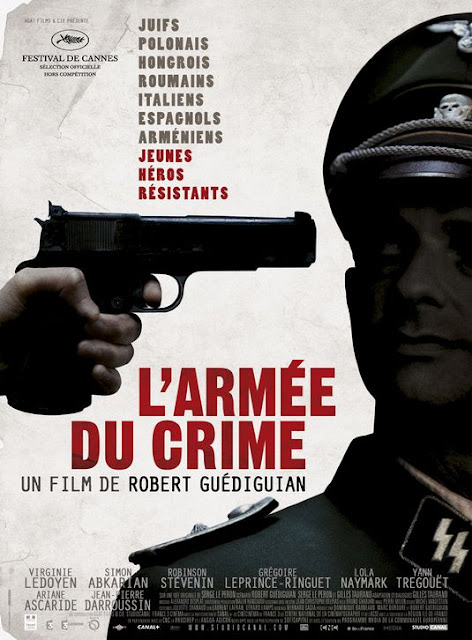
ARMY OF CRIME THE MOVIE

There's a fine line between resistance and terrorism, and that's just one of the ideas explored in Robert Guédiguian's latest French pseudo-reality melodrama, The Army of Crime
(http://filmsweep.blogspot.in/2011/03/army-of-crime-2009-robert-guediguian.html)

Share this PostPin ThisShare on TumblrShare on Google PlusEmail This

Did the Allies Deal Fairly With The Germans During And After WW2?

"My heart is saddened by the tales of the masses of German women and children flying along the roads everywhere in 40-mile long columns to the West before the advancing [Russian] armies. I am clearly convinced they deserve it; but that does not remove it from one's gaze. The misery of the whole world appalls me. "
Winston Churchill


The official attitude towards Germans was always much harsher in America than it was in Britain. At the Tehran conference, while the British advocated the splitting of defeated Germany into three administrative regions, Roosevelt wanted to break up the country even further. ‘Germany,’ he said, ‘was less dangerous to civilization when it was in 107 provinces.’ During the Anglo-American conference in Quebec in 1944, the US Treasury Secretary Henry Morgenthau put forward a plan to dismantle Germany’s entire industrial infrastructure, effectively returning the country to the Middle Ages. While Roosevelt approved this plan, the British only went along with it under duress.


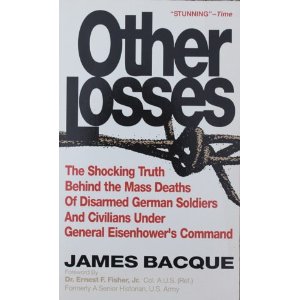
Other Losses James Bacque


------------------------
 His best estimate is that some three million Germans, military and civilians, died unnecessarily after the official end of hostilities.....Most of the two million German civilians who perished after the end of the war were women, children and elderly -- victims of disease, cold, hunger, suicide, and mass murder.....perhaps the most shocking outrage recorded by MacDonogh is the slaughter of a quarter of a million Sudeten Germans by their vengeful Czech compatriots......We are ceaselessly reminded of the Third Reich’s wartime concentration camps. But few Americans are aware that such infamous camps as Dachau, Buchenwald, Sachsenhausen and Auschwitz stayed in business after the end of the war, only now packed with German captives, many of whom perished miserably.

From After the Reich: The Brutal History of Allied Occupation by Giles MacDonogh


****************
Between 1941 and 1950 around one and a half to two million German prisoners of war died, whilst a further five million seven hundred thousand German civilians died between 1946 and 1950, largely, Bacque maintains, as a result of Allied policy. In all Bacques estimates that between nine and half and fourteen million ethnic Germans, German prisoners of war and civilians were to die in these iniquities. Part of the blame for this can be laid at the feet of Josef Stalin who, through his propaganda minister, Ilya Ehrenburg, actually encouraged the rape and degradation of the German civilian population. 

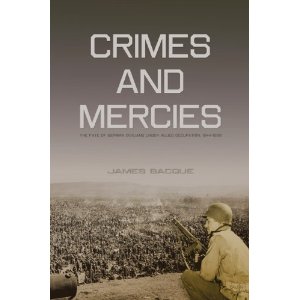
Crimes and Mercies

Crimes and Mercies: The Fate of German Civilians Under Allied Occupation, 1944-1950
by JAMES BACQUE
German women walk past dead soldier 1945

Probably the one question most frequently asked by people who express an interest in revisionism is: "Do you have any proof that Germans were tortured in order to extract confessions?"

It has been my experience to discover that even non-revisionist authors often pose this question as well, usually seeking to discredit the revisionist viewpoint. Due to the cloak of secrecy shrouding the allies use of torture, subterfuge, and intimidation, it has been quite difficult to document their record of abuse.

Nevertheless, over the years a number of able historians have done an admirable job in exposing the facts relating to the shocking use of torture by the allies. Admittedly, documentation is often difficult to obtain, due to the fact that the allied "interrogators" generally covered their tracks well, yet the persistence of historians and researchers interested in the truth has begun to pay off. The information which follows was culled from a variety of sources which should be easily accessible to parties interested in further research. Precisely because the documentation has been so scarce, a reconstruction of events will be necessary to prepare a proper foundation for argumentation, as the larger picture at this point is more important than the details. However, as the reader shall soon discover, details shall not be lacking.
-------------------
More than nine million Germans died as a result of Allied starvation and expulsion policies in the first five years after the Second World War -a total far in excess of the figures actually reported. That these deaths occurred at all is still being concealed and denied, especially by Western governments.
--------------------

If I were to point to one particular event which to my mind signaled the allies policy in regard to treatment of the vanquished, I would designate the meeting of the so-called "Big Three" at Teheran in 1943. As described by both Churchill and Elliott Roosevelt in their memoirs, "Stalin rose and proposed a blood-curdling toast. The strength of the German army depended, he said, upon fifty thousand high officers and technicians. His toast was a salute to shooting them, "as fast as we can, all of them." Churchill was horrified. Quick as a flash, he was on his feet; his face and neck were red, says Elliott Roosevelt, who was present. He announced that British conceptions of law and justice would never tolerate such butchery. Into this breach stepped President Roosevelt. He had a compromise to suggest. Instead of executing fifty thousand, perhaps "we should settle on a smaller number. Shall we say 49,500?" All the Russians at the table roared with laughter. So did the Americans, who were obliged to show proper appreciation for their chief’s "humor." Churchill left the table."

Undoubtedly, the President’s little grim "joke" was a source of great amusement for the Soviets, who were still laughing over the 14,000 Polish officers they had slain at Katyn, Miedjoye, and Kharkov Forest. Later, one of President Roosevelt’s interpreters said of his emaciated, crippled chief: "He looked sick, he acted sick, and he talked sick."

Lest anyone think that the President’s remark was made in jest, consider that less than one year later he was willing to ratify the notorious "Morgenthau Plan" , had it not been for the adamant objections of his Secretary of War, Henry Stimson.
---------------------------
Stalin's attitude to the prisoners of war,who would supply a vast pool of slave labor for reparations after the war, was very casual. When asked later by Harry Hopkins, special assistant to Roosevelt, what he was doing with the prisoners Russia had taken, he said vaguely that he thought they were being made to work
---------------------------------

In order to fully appreciate the attitude of the allies in regard to the treatment meted out to the defeated Germans, a brief review of events would be in order. To those who might object that the allies were too "civilized" to employ third degree methods on captured German officers to extract damning "confessions", I believe that certain criteria should first be investigated , presented, and addressed, namely:

1. How did the allies treat non-combatants? How were Germans treated who had nothing to do with the waging of the war? What was the allies policy in regard to women, the elderly, and in particular, German children?
2. How were German prisoners of war treated? Specifically, members of the Wehrmacht, Luftwaffe, etc. against whom no criminal charges had been preferred?

If the allies treated the defeated Germans with justice and equity, and can be proven so by documentation and the actual historical record, then the allegation that German POW’s were tortured and mistreated falls flat on it’s face.


------------------
THE ROOTS OF THE AMERICAN ATTITUDE TOWARDS GERMANS
From
by JAMES BACQUE

Western planning for vengeance against Germans and for the destruction of Germany began in England in August 1944, with its chief architects Morgenthau and Dwight D. Eisenhower. The birth of the plan was witnessed by one of Morgenthau's aides, Fred Smith, who wrote: On August 7, 1944 at approximately 12:35 .in a tent in southern England, the Morgenthau Plan was born. Actually, it was General Dwight D. Eisenhower who launched the project.. . 

The subject first came up at lunch in General Eisenhower's mess tent. Secretary Morgenthau, Assistant to the Secretary Harry D. White and I were there. White spoke of Germany,which was now certain to be defeated . . . White said, 'What I think is that we should give the entire German economy an opportunity to settle down before we do anything about it.' Here Eisenhower became grim and made the statement that actually sparked the German hardship plan. [Smith notes here that 'This material is taken from notes made directly after the meeting.'] He said: 'I am not interested in the German economy and personally would not like to bolster it if that will make it any easier for the Germans.' He said he thought the Germans had punishment coming to them: The ringleaders and the SS troops should be given the death penalty without question, but punishment should not end there.

'He felt the people [emphasis in the original] were guilty of supporting the regime and that made them a party to the entire German project, and he personally would like to 'see things made good and hard for them for a while'. He pointed out that talk of letting Germany off easy after taking care of the top people came from those who feared Russia and wanted to strengthen Germany as a potential bulwark against any desires Russia might someday have . . .The General declared he saw no purpose in treating a 'paranoid' gently, and the 'whole German population is a synthetic paranoid. All their life the people have been taught to be paranoid in their actions and thoughts, and they have to be snapped out of it. The only way to do that is to be good and hard on them. I certainly see no point in bolstering their economy or taking any other steps to help them.' White remarked: 'We may want to quote you on the problem of handling the German people.'Eisenhower replied that he could be quoted. He said: 'I will tell the President myself, if necessary.'
-----------------------------------------


Let us now examine the record: Germany’s civilian population received a foretaste of allied policy in 1940, when British pilots bombed a Berlin schoolhouse, killing a number of children. The air strikes increased in severity over the course of the war, culminating in the destruction of Dresden, Hamburg, Berlin, Nuremberg, Munich, and other cities at a loss of probably half a million lives. It was a common occurrence for allied pilots to bomb and strafe columns of refugees and the homeless. For this reason, American and British pilots earned the infamous sobriquet "terror-pilots" and were often treated as such when caught by German civilians. Parachuting pilots were often killed upon capture by German civilians who had often lost beloved family members to the attacks of terror-bombers. The allies made it a point to trace down the civilians responsible for these acts of righteous retribution and summarily hanged them all, whenever and wherever they were found.

The allies were particularly sensitive concerning the shooting of 50 allied fliers who had escaped from the Sagan POW camp in 1944. From the German point of view, many of these fliers were warned that should they attempt any more escapes, they would be shot. Aside from that, many of the escapees were caught in civilian clothes or else in German uniforms, thus leading the German authorities to conclude that they were spies. When one reflects on the fact that members of Otto Skorzeny’s commando group, which infiltrated American lines during the battle of the Bulge, were also shot upon capture even though they were wearing German uniforms under the American gear, then the shooting of the 50 terror fliers loses some of it’s punch. Nevertheless, German officers were executed for this "crime" while the allied crime of shooting the German "spies" went unpunished.

http://www.cwporter.com/gerund1.htm 


Old German woman flees with meagre belongings


The shooting of Americans at Malmedy was given the widest publicity, and those German units which participated in this battle were all brought before the allied inquisition, notwithstanding the fact that the allies had, in one incident shot down members of the Waffen SS in France in cold blood, and not one of the responsible parties was ever brought to justice.

At Dachau, American soldiers lined German guards up against a wall and shot them down without mercy. The Americans also allowed crazed inmates of the camp to savagely murder other guards who were stationed there. Often these victims were simply Wehrmacht officers who were left to guard the camp after the SS personnel absconded.

When the allied armies first entered German territory, did the victorious "champions of democracy" comport themselves with dignity and honor? Let the reader be the judge. What follows is just an excerpt from volumes of documents relating to the rampaging allied troops as they plundered, raped, and stole from the defenseless German population. The one crime most often committed by allied forces against German civilians in all sectors was forcible, violent rape, which is evidenced by a selection of the following reports. Few of the offenders were ever punished for this crime against women and children.

According to the publication "The U.S. Army in the Occupation of Germany":

"Of all the crimes committed by U.S. troops, the best....documented was rape, and it showed a "spiral increase" in the closing months of the war. Between July 1942 and October 1945, 904 rape cases were charged in the European theater, 552 of them in Germany. All told, 487 soldiers were tried for rapes committed in the months of March and April, 1945.(!)....By no means all the incidents were reported or, of those reported, brought to trial, and the conviction rate was relatively low."

"Reports of rape and robbery by U.S. troops piled up on the public safety officer’s desk.."
"The tension was greatest in areas where Negro troops were stationed, since they....frequently interpreted efforts to curb prostitution as another form of discrimination. In Kuenzelsau, Wuerttemberg, Negro soldiers of the 350th Field Artillery Battalion beat up the local jailer when he refused to release prostitutes being held for venereal disease treatment. Later the whole police in Kuenzelsau tried to resign after being threatened that they would be killed if they interfered with the prostitutes."

"Nearly all incidents involved liquor or women, often both. The population of vagrant women-which the Army inadvertently increased after November when it released penicillin for treating venereal diseases in German women, thereby shortening for some the "turn around time" from jail or hospital and attracting others who had been deterred by the fear of infection-was often at the root of soldier attacks on German officials and police....In one instance an American officer took an Austrian girl from Linz to Stuttgart, raped her three times, and then transported her to Ulm, where he turned her over to the military police on a charge of having improper papers."

"...the Negroes, believing they were not getting an equal share of the women, nursed grudges against both the Germans and the white Americans."
Take note that these are cases which have been confirmed by the Allied Occupation Authorities. Other reports may be offered to substantiate the above in greater detail:
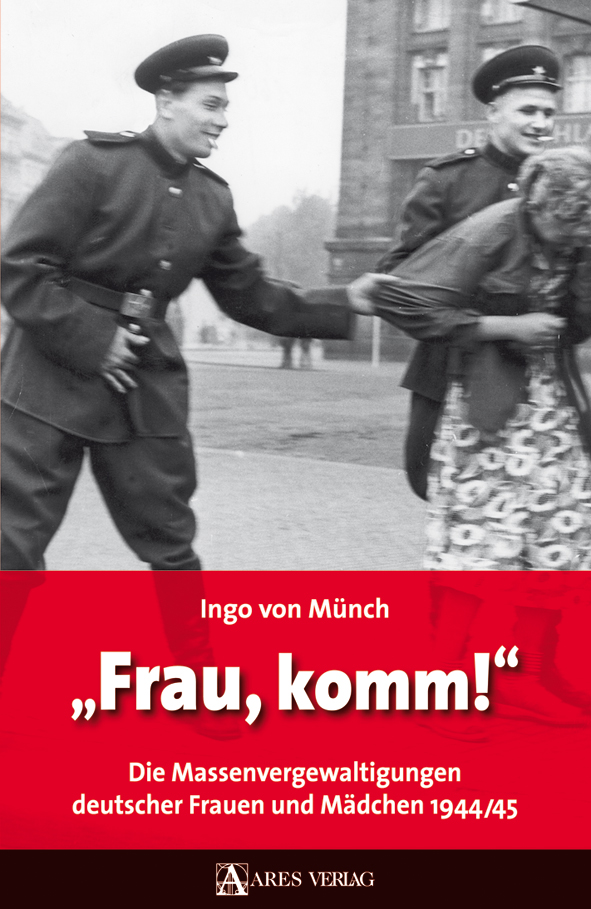
"From the east came the Bolshevized Mongolian and Slavic hordes, repeatedly raping every captured woman and girl, contaminating them with venereal diseases and impregnating them with a future race of Russo-German bastards.
In the west the British used colonial troops, the French Sengalese and Moroccans, the Americans an excessively high percentage of Negroes. Our own method was not so direct as the Russian: ....we compelled women to yield their virtue in order to live-to get food to eat, beds to sleep in, soap to bathe with, roofs to shelter them."

The following was related by a catholic priest concerning a letter which was smuggled out of Breslau, Germany, September 3, 1945: "In unending succession were girls, women and nuns violated....Not merely in secret, in hidden corners, but in the sight of everybody, even in churches, in the streets and in public places were nuns, women and even eight year old girls attacked again and again. Mothers were violated before the eyes of their children; girls in the presence of their brothers; nuns in the sight of pupils, were outraged again and again to their very death even as corpses."


Die Russen Kommen


Making the world "safe for democracy", when our "Russian allies "liberated" Danzig they promptly liberated all the women of their virtue and chastity-by raping all-from small girls to ladies as much as 83 years of age....When women of the city pleaded for protection, a Russian officer told them to seek shelter in the Catholic Cathedral. After hundreds of women and girls were securely inside, the brave sons of mother Russia entered and "playing the organ and ringing the bells, kept up a foul orgy through the night, raping all the women, some more than 30 times."

According to Ralph Keeling, "The Russians were not alone in violating these principles. Police records of Stuttgart show that during the French occupation, 1,198 women were raped and eight men violated by French troops, mostly Moroccans."


German women children 1945


According to the same source the average rate of venereal disease among Negro troops stationed in the American occupation zone in Germany was an amazing 771 per thousand! In attempting to explain this phenomenon to the American public, Lee Hills, foreign correspondent for the Chicago Daily news wrote:
"The other problem-and one so politically touchy that the war Department is afraid to remedy-is the heavy use of Negro American troops. The result, despite some superb Army leadership at the top, is that American prestige has dropped from its V-E Day peak. The top men in Germany, almost without exception, think it’s a mistake to have so many (42,000) Negro troops here.....They have a higher crime rate, a venereal disease rate several times that of the white soldier, and a worse record for mischief in general...Frankly, the worst problem comes from our colored troops going with white German girls. this stirs bitter hatred among German men. Many of our own soldiers feel almost as strongly about it."

There exists such a plethora of documentation regarding the mass rape of German women and children that I must refer the reader to these sources, which shall be included in a "recommended reading" section at the end of this article. Now that we have demonstrated how German women were treated by the allies, let us proceed to examine the treatment of children:
President Roosevelt again assumed the lead in directing allied policies in regard to the treatment of German civilians. His policy was reflected in a statement he uttered regarding the nourishment of the defeated. As Marie Antoinette once said of the French citizenry, "Let them eat cake", Roosevelt’s advice was "They should be fed three times a day with soup from Army soup kitchens."

As it turned out, the Germans were denied even this "luxury". According to the book "The U.S. Army in the Occupation of Germany", published by the Center of Military History, United States Army,...."military government did not provide relief for German refugees, at this stage not even for starving children." 

So here we are confronted with a direct admission from a government source that starving German children were given no assistance whatsoever. Consequently we can only assume that they were left to starve. Often these children were orphaned. Their fathers were either deceased or else languishing in a POW camp. The mothers had either been raped and murdered or else victims of the appalling allied bombing offensive. If anything, allied policy was consistent. For instance, during the first few months of allied occupation in Berlin, typhus raged in the city, killing 65% of new-born babies. This particular strain of typhus was labeled by the Berliners as "hunger typhoid." Indeed, the death rate for infants rose to 660 per 1,000 in July! It is clear that allied policies and politicians were responsible for these outrages and crimes against humanity and against innocent children in particular. The allies didn’t "gas" them to death, which would have been more humane. They simply allowed them to starve to death.


According to Douglas Botting, author of "From the Ruins of the Reich", nineteen out of twenty babies died in the American Sector of Berlin in July 1945. According to the same source, in the British zone:
"The death rate of the very young and the very old reached a level not seen since the Thirty Years War nearly three hundred years before: in August, four thousand people died each day, compared with one hundred and fifty before the war...the dead had to be transported by wooden carts or hand stretchers, wrapped in rags or paper, as there were no coffins....there were still 53,000 orphans living like wild animals in holes in the ground, some of them one-eyed or one-legged veterans of seven or so, many so deranged by the bombing and the Russian attack that they screamed at the sight of any uniform, even a Salvation army one."

In view of the indescribable conditions noted above, the Americans charitably authorized the addition of a piece of meat or fish "one half the size of an egg"(!) when available. However, American servicemen were receiving over 4,000 calories a day during this same period.

Jews and Jewish DP’s received the next highest allotment: over 3,000 calories.

In the French zone conditions were even worse, if one can even imagine such a scenario. All over Germany, children were suffering from rickets and little bodies were covered with festering sores and boils, due to malnutrition, starvation, neglect and abuse. Often they had no shoes and went for days on end without a meal, while American soldiers carried out the orders of American Occupation authorities and dumped thousands of gallons of milk in the trash, rather than give it to the starving children. It was this incident more than any other which aroused the righteous anger and indignation of General George Patton, which resulted in the feud with Eisenhower, who relieved him of his post.

In Botting’s book, he quotes the statement of a British Officer named Christopher Leefe who at the time was serving with the Green Howards in Berlin. He relates the story of how a German youngster was apprehended stealing items from the officer’s barracks in order to buy food. Instead of having compassion on the boy, a Royal Major beat him repeatedly and unmercifully. The boy was approximately 10 years old, "thin as a bean pole, clothes hanging on him like sacks." The English bully struck this boy again and again screaming, "YOU FU**ING LITTLE KRAUT!"

What is most disturbing about this event is that not one person interceded on the boy’s behalf. What a particularly virulent hatred it is, to allow something so deplorable to occur without so much as a protest. Mr. Leefe was later quoted as saying:

"The point is that none of us could have cared a bit for that little boy. He was probably an orphan, his father dead on the Eastern Front, his mother rotting under the rubble of the bombed-out ruins, and here he was-starving and risking his life climbing up drainpipes in the middle of a British tank regiment. So what? We didn’t feel any compassion for him or any of the Germans. They had been public enemy number one. (!) So now we commandeered their horses, commandeered their Mercedes, commandeered their women. I would reckon that 60 or 70 percent of young Englishmen in Germany thought that way. Most of us were for having a bloody good time and believed we could get away with anything."

Aside from the infants who were left to die en masse, the conditions under which German youngsters were compelled to subsist were deplorable. If the allies were unconcerned about the fate of infants, German teen-agers and pre-adolescents fared no better-and often, their fates were worse than death. German boys who were inducted into the home army during the last days of the war received particularly brutal treatment at the hands of their captors. I have viewed many photos of such youngsters after they were taken captives and the condition they were in was unforgivable. Thin, pale, their faces bruised and bloodied, these unfortunate youngsters were often "escorted" by brutish looking military police twice their size. The book "Alliierte Kreigsverbrechen und Verbrechen Gegen die Menschlichkeit" (Allied War Crimes and Crimes against Humanity), re-published a photograph emanating from American newspapers entitled "Hitler Youth Walks the Last Mile." The photograph shows a youngster not any more than 13 or 14 years old being escorted by MP’s to a place of execution. The crime? "Suspicion" of spying. No trial, no evidence....simply shot to death for "suspicion" of spying. Why this youngster had to forfeit his life at the end of the war on such a flimsy pretext will be a mystery I will never be able to fathom. Yet I have already presented evidence of the brutal mistreatment a young boy of 10 suffered at the hands of the British, simply because he was starving.
American author Marguerite Higgins visited Germany during the time in question and later wrote of her experiences. In her book, "News in an singular thing" she described a visit to a GI "Interrogation Center" :
"The GI led us to the main door of the camp...Behind the bars of the cell we saw 3 uniformed Germans. Two of them, beaten and covered with blood, were lying unconscious on the floor. A third German was lifted up by the hair on his head, and I shall never forget, he had red hair like a carrot. A GI turned his body over and struck him in the face. When the victim groaned, the GI roared, "Shut your mouth, damned Kraut!" ....It turned out that for almost a quarter of an hour, the doubled rows of 20 to 30 GI’s stood aligned taking turns methodically beating the six captured Germans...It came out later that the worked-up GI’s had captured six young German boys, who had never even been members of the SS. The youngsters had only recently been inducted into a government work battalion. The boy with the red hair was 14 years old. The other 5 German boys in the cell blocks were between 14 and 17 years old."

Should anyone think that this was only an isolated case, then I will offer more evidence to prove that these beatings were endemic. These were not isolated occurrences. In fact, they were commonplace. Non-revisionist historians often take the position that such beatings never occurred, yet the evidence is overwhelming. And if this was the treatment meted out to the innocent-and to children in particular-it is only logical to assume that Nazis accused of heinous crimes were treated far worse.

The book "Vorsicht! Faelschung!" reproduces a photograph of 2 German youngsters taken after their "interrogation" by Allied investigators. The photo speaks for itself. The faces of the two youngsters are bruised, swollen, and bloody. In conclusion, the episodes recounted above for the benefit of the reader are only a small fraction among thousands of documented cases. The policy of the allies is clear. It was their intention to turn the entire German nation into one huge concentration camp. This policy was enforced throughout the breadth of the land. Germany’s youth were left to starve and languish. Thousands of youngsters, homeless and parentless, formed into "gangs" where they were forced to resort to crime simply in order to live. Young children of both sexes were compelled to resort to prostitution in order to buy a tidbit of food. The allies took no responsibility for the horrors and suffering they imposed upon another nation, nor have they ever apologized. In fact, when youngsters confessed to crimes without any coercion, the Americans seemed quite disappointed, as is evidenced by the following remark:

"The amusing thing about these youths and the Nazis we subsequently questioned was their complete willingness to betray one another once they were convinced that a friend had tattled, and it required very little "persuasion" to convince them that they had been betrayed. To the disappointment of some of our men, it was quite unnecessary to become physical in the interrogation."


SOME STATISTICS


   TOTALS OF DEATHS
                                  Minimum     Maximum
Expellees (1945-50)   2,100,000   6,000,000
Prisoners (1941-50)    1,500,000   2,000,000
Residents (1946-50)   5,700,000   5,700,000
                      _________  __________
Totals                9,300,000  13,700,000 

  "Expellees" refers to the 16,000,000 ethnic Germans who were driven from their ancestral homelands in Poland, Hungary, Czechoslovakia, and elsewhere in Europe, at war's end.
  These included mostly women and children and elderly men who, with a few belongings in hand and running the gauntlet of deep, local animosity, set out upon the open road toward the rump state of Germany.
  "Prisoners" are, of course, the German POWs 
  "Residents" here refers to the German civilian population that survived the Second World War.
---------------------------------

In February, 2006, the remains of around 4,000 German soldiers were discovered in a disused factory building in the Czech town of Ústì-nad-Labem. (Aussig an der Elbe). The remains were found piled high in numbered cardboard boxes which had been stored in the building for over sixty years. These Wehrmacht soldiers had fought and died on Czech soil during World War II but were never given a dignified burial. A cemetery in the northern town of Hlucin was chosen as their final resting place, the local council agreeing to purchase land to extend the cemetery.
-----------------------------------
ORDINARY GERMANS PERSECUTED

The merciless revenge perpetrated on the entire German civilian population of Eastern Europe during the closing stages of the war, and for many months after, took the lives of over 2,100,000 ethnic German men, women and children. For generations these Germans had lived and toiled in areas that today are part of central and Eastern Europe. Around fifteen million of these Volksdeutsche were driven from their homes and ancestral lands in Poland, East Prussia, Silesia, Ukraine, Belarus and Serbia and forced back into the Allied occupied zones of Germany. This was the greatest forcible evacuation of people in European history. It is estimated that of the eight million Germans expelled from Poland around 1,600,000 died in the process. 

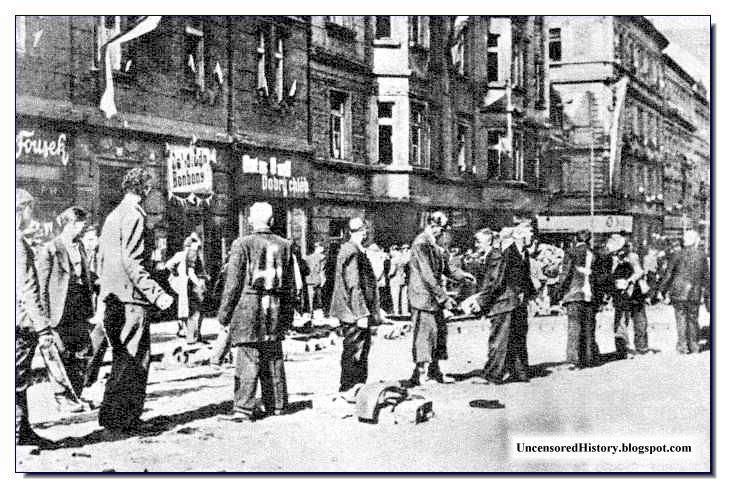
In Czechoslovakia, memories of the Lidice massacre inspired acts of revenge against German soldiers and civilians. Soldiers were disarmed, tied to stakes, doused with petrol and set alight. Wounded German soldiers in hospital were shot in their beds, others were hung up on lamposts in Wenzell Square and fires were lit beneath them so that they died the gruesome death of being roasted alive. These ethnic Germans lived in fear of the Russians but no one thought that the dreadful fate which awaited them would not even emanate from the Soviets at all but from their own neighbours, the Czechs! Thousands of innocent German residents were murdered in their homes by the Czechs, others were forced into interment camps where they were beaten and maltreated before being expelled. 

Bishop Beranek of Prague declared: 'If a Czech comes to me and confesses to having killed a German, I absolve him immediately'. The Americans, utterly blind to the political consequences of allowing the Soviets to liberate Czechoslovakia, halted at the Karlsbad-Pilsen-Budweis line. The Sudeten Germans now had no protection from the torrent of bestiality vented on them by the Czechs. In Brno, 25,000 German civilians were forced marched at gun-point to the Austrian border. There, the Austrian guards refused them entry, the Czech guards refused to re-admit them. Herded into an open field they died by the hundreds from hunger and cold before being rescued by the US 16th Tank Division on May 8th 1945. 

In the Russian occupied zones of Eastern Europe and in Germany, hundreds of thousands of civilian men and women, Poles, Czechs, Romanians and Germans, were transported to the Urals in the Soviet Union and used as slave labourers until released in the late 40s. Mostly ignored by the world's press, the unimaginable suffering experienced by the expellees is largely unknown outside Germany, yet it was systematically carried out in a brutal fashion as official Allied policy in accordance with the decisions formulated at Yalta and Potsdam.

-------------------------
Churchill said to the Germans in January, 1945, "We Allies are no monsters. This, at least, I can say, on behalf of the United Nations, to Germany. ...Peace, though based on unconditional surrender, will bring to Germany and Japan immense and immediate alleviation of suffering and agony." 

Those Allies who were "no monsters" literally raped more European women than had ever before been raped in the history of the world. They put Germany on a starvation-level diet. Under direct orders from Dwight Eisenhower, they killed more than a million German POWs. They looted 12 million people of their homes, goods, food, and even clothes and drove them from their homelands. They took one-fourth of their farmland, they took their ships and their factories and their farm implements and then told them to live by farming. They abused and starved to death more German babies than there ever were Jews in Germany. They raped and debauched hundreds of thousands of German, Austrian, and Hungarian girls and women from eight to eighty. They brought to their death five times as many Germans in one year of peace as died during five years of war. Yes, yes, of course, these men of the United Nations, these men of the New World Order are no monsters.

-----------------------------------------------------

Suggested Documentary
(A German Video)

Der Jahrhundertkrieg: Der Sturm The War of the Century: The Perfect Storm
Der Jahrhundertkrieg: Der Sturm (The War of the Century: The Perfect Storm)

Spätestens seit Stalingrad stand fest, dass der Krieg nicht mehr zu gewinnen war. Doch bedenkenlos verknüpfte Hitler das Schicksal Deutschlands mit seinem eigenen Alles oder nichts. Wenn schon kein Sieg, dann der totale Untergang. Im Oktober 1944 erreichte die Rote Armee schließlich im Osten den deutschen Boden, Mitte April 1945 begann der Großangriff auf Berlin. Was folgte, war der jämmerliche Abgesang eines Reiches, das tausend Jahre währen sollte und nach zwölf zusammenbrach. Am Ende lag Deutschland in Trümmern, der Krieg war dorthin zurückgekehrt, wo er entfesselt worden war. Noch nie hatte sich ein Volk auf so selbstzerstörerische Weise um die Grundlagen der eigenen Existenz gebracht. 28 Millionen Tote allein in der Sowjetunion sind den Opfern des "Sturms" der letzten Kriegsmonate vorausgegangen. Noch können die Überlebenden davon berichten - vielleicht zum letzten Mal. Deutsche und Russen erinnern gemeinsam an das düsterste Kapitel ihrer Geschichte. Die 4-teilige Dokumentation umfasst folgende Einzeltitel Folge 1 Die Schlacht um Ostpreußen, Folge 2 "Die Russen kommen!", Folge 3 "Die Todesfalle", Folge 4 "Bis zum bitteren Ende".


Preview
Share this PostPin ThisShare on TumblrShare on Google PlusEmail This
Related Posts Plugin for WordPress, Blogger...
Advertisement

Popular Articles On This Site

UncensoredHistory.blogspot.com

UncensoredHistory.blogspot.com