Showing posts with label Mass Rape. Show all posts

Rape And Abuse Of Chinese, Korean, Dutch And Asian Women By Japanese Soldiers During WW2

Japanese soldiers rape victims ww2Rape is a part of war. It should not be. But reality is, nobody fight wars following the Queensberry rules. The Geneva Conventions to be more relevant. Why should women be violated when the men do the fighting? But real life is not fair. So as we said rape inevitably occurs during war.

Coming to the Second World War we have talked at length of the rape of German, French and Italian women. Now we come to rape committed by Japanese soldiers. The victims were mostly Chinese and Korean women. This aspect has received slightly less coverage than say, the rape of German women. May be continents matter. Or may be color of the skin. Only lately has the rape by Japanese soldiers received increasing  prominence in the western media because both the perpetrators and the victims have become front rank economies (Japan has been a big power since the late sixties).

The reality of war is that is that nobody is a saint in war. After Japan was defeated in 1945 and the Americans too raped Japanese women and kept "comfort women" during the occupation. But that is dealt elsewhere.

The roots of the present confrontation between Japan and China (and Korea} lies in the bitter history of WW2. And  the mass rape and abuse of Chinese and Korean women by Japanese soldiers has left a deep imprint. The wounds have never healed.

Hatred and aggression have very very long shadows.....


"Let's have some fun," the officer of the Japanese army ordered the girl, "You look pretty." He urged me to lie down on the floor and injured me with his bayonet. He took off my pants and raped me until I was bleeding."

The scene was described by the Korean Kim Young Suk in December 2000 before an unofficial war crimes tribunal in Tokyo

-----------------------------------
The Motivation For Rape During War

The need to dominate the "other," the enemy, is imperative in battle with other men. The violation of the bodies of women becomes the means by which such a sense of domination is affirmed and reaffirmed.
----------------------------------------------


RAPE OF DUTCH WOMEN BY JAPANESE SOLDIERS

Japanese troops seem to have committed sexual violence against Dutch women at various places in the Dutch East Indies immediately after the invasion. For example, when they entered Tjepoc, the main oil centre of central Java, “women were repeatedly raped, with the approval of the [ Japanese commanding officer.”

The following are some extracts from the testimony on this case given by a Dutch woman after the war, which was subsequently presented at the Tokyo War Crimes Tribunal as one of numerous pieces of evidence of war crimes that the Japanese troops committed against Allied civilians.


On that Thursday, 5 March 1942, we remained in a large room all together.
The Japanese then appeared mad and wild. That night the father-in-law
and mother-in-law of Salzmann. . . . were taken away from us and fearfully
maltreated. Their two daughters too, of about 15 and 16 had to go with
them and were maltreated. The father and mother returned the same night,
fearfully upset, the girls only returned on Friday morning, and had been
raped by the Japanese.
On Saturday afternoon, March 7, 1942, the Japanese soldiers (odd
soldiers) had appeared in the emergency hospital where the women and
children were seated together. The ladies were here raped by the Japanese,
in which connection it should be mentioned that this happened where the
children were not present. These ladies were myself, Mrs. Bernasco, Mrs.
Mebus, Mrs. Dietzel, Mrs. de Graaf, Mrs. van Bakerghem, Mrs. Verbeek,
Mrs. Warella.
This occurred from March 7 to 17, 1942; generally the Japs came at
night, but by way of exception, also during the day. It was a mass, continuous
merciless rape. The first afternoon that this happened, as mentioned,
three enlisted men came, and everything took place under threat. After this
happened, we managed to tell the Chinese doctor Liem. He went to the
Commandant, whereupon that afternoon, Mrs. Dietzel, myself and one or
two others had to appear before the Commandant. The Commandant said
that we would be given an opportunity to point out the Japs who had
misconducted themselves, and that they would be shot dead before our very
eyes.
However, nothing happened and after an hour we were sent back to the
emergency hospital.
That evening, at 8 o’clock, we were transferred to a classroom in a school
near by. According to what we were told, this was done for our own safety,
since the Japs would not come there.
Between 10 and 12 o’clock that night, when we were all asleep, a whole
mass of Japanese soldiers entered with the above-mentioned commandant
at the head. The Commandant sat on a table in our classroom and then
watched how each of the women was dragged away, one by one, to be
raped. He himself did not join in this.


As only a part of this testimony was read at the Tokyo War Crimes Tribunal, it is not clear what happened to these women after this incident. However, Lieutenant Colonel Damste, a Dutch prosecutor who submitted this testimony to the Tribunal, claimed that this was “the same as happened when the Japanese entered the oil town of Balikpapan” in southwest Borneo.

According to a Dutch government report, rape of Dutch women was also committed by the Japanese in Tarakan, Menado, Bandung, Padang, and Flores during the invasion and the early stage of the occupation.6 It is also reported that at Blora, a place near Semarang on Java, about 20 European (presumably Dutch) women were imprisoned in two houses. Of these, 15, including mothers and their daughters, were raped several times a day for three weeks by the Japanese troops passing by. This was finally ended by a high-ranking Japanese officer who happened to visit.


comfort women

The full story of the Rape of Nanking, which occurred in 1937, did not come out until the post-World War II Tokyo war crimes tribunal, held almost ten years later. While none of the war crimes defendants were tried for rape, prosecutors presented evidence of mass rape to help convict several defendants of crimes against humanity.

[note: This was similar to the treatment of rape during the Nuremberg war crimes trials for Nazi war criminals. ]

The Chinese Nationalist Army had used Nanking as its capital, but General Chiang Kai-shek had decided not to defend the capital and withdrew the army as Japanese forces arrived. This withdrawal left the city-full of refugees, women and children-defenseless in the face of invading forces:

There were many cases of rape. Death was a frequent penalty for the slightest resistance on the part of a civilian or the members of the woman's family who sought to protect her. Even girls of tender years and old women were raped in large numbers throughout the city, and many cases of abnormal and sadistic behavior in connection with these rape occurred. Many women were killed after the act and their bodies mutilated. Approximately 20,000 cases of rape occurred within the city during the first month of the occupation.
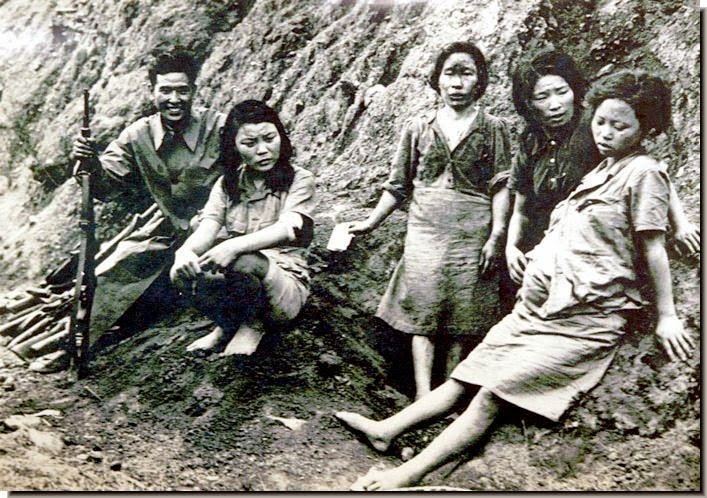


asian women pregnant japanese soldiers


Reports indicate that superior officers often did not stop such behavior: a soldier caught by a Japanese officer or military police "was very politely told that he shouldn't do that again." At the Tokyo tribunal, testimony of continued rapes by Japanese soldiers on the campus of Nanking University indicated knowledge and complicity on the part of the Japanese government: the university campus was located next to the Japanese Embassy. The tribunal found General Iwane Matsui, the man in charge of the Nanking invasion, guilty of crimes against humanity and sentenced him to death by hanging.

[note: The tribunal ruled that the behavior of the Japanese army could not be considered the acts of a military group that temporarily had "gotten out of hand"; rather, rape, arson, and murder had continued to be committed on a large scale for at least six weeks after the city had been taken.]

 In 1991, the world learned that Japanese soldiers during World War II forced 80,000 to 200,000 Asian women, mostly Koreans, to serve as sex slaves. Known as "comfort women", they were held in front line brothels to service the Japanese Imperial Army.

[note: Only Japanese prostitutes were sent to the brothels at first, but Japan later began using women from its Asian colonies, drawing primarily from its oldest colony, Korea. ]

The government had provided the women in order to control the spread of venereal disease among soldiers, and to discourage troops from raping local women, which "would have intensified civilian resistance to the Japanese army as it swept through Asia." The story of the "comfort women" was a secret for nearly half a century due to the shame felt by the women,

[note: According to the mores of Korean society, the women felt they had brought great and lasting dishonor to their families. ]

the weak political and social status of women in Korean society, and the women's fear of becoming objects of derision. A group of elderly South Korean women in 1991 decided to end their silence, announcing to the world the atrocities they had suffered.

The Japanese government at first denied involvement in the brothels, claiming that the brothels were run by private contractors, but it eventually released a report acknowledging its direct involvement in the brothels and apologizing for recruiting the women. The report, based on a six-month survey of wartime documents, stated that the government systematically obtained women from Japan, Korea, China, Taiwan, the Philippines, and Indonesia to serve in the brothels. The documents showed that military officials had not only set up the brothels, but also kept meticulous records about venereal disease, revenue generated and even price per woman: one yen to use a Chinese woman, one and a half to use a Korean woman and two yen to use a Japanese woman. Each soldier got thirty minutes with a woman and had to wear a condom; each woman had to service at least forty men per day, although some served up to 100 a day" The report found no evidence that the government recruited these women forcibly. The refusal of Japan to state that the women were forced or tricked into the brothels evoked a bitter reaction, especially from South Korea, where the government demanded further investigation. A 211- page interim report released by the South Korean Foreign Ministry included 155 examples of women sent to the Japanese brothels under "threatening circumstances".


The few remaining survivors also tell of forcible recruitment or trickery. The Korean Council for Women Drafted for Sex Service by Japan located sixty survivors; half said that Japanese soldiers kidnapped them, and the other half said that recruiters misled them by offering them jobs as nurses or factory workers.

[ note: One woman said she was picking vegetables when soldiers abducted her and a truckload of other village girls. Another woman said she was sent to Taiwan, but refused to work as a prostitute until she was beaten so badly that her bones were broken. When she tried to escape, she was sent to Manchuria, where she was forced to have sex with up to fifty men a day. Some women said they were tortured with bamboo slivers pushed under their nails; many spoke of ailing friends who were left to starve. After the war, the Japanese army left the women in distant outposts; many were killed. ]

One former Japanese soldier admitted that he participated in dawn raids on Korean villages, dragging young women away from their screaming children and loading them into trucks. Witnesses reported that soldiers seized one woman who resisted, tied her to five horses by the arms, legs, and neck and then whipped the horses away.

Historians believe most of the women held in Japanese brothels died during World War H or soon afterwards. When the women contracted diseases or suffered from malnutrition, the soldiers threw them into the sea or doused them with gasoline and burned them alive. Thousands were slain by soldiers who wanted to set an example to the rest of the women. A witness reported that once a soldier considered a woman "useless", the soldier sometimes would insert a gun into her vagina and blow her apart. Many other women died shortly after the war, either from untreated venereal disease, beatings, botched abortions, or the effects of deprivation." Still others committed suicide, many while being forced to serve as "comfort women".


http://coursesa.matrix.msu.edu/~fisher/bosnia/readings/Aydelott1.html


The Japanese Imperial Army enslaved between 80,000 and  200,000 women and girls from 1932 to 1945. Most came  from Korea, with many also from Japan and the Dutch East  Indies. Women and girls were obtained through abduction or  deception and, in some cases, purchased from destitute parents. Euphemistically known as “comfort women,” they  were taken to ‘comfort stations’ throughout the Pacific,  including then East Timor and the Solomon Islands. Women  were kept for months or years on end, and while most were  under the age of 20, some were as young as 12. For many,  the comfort stations were their first sexual experience, and  many are infertile as a result of their enslavement. Women  who made it home at the end of the war kept silent about  their experience through fear and shame, and threats received from the Japanese military. 

The atrocities were not just against the Chinese, but also British, Canadians, and people of other nationalities. For example, at a hospital for injured British soldiers, the Japanese soldiers slaughtered 170 recuperating soldiers and a few hospital staff. The eyes, ears, noses, tongues, or limbs were cut off on many victims. Seventy of the soldiers were killed with swords while they were lying in bed. The hospital’s seven nurses were raped, sometimes while lying on top of the bodies of murdered British soldiers. Several of the nurses were also slaughtered, and one of them almost had her head severed.
http://www.dontow.com/2007/04/massacre-and-atrocities-in-hong-kong-during-wwii/

--------------------------
WHY COMFORT WOMEN?

Japanese military leaders believed that the provision of comfort women was a good means of providing their men with some kind of leisure to compensate for unlimited tours of duty. Unlike US and other Allied soldiers, the rank and file of the Japanese military forces did not have designated leave periods or limited tours of duty.

Japanese military leaders were very concerned about the rape of civilians by members of the Japanese armed forces – but not out of concern for those civilians. For good strategic reasons, they believed that the antagonism of civilians in occupied territories towards their conquerors was exacerbated by such behaviour. They also believed that a ready supply of women for the armed forces would help to reduce the incidence of rape of civilians.

Another concern of military leaders was the incidence of VD among the armed forces. They believed that VD threatened to undermine the strength of their men (and hence their fighting ability). They also feared the spread of the disease could potentially create massive public health problems back in Japan, once the war was over. The leaders believed that a regulated system, such as the comfort stations, would enable them to take effective preventive health measures.

A further concern was security. Military leaders believed that private brothels could easily be infiltrated by spies and that prostitutes working in them could easily be recruited as spies.

---------------------------------------

One Chinese physician who practiced in Hong Kong between 1941 and 1942 claimed that possibly 10,000 girls and women were raped in the month following Japanese occupation.


RAPE AT ST. STEPHENS HOSPITAL, CHRISTMAS DAY 1941

"We have not seen comfort women for three months," yelled the Japanese soldiers  They decided to pull out 12 women, guarded each channel and college entrance, then this group of female doctors and nurses were raped.

First squadron leader Daisaku Yoshida Chezhu (A Japanese officer} raped one of the most beautiful female doctor. "Now I command: All the Chinese women here come forward!" All Japanese soldiers, immediately fell upon struggling female doctors and nurses. Half-naked Japanese soldiers were seen everywhere in the grounds., Disrobed women lay on the ground. Others ran around with dishevelled hair.. On an average each woman was raped by six Japanese.


NANKING

From the Judgement of the International Military Tribunal On War Crimes In The Far East....

From Documents On Rape Of Nanking by Timothy Brook (Page 259)
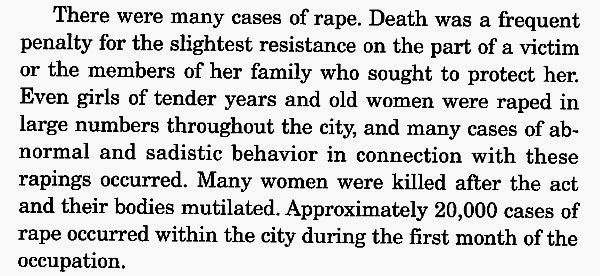


Women were killed in indiscriminate acts of terror and execution, but the large majority died after extended and excruciating gang-rape. "Surviving Japanese veterans claim that the army had officially outlawed the rape of enemy women," writes Iris Chang. But "the military policy forbidding rape only encouraged soldiers to kill their victims afterwards." She cites one soldier's recollection that "It would be all right if we only raped them. I shouldn't say all right. But we always stabbed and killed them. Because dead bodies don't talk ... Perhaps when we were raping her, we looked at her as a woman, but when we killed her, we just thought of her as something like a pig." (Chang, The Rape of Nanking, pp. 49-50)

Kenzo Okamoto, another Japanese soldier, recalled: "From the time of the landing at Hangzhou Bay, we were hungry for women! Officers issued a rough rule: If you mess with a woman, kill her afterwards, but don't use bayonets or rifle fire. The purpose of this rule was probably to disguise who did the killing. The military code with its punishment of execution was empty words. No one was ever punished. Some officers were even worse than the soldiers." (Yin and Young,The Rape of Nanking, p. 188)

http://www.gendercide.org/case_nanking.html

After the occupation of Nanjing, the soldiers immediately formed into groups and roamed throughout the city. When they came across a woman, they would take turns raping her. A report on these atrocities can be found in the appendices of Harold John Timperley's book "A Foreigner's Eyewitness Account of the Atrocities Committed by the Japanese." Almost the entire account is devoted to crimes involving rape. A few items selected from Timperley's book will suffice to show how these scattered troops from the Japanese army went about committing the crime of rape.

At noon, December 14th, on Chien Ying Hsiang Road, Japanese soldiers entered a house and took four girls, raped them, and let them return [home] in two hours.

On the night of December 14th there were many cases of Japanese soldiers entering Chinese houses and raping women or taking them away.

On the night of December 15th, a number of Japanese soldiers entered the University of Nanking buildings at Tao Yuen and raped thirty women on the spot, some by six men.

On the evening of the 15th [of December] at San Tian Hsiang many soldiers got into the house and raped many women.

On December 16, seven girls (ages ranged from 16 to 21) were taken away from the home at the Military College. Five returned. Each girl was raped six or seven times daily -- reported December 18th.

On December 18th, evening, 450 terrified women fled for shelter to our office and spent the night in our yard. Many have been raped.


http://www.cnd.org/njmassacre/njm-tran/njm-ch10.htm
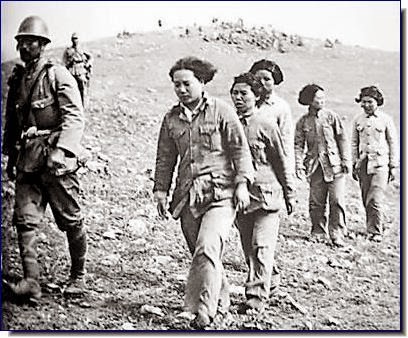

Chinese women victims
Chinese victims


 MASS RAPE OF A FILIPINO WOMEN

An extract from the autobiography of Maria Rosa Henson, a former Filipina comfort
woman. The passage depicts clearly how military violence involves atrocious
abuse of women’s sexuality.

Twelve soldiers raped me in quick succession, after which I was given half an hour rest. Then twelve more soldiers followed. They all lined up outside the room waiting for their turn. I could not even stand up. The next morning, I was too weak to get up . . . I could not eat. I could not resist the soldiers because they might kill me. So what else could I do? Every day, from two in the afternoon to ten in the evening, the soldiers lined up outside my room and the rooms of the six other women. I did not even have time to wash after each assault. At the end of the, I just closed my eyes and cried.
Japan's Comfort Women: Sexual Slavery and Prostitution during World War II and the US Occupation  By Toshiyuki Tanaka Introduction Page 1


WHY WERE KOREAN COMFORT WOMEN USED IN CHINA?

The Medical Unit of the 3rd Division set up a comfort station soon after they entered Yangzhou on December 18. A Chinese local security council was ordered to supply 60 women to this station. ( These councils were organizations that occupying Japanese troops forced local civilians to establish.) Eventually 47 women were secured. The 26th Brigade of the 13th Division, stationed in Bengbu, also set up a comfort station staffed with 10 Chinese women, which opened at the end of January 1938. Therefore it seems that the Japanese forces which invaded Nanjing and neighboring areas used many Chinese women as comfort women. Some troops used devious methods to “recruit” these women.

However, the exploitation of local Chinese women in territories occupied by the invading Japanese troops did not become a general pattern. Before March 1938, some units such as the 104 Regiment stationed in Chuxian, were reluctant to use local women as comfort women. They did not set up a comfort station until mid-March when Japanese and Korean women were sent to this unit. It  that sooner or later troop commanders realized that it was not good policy to force local women into prostitution, out of consideration for the public. Another reason that the Japanese troops were generally reluctant to use local Chinese was related to security.
Source: Tanaka, Page 14

MORE ON COMFORT WOMEN

The comfort women were treated as “military supplies,” but relevant documents were either hidden or destroyed at the end of the war. It is impossible to know, therefore, how many women were exploited. The best estimates range from 80,000 to 100,000. According to the Japanese military plan devised in July 1941, 20,000 comfort women were required for every 800,000 Japanese soldiers, or one woman for every 40 soldiers.62 There were 3.5 million Japanese soldiers sent to China and Southeast Asia during the war, and therefore, by this calculation, an estimated 90,000 women were mobilized. Of these women, 80 percent are believed to have been Koreans, but many also came from Taiwan, China, the Philippines, Indonesia, and Malaysia.

Why were comfort women almost invariably from Taiwan, China, or various places in Southeast Asia, and above all Korea? This might seem odd at first, given that the Japanese were notorious for their racism towards the people of other Asian countries. However, racial prejudice provides part of the answer to the question – that very racism helped make these women suitable for the role of comfort women.


Japanese prostitutes did serve the military abroad during the war, but most were in a different position from the comfort women. The Japanese prostitutes worked in comfort stations that served high-ranking officers, and they experienced better conditions than the Asian comfort women. Apart from the difficulty in recruiting Japanese women into comfort stations, Japanese military leaders did not believe Japanese women should be in that role. Their mission was to bear and bring up good Japanese children, who would grow up to be loyal subjects of the Emperor rather than being the means for men to satisfy their sexual urges.


Source: Tanaka, Pages 31, 32


Suggested Reading
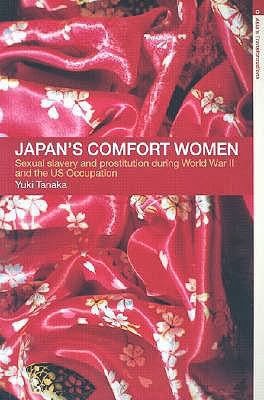

Japanese comfort women  book Yuki Tanaka
Japan's Comfort Women: Sexual Slavery and Prostitution during World War II and the US Occupation  By Toshiyuki Tanaka
RAPE BY JAPANESE  SOLDIERS (AND LATER OCCUPYING AMERICAN SOLDIERS)
Japan's Comfort Women tells the harrowing story of the "comfort women" who were forced to enter prostitution to serve the Japanese Imperial army, often living in appalling conditions of sexual slavery. Using a wide range of primary sources, the author for the first time links military controlled prostitution with enforced prostitution. He uncovers new and controversial information about the role of the US' occupation forces in military controlled prostitution, as well as the subsequent "cover-up" of the existence of such a policy. This groundbreaking book asks why US occupation forces did little to help the women, and argues that military authorities organised prostitution to prevent the widespread incidence of GI rape of Japanese women, and to control the spread of sexually transmitted diseases.
-------------------------------------------
xxxxxxxxxx
Hidden Horrors: Japanese War Crimes In World War II
-------------------------------------
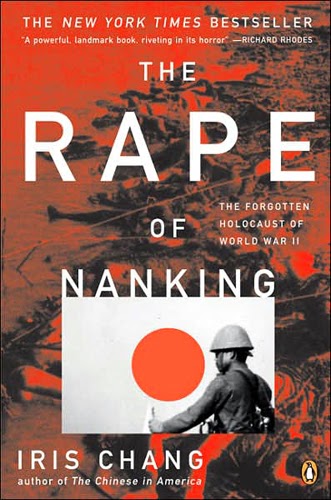

The Rape Of Nanking
----------------------------------------------------
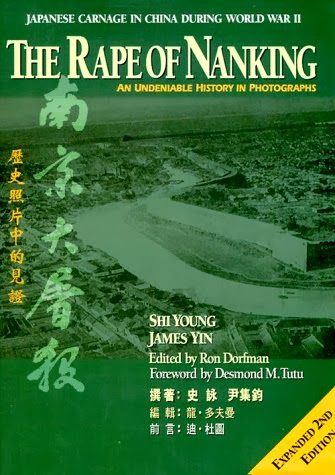

The Rape of Nanking: An Undeniable History in Photographs

------------------------------------------


What war means: the Japanese terror in China; a documentary record By H J Timperley


Documents On The Rape Of Nanking By Tomothy Brook
----------------------------------------------------


Documents of The Nanking Safety Zone

------------------------------------------
Share this PostPin ThisShare on TumblrShare on Google PlusEmail This

BRUTAL MASS RAPE OF GERMAN WOMEN During (And After) WW2

Churchill said to the Germans in January, 1945, "We Allies are no monsters. This, at least, I can say, on behalf of the United Nations, to Germany ... Peace, though based on unconditional surrender, will bring to Germany and Japan immense and immediate alleviation of suffering and agony." Austin Joseph App says that those Allies who were "no monsters" literally raped more European women than had ever before been raped in the history of the world.

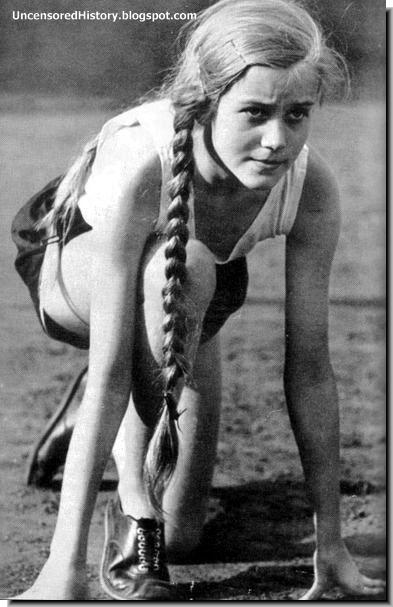
Young German girl before WW2
Glaube und Schönheit ( A Nazi outfit for girls) girl in "happier" days. One shudders to think what the Allied soldiers did to her.

German women were raped by members of the Russian, Polish, French and American forces during and at the end of World War II. During their flight to the West and the period of expulsions, German girls and women were also raped by Czechs, Serbians and Slovenians. Before that German soldiers and members of the SS troops had been the rapists.

helpless german women mass gang raped 1945 berlin WW2
A defeated nation. No men to protect them. These German women suffered mass rape when Germany lost in 1945. These brave women try to build a future amongst the ruins of Berlin in 1945.

At the end of World War II, Red Army soldiers are estimated to have raped around 2,000,000 German women and girls. Norman Naimark writes in "The Russians in Germany: A History of the Soviet Zone of Occupation, 1945–1949." that although the exact number of women and girls who were raped by members of the Red Army in the months preceding and years following the capitulation will never be known, their numbers are likely in the hundreds of thousands, quite possibly as high as the 2,000,000 victims estimate made by Barbara Johr, in "Befreier und Befreite". 

Many of these victims were raped repeatedly. Antony Beevor estimates that up to half the victims were victims of gang rapes. Naimark states that not only did each victim have to carry the trauma with her for the rest of her days, it inflicted a massive collective trauma on the East German nation. 

Naimark concludes "The social psychology of women and men in the soviet zone of occupation was marked by the crime of rape from the first days of occupation, through the founding of the GDR in the fall of 1949, until – one could argue – the present." German women who became pregnant after being raped by Soviet soldiers in World War II were invariably denied abortion to further humiliate them as to carry an unwanted child. 

As a result, according to the book Berlin: The Downfall, 1945 by Antony Beevor, some 90% of raped Berlin women in 1945 had venereal diseases as results of these consequential rapes and 3.7% of all children born in Germany from 1945 to 1946 had Soviet fathers. The history behind this particular rape of the German women by the Soviet troops was considered a taboo topic until 1992.

German women depended  Soviet Army for food
Berlin women were at the mercy of the Soviet soldiers for food in 1945

------------------------------

Vulnerable German girlsThe West Allies went into the Second World War with the aim to bring to an end the fascistic dictatorship and introduce democracy and dignity to the German people. This honourable goal is still to this day attributed to the West Allies in history books. The reality of 1945 was quite different. The victors occupied the conquered land but there was not any respect shown for dignity. The ideals they once held went to dust. Any mans of degradation, humiliation was applied, and the people were treated as monsters. When, towards the end of the war and after May 8th, 1945, the victors feared no more German retaliation, they proved on many instances what they were really thinking of human dignity - namely nothing. Cruel tortures of imprisoned German soldiers went on daily, robbing them of their personal belongings, denying them any right to a rightful hearing. High-handed sentences were given out on a daily basis in the years after the war. Women were fair game, even in the West. 

Defenseless German woman with child
Defenseless German girls and women bore the brunt of Russian vengeance and the atrocities by Allied armies

 The enormous personal humiliations and violations of dignity towards the prisoners during interrogation happened especially in 1945. Ernst von Salomon delivered impressive examples of those deeds in his questionnaire. German women had to endure rape on top of this. The victors of the East and West are both guilty of these crimes. Millions of German women and girls were ravished by this barbaric behaviour. The estimated figures are about two million. Ingo von Münch calculates 1.4 million rapes for the territory east of the Oder and Neiße line, about 500,000 in the former DDR. Ilya Ehrenburg, distributed flyers among the Soviet soldiers weeks ahead before the Red Armey entered East Germany, calling for rape in public and killing of at least one German each day. Soldiers and Officers alike took part in it to follow Ilya Ehrenburg`s appeal. Very few officers resisted this lack of discipline and very few seldom interfered. In Berlin alone tens of thousands of women had to endure this brutal, humiliating behaviour by the Red Armey. The call "women come" became a feared word. Just recently are extensively written monographs made public.
---------------------
As the Red Army advanced toward her in 1945, the city of Berlin had become a city virtually without men. Out of a civilian population of 2,700,000, 2,000,000 were women. It is small wonder that the fear of sexual attack raced through the city like a plague. Doctors were besieged by patients seeking information on the quickest way to commit suicide, and poison was in great demand.
-----------------

french colonial troops mass raped german italian women
The French colonial troops were notorious
 The French let loose their coloured troops from time to time on German women and girls to show their disdain and disrespect towards them. In Freudenstadt e.g. the French officers let their Moroccan troops loose on the German public to have a field day in looting and raping. The German women and girls were considered fair game. Similarly happened in the district of Tübingen where hundreds of women where raped by French troops that came marching into the district. In Stuttgart, French white officers took pleasure for weeks on end using force on German women until the American leadership put a stop to it.

 The U.S. troops, especially when they subjected women to interrogation, practiced rapes besides their normal bodily torture. American units had already made themselves a bad name when landing on French soil, towards the native women shortly after the landing to the point, that the ‘French people wished the Germans were back. Even less moral scruples were shown by the Americans when they entered Germany. Johann Heilmeyer gave an affidavit to an interrogation hearing, that the U.S. members in his presence, raped a woman bound by her hands to a chair, torn off the bits of clothes off her body and tortured her. Other women were threatened, that, if they did not give the information to the interrogators they wanted to hear, they would be put together for a night long with coloured troops of the U.S.
----------------------
On March 24, 1945, the Red Army entered Danzig. A 50-year-old Danzig teacher reported that her niece, 15, was raped seven times, and her other niece, 22, was raped fifteen times. A Soviet officer told a group of women to seek safety in the Cathedral. Once they were securely locked inside, the beasts of Bolshevism entered, and ringing the bells and playing the organ, "celebrated" a foul orgy through the night, raping all the women, some more than thirty times. A Catholic pastor in Danzig declared, "They violated even eight-year-old girls and shot boys who tried to shield their mothers."
---------------------

Stalin revenge  German women


 On May 4th, 2010, the Süddeutsche Zeitung (German news paper published in Munich ) wrote about the mass rapes that were held secret for so many years. The number of women that were raped at the end of the Second World War goes probably into the hundreds of thousands if not into the millions. So far only the Red Armey’s shameful and scandalous deeds have been made public and that sits deep in the collective conscience of the post war time. “The Russians were rapists, the Americans were liberators”. That is how in 1945 German people judged after 1945. Today we know that this is not true. 65 years after the end of the war it becomes more and more clear, that many violations go the account of the French and American troops!
-----------------------
The rapists did not all wear a red star. John Dos Passos, writing in LIFE magazine for January 7, 1946, quotes a "red-faced major" as saying that "Lust, liquor and loot are the soldier's pay." A serviceman wrote to TIME magazine for November 12, 1945 "Many a sane American family would recoil in horror if they knew how 'Our Boys' conduct themselves, with such complete callousness in human relationships over here." An army sergeant wrote "Our own Army and the British Army ...have done their share of looting and raping... This offensive attitude among our troops is not at all general, but the percentage is large enough to have given our Army a pretty black name, and we too are considered an army of rapists."
-----------------------

Nazi poster warning Germans what Russians would do
This Nazi poster warning Germans what the Russians would do to them seemed prophetic

 Contrary to the general believe, the German troops showed right to the end of the Second World War a model discipline towards prisoners and civil population alike in the occupied lands. Particularly superiors tolerated no encroachments by their subordinates towards the local women of the occupied lands. In the appeal of the German commanders to their troops it was made very clear, that violations towards women would be severely punished . If nevertheless something occurred, that can happen in a million strong army, the military justice would be swift in punishment to keep up the discipline and moral of the troops.

 Source: http://www.thenewsturmer.com/Richtstellungen/Westalliierten/Alliedraped.htm
 This article is based upon the books, "Richtstellungen zur Zeitgeschichte" (Corrections to History of our Time) Volume 4, page 526, published by Grabert Verlag, D-72066 Tübingen, Postfach 1629, Germany
------------------------
For the Americans and British, open rape was not as common as among the Soviet troops. The Soviets simply raped any female from eight years up and if a German man or woman killed a Russian soldier for anything, including rape, 50 Germans were killed for each incident, as reported in TIME magazine, June 11, 1945. But for most of our boys, having that "wonderful time" depended a great deal on the "cooperation" of the German and Austrian women. From the starving and the homeless, of course, sexual "cooperation" could be bought for a few pennies or a mouthful of food.
--------------------------------------

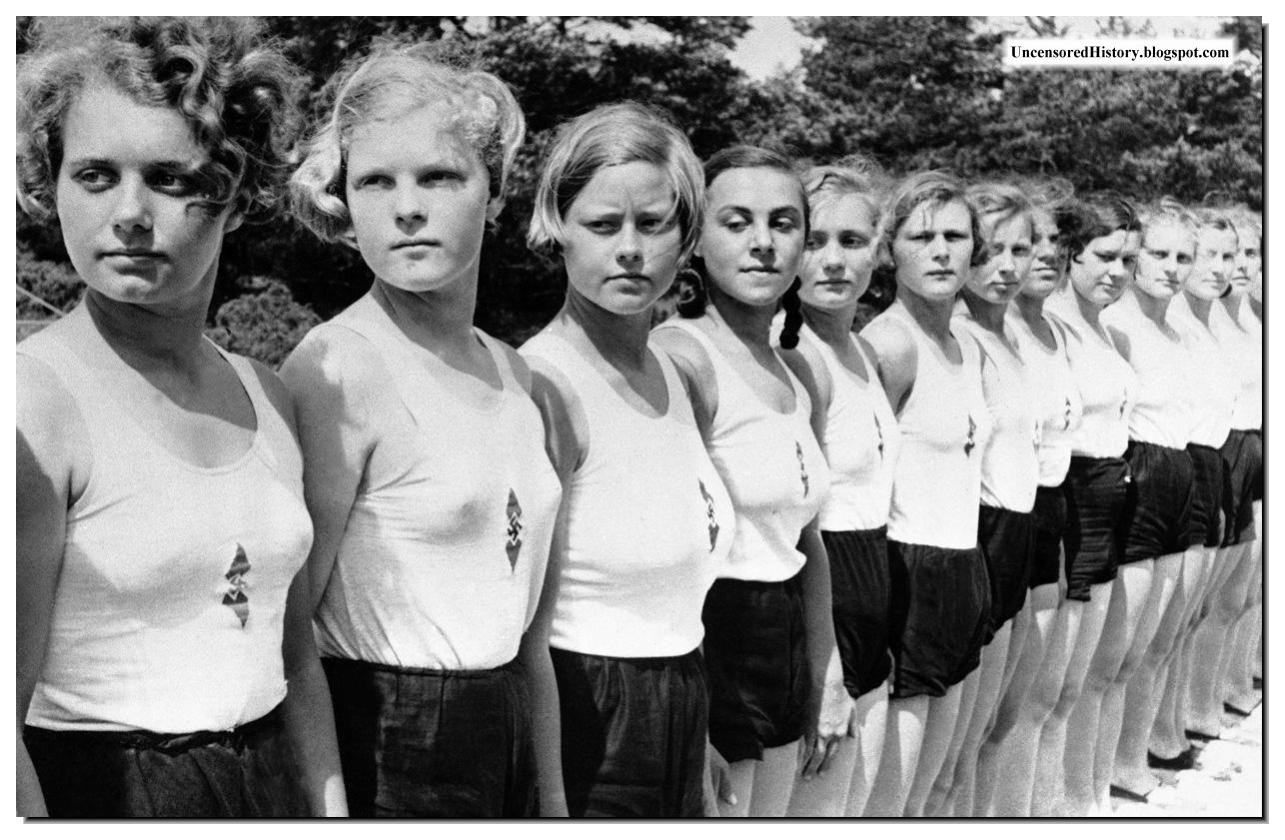
 BDM Nazi organisation for women
One shudders to think what the Russian soldiers did to BDM (Nazi organisation for women) girls like these

From 'Armageddon: Battle for Berlin' by MAX HASTINGS
Buy book in the US
Buy book in the UK
-----------------------------
Rape in East Prussia in 1945. Eyewitness account
Dr. Arnold Niedenzu, A German surgeon in East Prussia

 "During the Russian invasion of East Prussia, I was a senior physician at the St. Josef Hospital in Roessel remained there. After replacement by a Polish doctor, I left East Prussia on 12.12.1945.

"I  think there were very few Russians who did not take part in these terrible crimes. There was little difference between officers and ordinary soldiers. "

Roessel  had not been evacuated due to complete failure of the competent German authorities. Few residents had time to get to safety before the Russians came. The city was occupied after very minor resistance on 28.01.1945 afternoon. Immediately, there was extensive looting, arson, violence and rape, murder and manslaughter. Already in the first few days  60 people were killed in Roessel.

After the first few a young woman was admitted in our hospital to the maternity ward with very severe lung shot. When a Russian tried to rape her, she made ​​it clear to him that tshe was close to giving birth. Then the Russian came to her on her stomach and shot her. The child was born prematurely, the mother came in an almost hopeless condition to the hospital, but lucky to get cured in a few months.

The rapes took place on an unimaginable scale. In my experience I can say that from the women and girls aged 15 to 50 years, only 10% were spared. The Russian made ​​no exceptions: old women (to 80 years), (down to 10 years) children, heavily pregnant women and new mothers. No one was spared. The Russians invaded the hapless women often even during the day,  but mostly at night. They entered through broken windows and pounced on the hapless women and girls. Usually at gunpoint. Often they kept the gun muzzle directly into the mouth of the unfortunate victim.  Many women were shot afterwards (eg, a very well known to me Mrs. K), another (Ms D) then run over with a car or tank.. Often, the women were raped or beaten in the worst way, engraved or otherwise mistreated.

Worse still was the moral degeneration. While initially stunned women and girls wept, later they took it with equanimity. A main topic of conversation was that last night the Russians "harassed", even amongst teenagers. Still later, some women and girls chose to go with Russians in an relationship in order to be protected against attacks by others And even later, because of hunger. Then there was the bad example of those who enticed the Russians  and even bragged about it.

-----------------------------------

Aleksandr Solzhenitsyn, then a young captain in the Red Army and a committed opponent to such outrages, describes the entry of his regiment into East Prussia in January 1945: "Yes! For three weeks the war had been going on inside Germany and all of us knew very well that if the girls were German they could be raped and then shot. This was almost a combat distinction . In his epic poem Prussian Nights, Solzhenitsyn gives a more compelling description of the wanton arson and murder:


We've hit him good and hard, the foe!
Everything's aflame. —Night quarters?
We'll have to spend it in the snow.
Oh, well, that's bad. But all the same,
We've given them a tougher time:
The whole district sees a dawn
The like of which it's never known! . . .
To flame the work of centuries turns,
Fire is weaving, fire is lashing,

Above my head it burns and burns. . .
.
In Neidenburg conflagrations shiver
To shards old masonry's good stone.
The town's a chaos; in a fever
Of acquisition our pursuit takes it. . .
.
Twenty-two Hoeringstrasse.
It's not been burned, just looted, rifled.
A moaning, by the walls half muffled:
The mother's wounded, still alive.
The little daughter's on the mattress,
Dead. How many have been on it?
A platoon, a company perhaps?
A girl's been turned into a woman,
A woman turned into a corpse.
It's all come down to simple phrases:
Do not forget! Do not forgive!
Blood for blood!K tooth for a tooth!
The mother begs, "Soldier, kill me!"
Her eyes are hazy and bloodshot.
The dark's upon her. She can't see.
Am I one of theirs? Or whose? . . .
A pram that's been abandoned,
Blue,
Lace trimmings, too:
"Look, a little 'un.
Still, he's a German!
He'll grow and put a helmet on.
Deal with him now, d'you think?
The order from Supreme Command
Is Blood for Blood! Give no quarter!". . .
And then they shot the housewife first,
Spattering with blood the carpet's pile.
The husband was bedridden, ill:
They cured him with a carbine burst.
Only the nephew, a young boy,
In a flash managed to escape
—Out of the window and away
Over the fence with a leap! With a leap!
Like a wild creature,
Like a little hare,
Across the field toward the wood
Running, ducking, dodging aside.
The whole troop, nearly, rushed from the road,
Firing anyhow, in pursuit:
"I'll get him". "Winged him!" "He's down!"
"He's away!" "—Shoot! Shoot!"
"Ah, the brute,
He's got away. Well, when he's grown . ."

-----------------------------------------------------

Adapted from Stalin's War of Extermination  by Joachim Hoffmann 

Stalin's War of Extermination   Joachim Hoffmann

---------------------------------------------------------

RAPE BY AMERICAN SOLDIERS DURING WW2 IN EUROPE

A study by Robert J. Lilly estimates that a total of 14,000 civilian women in England, France and Germany were raped by American GIs during World War II. It is estimated that there were around 3,500 rapes by American servicemen in France between June 1944 and the end of the war and one historian has claimed that sexual violence against women in liberated France was common.


The journalist Osmar White, a war correspondent from Australia who served with the American troops during the war, wrote that:


"After the fighting moved on to German soil, there was a good deal of rape by combat troops and those immediately following them. The incidence varied between unit and unit according to the attitude of the commanding officer. In some cases offenders were identified, tried by court martial, and punished. The army legal branch was reticent, but admitted that for brutal or perverted sexual offences against German women, some soldiers had been shot – particularly if they happened to be Negroes. Yet I know for a fact that many women were raped by white Americans. No action was taken against the culprits. In one sector a report went round that a certain very distinguished army commander made the wisecrack, 'Copulation without conversation does not constitute fraternisation."


A typical victimization with sexual assault by drunken American personnel marching through occupied territory involved threatening a German family with weapons, forcing one or more women to engage in sex, and putting the entire family out on the street afterward.


As in the eastern sector of the occupation, the number of rapes peaked in 1945, but a high rate of violence against the German and Austrian populations by the Americans lasted at least into the first half of 1946, with five cases of dead German women found in American barracks in May and June of 1946 alone.


American soldiers raped German women and then left gifts of food for them may have permitted themselves to view the act as a prostitution rather than rape.


At the end of World War II roughly 300,000 American GIs were deployed as occupation forces in Germany. Many of them quickly developed intimate relations with their former enemies. Those informal interactions played a significant role in the transformation of Germany from enemy to ally of the United States, argues Petra Goedde in this study. Goedde finds that as American soldiers fraternized with German civilians, particularly as they formed sexual relationships with women, they developed a feminised image of Germany that contrasted sharply with their wartime image of the aggressive Nazi stormtrooper.
---------------------------------------
FROM BARBARA JOHR

In her book “Against our Will”, Susan Brownmiller points out that American soldiers did not have to resort to rape because the sight of the Dollar presented sufficient means of coercion and temptation for hungry women in the liberated countries. However, one of the interviewees in the film said: “I would say Yes to chocolate and stockings but No if I were to do all this for them”. She had been raped by a US soldier. French soldiers were guilty of hundreds of cases of rape in Southern Germany, above all in Stuttgart, Pforzheim and Freudenstadt. Research showed, however, that British soldiers were practically blameless in this respect. After the war, the Western Allies showed little interest in bringing up the rapes by members of the Red Army because they would have had to question the behavior of their own troops as well.

Nazi propaganda had prepared German women to regard Russians as rapists but little credence was in fact given to these horror stories. The disappointment at the behaviour of the liberators was therefore all the greater, particularly among communist and social-democratic women and the few Jewish women who had survived the war on German soil.

Ruth Andreas Friedrich, a journalist and underground fighter, wrote in her diary:
 “For four years Goebbels kept telling us that the Russians were rapists, that they would violate, murder, rob and pillage us. Such propaganda did not shock us and we looked forward to being liberated by the Allies. We did not want to be disappointed. We could not bear it when Goebbels turned out to be right.”

The German Women Suffered After The Rape:

The first hours and weeks following the event: the reaction, particularly of young girls, was one of total disintegration. The shock persisted for many weeks. They had no prior knowledge of sex and the shame was enormous: “I was panic-stricken - I was always afraid that everybody could see it in me. I was insecure in myself - I felt so empty.” Young girls became suicidal: “I wanted to do away with myself and kept crying. My mother would not let me go anywhere alone, not even to the toilet.” The reaction of adult women, some married, was calmer: “Apathy sets in - I kept thinking, I wish it was all over.” There was something of a team-spirit during that first period, some mutual understanding among the women. But this understanding disappeared almost totally once the gossip of the cellar, bunker and escape communities got going: “There was no compassion for us.” The reaction of husbands, families and neighbors was nearly as hurtful as the rape itself: “My husband said that he would leave home if I had the child - You promised me to be faithful - Ah, this is the one the Russians have had.”

The following two years: the women tried to regain control of their lives, to organize their affairs and the survival of their children. In this way they hoped to escape the magnitude of their emotional upheaval. The fear of death which they had experienced became a phobia for some women: “I was a bunch of nerves, full of anxieties.”

Three to five years afterwards: women became extremely cautious in their relations with other people, single women particularly in their attitude to men: “Relationships would develop just up to a certain point and then I acted as if I were totally numb. I promised myself I would remain single.” Married women had to realize that “the marriage was never the same as before”. There were many divorces. Plenty of difficulties developed in those marriages which survived. A patient and sympathetic man was needed to make a new marriage work out. Only a few women had the good luck to find such a husband. When a child was born, the relationship between the mother and the child was rather distant because each physical touch and each physical contact was difficult for them. Their attitude to their own bodies was just as confused as to other people.

Situation at present: the women realize the full depth of how the act of rape affected them and that their endeavours to blot out the enormous significance of the event from their lives were futile. Their attempts at coming to terms with the situation yielded various results: they had more pity for the men returning from war than for themselves; they did not want anything for themselves; in later life, they existed more for others than for themselves. When it became clear to many women that “they paid the price for what the German men had done in the countries which they had invaded” they felt that they had no right to complain and did not consider themselves any longer as the victims. Some of the women became purposely active in politics (against rearming West Germany, in the extra-parliamentary opposition etc.) but they never publicized the personal motivation that drives them.

Only a small fraction of these women took the opportunity to claim compensation for themselves (offered by the West German legislature) or the payment of maintenance for children born as the result of rape (in accordance with the Compensation for Occupation Damages Law). Apart from the fact that most women were not aware of these possibilities, applications for compensation also involved the publication of the victims’ names. Many women shied away from this and decided against applying at least until their financial means were exhausted. Those who did apply experienced depressing situations with the authorities. Women had to prove that they were victims, i.e. that their cases were indeed cases of true rape and not just of coercion and that the damage to their health could be directly attributed to the rape. This was almost impossible to prove.
-----------------------------

The following is from the famous book "Downfall, Berlin 1945" by Antony Beevor. The article was published in the Guardian on May 1, 2002.


"Red Army soldiers don't believe in 'individual liaisons' with German women," wrote the playwright Zakhar Agranenko in his diary when serving as an officer of marine infantry in East Prussia. "Nine, ten, twelve men at a time - they rape them on a collective basis."

The Soviet armies advancing into East Prussia in January 1945, in huge, long columns, were an extraordinary mixture of modern and medieval: tank troops in padded black helmets, Cossack cavalrymen on shaggy mounts with loot strapped to the saddle, lend-lease Studebakers and Dodges towing light field guns, and then a second echelon in horse-drawn carts. The variety of character among the soldiers was almost as great as that of their military equipment. There were freebooters who drank and raped quite shamelessly, and there were idealistic, austere communists and members of the intelligentsia appalled by such behaviour.

Beria and Stalin, back in Moscow, knew perfectly well what was going on from a number of detailed reports. One stated that "many Germans declare that all German women in East Prussia who stayed behind were raped by Red Army soldiers". Numerous examples of gang rape were given - "girls under 18 and old women included".

Marshal Rokossovsky issued order No 006 in an attempt to direct "the feelings of hatred at fighting the enemy on the battlefield." It appears to have had little effect. There were also a few arbitrary attempts to exert authority. The commander of one rifle division is said to have "personally shot a lieutenant who was lining up a group of his men before a German woman spreadeagled on the ground". But either officers were involved themselves, or the lack of discipline made it too dangerous to restore order over drunken soldiers armed with submachine guns.

Calls to avenge the Motherland, violated by the Wehrmacht's invasion, had given the idea that almost any cruelty would be allowed. Even many young women soldiers and medical staff in the Red Army did not appear to disapprove. "Our soldiers' behaviour towards Germans, particularly German women, is absolutely correct!" said a 21-year-old from Agranenko's reconnaissance detachment. A number seemed to find it amusing. Several German women recorded how Soviet servicewomen watched and laughed when they were raped. But some women were deeply shaken by what they witnessed in Germany. Natalya Gesse, a close friend of the scientist Andrei Sakharov, had observed the Red Army in action in 1945 as a Soviet war correspondent. "The Russian soldiers were raping every German female from eight to eighty," she recounted later. "It was an army of rapists."

Drink of every variety, including dangerous chemicals seized from laboratories and workshops, was a major factor in the violence. It seems as if Soviet soldiers needed alcoholic courage to attack a woman. But then, all too often, they drank too much and, unable to complete the act, used the bottle instead with appalling effect. A number of victims were mutilated obscenely.

The subject of the Red Army's mass rapes in Germany has been so repressed in Russia that even today veterans refuse to acknowledge what really happened. The handful prepared to speak openly, however, are totally unrepentant. "They all lifted their skirts for us and lay on the bed," said the leader of one tank company. He even went on to boast that "two million of our children were born" in Germany.

The capacity of Soviet officers to convince themselves that most of the victims were either happy with their fate, or at least accepted that it was their turn to suffer after what the Wehrmacht had done in Russia, is striking. "Our fellows were so sex-starved," a Soviet major told a British journalist at the time, "that they often raped old women of sixty, seventy or even eighty - much to these grandmothers' surprise, if not downright delight."

One can only scratch at the surface of the psychological contradictions. When gang-raped women in Königsberg begged their attackers afterwards to put them out of their misery, the Red Army men appear to have felt insulted. "Russian soldiers do not shoot women," they replied. "Only German soldiers do that." The Red Army had managed to convince itself that because it had assumed the moral mission to liberate Europe from fascism it could behave entirely as it liked, both personally and politically.

Domination and humiliation permeated most soldiers' treatment of women in East Prussia. The victims not only bore the brunt of revenge for Wehrmacht crimes, they also represented an atavistic target as old as war itself. Rape is the act of a conqueror, the feminist historian Susan Brownmiller observed, aimed at the "bodies of the defeated enemy's women" to emphasise his victory. Yet after the initial fury of January 1945 dissipated, the sadism became less marked. By the time the Red Army reached Berlin three months later, its soldiers tended to regard German women more as a casual right of conquest. The sense of domination certainly continued, but this was perhaps partly an indirect product of the humiliations which they themselves had suffered at the hands of their commanders and the Soviet authorities as a whole.

A number of other forces or influences were at work. Sexual freedom had been a subject for lively debate within Communist party circles during the 1920s, but during the following decade, Stalin ensured that Soviet society depicted itself as virtually asexual. This had nothing to do with genuine puritanism: it was because love and sex did not fit in with dogma designed to "deindividualise" the individual. Human urges and emotions had to be suppressed. Freud's work was banned, divorce and adultery were matters for strong party disapproval. Criminal sanctions against homosexuality were reintroduced. The new doctrine extended even to the complete suppression of sex education. In graphic art, the clothed outline of a woman's breasts was regarded as dangerously erotic. They had to be disguised under boiler suits. The regime clearly wanted any form of desire to be converted into love for the party and above all for Comrade Stalin.

Most ill-educated Red Army soldiers suffered from sexual ignorance and utterly unenlightened attitudes towards women. So the Soviet state's attempts to suppress the libido of its people created what one Russian writer described as a sort of "barracks eroticism" which was far more primitive and violent than "the most sordid foreign pornography". All this was combined with the dehumanising influence of modern propaganda and the atavistic, warring impulses of men marked by fear and suffering.

The novelist Vasily Grossman, a war correspondent attached to the invading Red Army, soon discovered that rape victims were not just Germans. Polish women also suffered. So did young Russian, Belorussian and Ukrainian women who had been sent back to Germany by the Wehrmacht for slave labour. "Liberated Soviet girls quite often complain that our soldiers rape them," he noted. "One girl said to me in tears: 'He was an old man, older than my father'."

The rape of Soviet women and girls seriously undermines Russian attempts to justify Red Army behaviour on the grounds of revenge for German brutality in the Soviet Union. On March 29 1945 the central committee of the Komsomol (the youth organisation of the Soviet Union) informed Stalin's associate Malenkov of a report from the 1st Ukrainian Front. "On the night of 24 February," General Tsygankov recorded in the first of many examples, "a group of 35 provisional lieutenants on a course and their battalion commander entered the women's dormitory in the village of Grutenberg and raped them."

In Berlin, many women were simply not prepared for the shock of Russian revenge, however much horror propaganda they had heard from Goebbels. Many reassured themselves that, although the danger must be great out in the countryside, mass rapes could hardly take place in the city in front of everybody.

In Dahlem, Soviet officers visited Sister Kunigunde, the mother superior of Haus Dahlem, a maternity clinic and orphanage. The officers and their men behaved impeccably. In fact, the officers even warned Sister Kunigunde about the second-line troops following on behind. Their prediction proved entirely accurate. Nuns, young girls, old women, pregnant women and mothers who had just given birth were all raped without pity.

Yet within a couple of days, a pattern emerged of soldiers flashing torches in the faces of women huddled in the bunkers to choose their victims. This process of selection, as opposed to the indiscriminate violence shown earlier, indicates a definite change. By this stage Soviet soldiers started to treat German women more as sexual spoils of war than as substitutes for the Wehrmacht on which to vent their rage.

Rape has often been defined by writers on the subject as an act of violence which has little to do with sex. But that is a definition from the victim's perspective. To understand the crime, one needs to see things from the perpetrator's point of view, especially in the later stages when unaggravated rape had succeeded the extreme onslaught of January and February.

Many women found themselves forced to "concede" to one soldier in the hope that he would protect them from others. Magda Wieland, a 24-year-old actress, was dragged from a cupboard in her apartment just off the Kurfürstendamm. A very young soldier from central Asia hauled her out. He was so excited at the prospect of a beautiful young blonde that he ejaculated prematurely. By sign language, she offered herself to him as a girlfriend if he would protect her from other Russian soldiers, but he went off to boast to his comrades and another soldier raped her. Ellen Goetz, a Jewish friend of Magda's, was also raped. When other Germans tried to explain to the Russians that she was Jewish and had been persecuted, they received the retort: "Frau ist Frau."

Women soon learned to disappear during the "hunting hours" of the evening. Young daughters were hidden in storage lofts for days on end. Mothers emerged into the street to fetch water only in the early morning when Soviet soldiers were sleeping off the alcohol from the night before. Sometimes the greatest danger came from one mother giving away the hiding place of other girls in a desperate bid to save her own daughter. Older Berliners still remember the screams every night. It was impossible not to hear them because all the windows had been blown in.

Estimates of rape victims from the city's two main hospitals ranged from 95,000 to 130,000. One doctor deduced that out of approximately 100,000 women raped in the city, some 10,000 died as a result, mostly from suicide. The death rate was thought to have been much higher among the 1.4 million estimated victims in East Prussia, Pomerania and Silesia. Altogether at least two million German women are thought to have been raped, and a substantial minority, if not a majority, appear to have suffered multiple rape.

If anyone attempted to defend a woman against a Soviet attacker it was either a father trying to defend a daughter or a young son trying to protect his mother. "The 13-year old Dieter Sahl," neighbours wrote in a letter shortly after the event, "threw himself with flailing fists at a Russian who was raping his mother in front of him. He did not succeed in anything except getting himself shot."

After the second stage of women offering themselves to one soldier to save themselves from others, came the post-battle need to survive starvation. Susan Brownmiller noted "the murky line that divides wartime rape from wartime prostitution". Soon after the surrender in Berlin, Ursula von Kardorff found all sorts of women prostituting themselves for food or the alternative currency of cigarettes. Helke Sander, a German film-maker who researched the subject in great detail, wrote of "the grey area of direct force, blackmail, calculation and real affection".

The fourth stage was a strange form of cohabitation in which Red Army officers settled in with German "occupation wives". The Soviet authorities were appalled and enraged when a number of Red Army officers, intent on staying with their German lovers, deserted when it was time to return to the Motherland.

Even if the feminist definition of rape purely as an act of violence proves to be simplistic, there is no justification for male complacency. If anything, the events of 1945 reveal how thin the veneer of civilisation can be when there is little fear of retribution. It also suggests a much darker side to male sexuality than we might care to admit.


-------------------------------------------

Tomb of the unknown rapist Berlin
The "Tomb of the Unknown Soviet soldier" in Berlin. To the victimised women of Berlin it was the  "Tomb of the unknown rapist".
Outside she could hear the Russian soldiers, their voices slurred with drink, shouting for women. “Frau komm, frau komm,” (“come here woman, come here woman”) they bellowed in heavily Russian-accented German. It was a cry that thousands of women would learn to dread.

Suddenly some of the soldiers stumbled into the kitchen and a handful of old women refugees,  fearful they would be attacked, dragged Gabriele out, thrusting her towards the  Russians. She was immediately raped by every soldier. It was not the first time. The day before she had been caught by two Russians, hurled to the ground and violated.

So it went on for two weeks until she was taken to another farm and hidden from the sex-crazed soldiers. Now aged 80 Gabriele still remembers those terrible days and in particular how she was betrayed by the old women. “I despised those women, I still do,” she said. “I have no tears but I feel hatred rising up inside me.”

It is a boiling hatred that has lasted 65 years since the Allies, including fierce Soviet forces, smashed their way across Europe to victory over Nazism. But as they advanced the Russians unleashed an orgy of sickening self-gratification as soldiers of the Red Army embarked on a lengthy campaign of rape, looting, murder and depravity.

Now Gabriele Koepp has written a book of searing honesty called Why Did I Have To Be A Girl, about the rapes carried out by the Red Army as it advanced towards Berlin. The book is unprecedented, being the first time a German woman has broken the lengthy taboo by writing about being one of the estimated two million victims of rampaging Soviet soldiers.

What sickened many at the time was that the soldiers were actively encouraged to rape German women by Russian dictator Josef Stalin. When one of his commanders protested Stalin exploded: “Can’t you understand it if a soldier, who has crossed thousands of kilometres through blood and fire and death, has fun with some woman or takes a  trifle?” To Stalin German women were merely the “spoils of war”.

Gabriele was such a “spoil” for those 14 days when she was relentlessly and repeatedly raped by Russian soldiers, so much so that she cannot even to this day, say the very word. “My life has been some 29,200 days,” she said. “But really it was destroyed in those 14 days of the ... I cannot say the word. I was innocent when it happened.

“There is a debate going on in Germany at the moment about the so-called expellees from land that once belonged to Germany, the loss of the homeland, etc, but that is nothing to me. I live with what happened to me all the time. There are days I cannot eat because of it, even now all these years later.

“Writing of what happened hasn’t made anything easier for me but I had to do it. Who else would?” Gabriele studiously avoids detail and writes in the book of “the place of the terror”, the “gates of hell” and calls the  rapists “brutes and scoundrels”. She avoids the word “rape” and adds with some fear in her eyes: “I cannot even say that word.”

The book is a searing scrutiny of the agony that to this very day the Russian establishment continues to deny. Gabriele was one of an  estimated two million German girls and women, some as young as six and as old as 80, who were raped by Soviet soldiers.

Their justification was that Hitler’s invasion of Russia had left 26million dead and revenge would be sweet. Much of the rape and murder by the Russians took place as they approached Berlin. They fought with superhuman toughness to reach the Nazi capital, smashing their way to the city’s edges. Hitler, cowering in his bunker like a terrified rat, would soon take the coward’s exit, shooting himself through the temple.

Berliners had prayed that the Western Allies would reach their city before the Russians but General Eisenhower, the overall commander- in-chief, had decided the Russians should reach Berlin first on account of their own huge losses.

But as early as 1944 terrible reports were seeping through to Berlin from the moment the thrusting Red Army entered East Prussia and Silesia.

By the time the Soviet troops entered Berlin there was terror on the streets. The rapes usually started in the evenings after the soldiers had drunk large amounts of vodka. That familiar cry of “frau komm” soon echoed around the rubble-strewn streets.

Any woman found, whatever her age, was savagely thrown to the ground and brutally attacked. Filthy drunken soldiers hunted in packs, some women were raped by as many as 20 men.

One of the worst mistakes of the defeated German authorities had been their failure to destroy Berlin’s considerable stocks of alcohol as the Red Army drew nearer. Erroneously, they thought a drunken enemy could not fight. But the Russians fought even harder, as well as having their desires inflamed.

Nor did the Soviet women soldiers do anything to stop their male comrades. One Berlin woman was being raped in succession by three men when three others arrived, one of them a woman. When the German woman appealed to her to intervene she merely laughed out loud. There were tragic attempts to resist the soldiers. A 13-year-old boy

started flailing at a soldier who was raping his mother in front of him.

When the Russian finished he turned to the boy and shot him. Although usually well-behaved, Soviet officers had little control over their men. When one girl was hauled out into the street and raped it was explained by a German neighbour that she was Jewish and had been persecuted by the Nazis. The officer’s reply was a shrug of the shoulders and the terse observation that “Frau ist frau” (“a woman is a woman”).

AS night closed in the screams of women being attacked could be heard all over the city. it is estimated that up to 10,000 of the women who were raped died, mostly from  suicide. Some could never talk about it and for the young such as Gabriele, it would prove a lifelong horror.

For many men returning home learning that their wives had been raped was traumatic. The historian Antony Beevor, in his book Berlin: The Downfall, 1945, recounts the reaction of one man on learning of the experiences which the inhabitants of one building had survived.

“You turned into shameless bitches, every one of you,” he yelled.

“I can’t bear to listen to these stories. You’ve lost all your standards!” Many marriages broke up as returning husbands considered their wives little more than damaged property.

Eventually communist leaders became deeply embarrassed by the reports of Soviet behaviour and made complaints to the Kremlin which admitted nothing and even claimed it was all Western propaganda designed to “damage the high reputation of the Red Army”. But discipline was suddenly tightened and some rapists were executed.

The Red Army war memorial in Berlin is dominated by a huge figure of a Russian soldier. There is an expression of heroic triumph on his sculptured face. in one hand he holds a child, while the other wields a sword that smashes a swastika.

But to German women of the wartime generation, including Gabriele Koepp, there is another name for that memorial: “The tomb of the unknown rapist.”


German women mass rape Red Army WW2 sculpture

RAPE OF GERMAN WOMEN BY THE POLISH AT THE END AND AFTER THE WAR


(From 'Savage Continent' by Keith Lowe, Page 236)


The rape of German women by the Polish began as the Red Army began its move towards Berlin. Polish men targeted German women fleeing from East Prussia, Pomerania and territory which had began occupied by the Nazis and which the 'Big Three' had decided was to be given to Poland. Many German victims gave their stories of rape to the German Ministry for Expellees, Refugees and war Victims in the later 1940s and 1950s.


Many of the victims were women who were captured while they were fleeing and made to work in Polish farms and factories where the vulnerable women were raped by the Polish soldiers and foremen.


An eye witness account by a victim, Anna Kientoff, tells of fleeing German women accosted by hordes of Polish soldiers who selected young girls and raped them. Their mothers wailed in agony as their young daughters were dragged away for the hellish experience. The Red Army soldiers stood watching and shrugged their shoulders when the German women appealed to them to save them from the Polish soldiers and said the Polish were the masters here. They could do nothing.


Many German women were raped in Czechoslovakia during the expulsion of Germans after the war was over.

RELATED


Freiwild: Das Schicksal deutscher Frauen 1945

Freiwild: Das Schicksal deutscher Frauen 1945


Die Frauen in den deutschen Ostgebieten und in Berlin waren 1945, als die Rote Armee zum Endsieg über Hitlers Drittes Reich antrat, Freiwild der russischen Soldaten. Hunderttausende wurden in sowjetische Arbeitslager verschleppt. Mehr als hunderttausend Frauen und Mädchen wurden allein in Berlin vergewaltigt, insgesamt waren es annähernd zwei Millionen. Viele starben an den ihnen zugefügten Qualen, andere begingen Selbstmord. Die, die überlebten, gingen durch die Hölle, waren traumatisiert und stigmatisiert. Sie wurden gemieden, von ihren Männern verlassen, ihre Kinder galten als »Russenbälger«. Das Schicksal dieser Frauen wurde zu einem der großen Tabus der deutschen Nachkriegsgesellschaft - in Ost und West. Erst der 2003 erschienene Bestseller »Eine Frau in Berlin«, der ergreifende Erlebnisbericht einer Berliner Journalistin aus dem Jahre 1945, brachte es an die Öffentlichkeit. Anlässlich der Verfilmung dieses Buches - mit Nina Hoss in der Hauptrolle – bereitet die TV-Journalistin Ingeborg Jacobs für das ZDF eine Dokumentation zum Thema vor. Das begleitende Buch stellt die Ergebnisse ihrer umfangreichen Recherchen vor. Es stützt sich maßgeblich auf die zahlreichen Interviews, die die Autorin mit betroffenen Frauen geführt hat und die sie mit Sensibilität und erzählerischer Kraft in das zeitgeschichtliche Umfeld einbettet. So entsteht erstmals ein Gesamtbild jenes schrecklichen Geschehens, das die Deutschen angesichts der Last ihrer Kriegsschuld tief verdrängt haben.

****************
Essential Reading

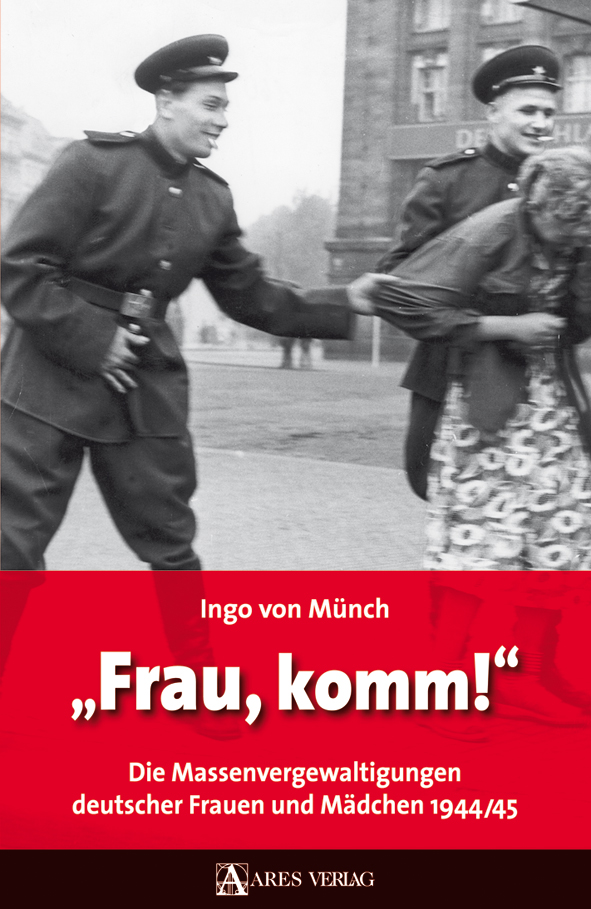
Frau Komm Ingo von Munch

One of the worst crimes in the Second World War included the mass rape of German women and girls by Soviet soldiers in 1944/45. Many of these women and girls were not once but  sexually abused many times. Neither children nor old women were spared. Reliable estimates suggest that around two million women and girls were victims of those rapes. The enormity of these crimes and the human suffering caused by it and experienced for decades, has not received adequate public attention. Only in recent times, these events are mentioned frequently, but almost always as part of a description of flight, expulsion and forced labor. In contrast, the present book deals exclusively with the rape and, among other things, the questions of how and why it has come to these excesses, why resistance was futile, and what happened to the children who were victims or "only" witness of sexual violence were . 

Zu den schlimmsten Verbrechen im Zweiten Weltkrieg gehören die Massenvergewaltigungen deutscher Frauen und Mädchen durch sowjetische Soldaten 1944/45. Viele dieser Frauen und Mädchen wurden nicht ein Mal, sondern viele Male sexuell mißbraucht. Weder Kinder noch Greisinnen blieben verschont. Verläßlichen Schätzungen zufolge wurden rund zwei Millionen Frauen und Mädchen Opfer jener Vergewaltigungen. Das ungeheure Ausmaß dieser Verbrechen und der durch sie verursachten menschlichen Leiden hat jahrzehntelang keine angemessene öffentliche Aufmerksamkeit erfahren. Erst in neuerer Zeit werden diese Ereignisse häufiger erwähnt, allerdings fast immer nur als Teil einer Schilderung von Flucht, Vertreibung und Zwangsarbeit. Demgegenüber befasst sich das vorliegende Buch ausschließlich mit den Vergewaltigungen und hier unter anderem mit den Fragen, wie und warum es zu diesen Exzessen gekommen ist, warum Widerstand zwecklos war und was mit den Kindern geschah, die Opfer oder „nur“ Zeuge der sexuellen Gewalttaten waren. Erlebnisberichte von Opfern und Tätern sind eine wesentliche, weil authentische Grundlage dieser Darstellung.

******************

BeFreier und Befreite: Krieg, Vergewaltigungen, Kinder


Eine Frau in Berlin Anonyma
-----

Sexual Violence in Conflict Zones: From the Ancient World to the Era of Human Rights
By
ELIZABETH HEINEMAN

Sexual Violence in Conflict Zones: From the Ancient World to the Era of Human Rights  ELIZABETH HEINEMAN


"[Sexual Violence in Conflict Zones] makes a significant contribution to our understanding of the relationship between sexual violence and periods of conflict."
-----
Brutality and Desire: War and Sexuality in Europe's Twentieth Century
By
DAGMAR HERZOG
Brutality and Desire: War and Sexuality in Europe's Twentieth Century  DAGMAR HERZOG
Tracing sexual violence in Europes twentieth century from the Armenian genocide to Auschwitz and Algeria to Bosnia, this pathbreaking volume expands military history to include the realm of sexuality. Examining both stories of consensual romance and of intimate brutality, it also contributes significant new insights to the history of sexuality.
Share this PostPin ThisShare on TumblrShare on Google PlusEmail This
Related Posts Plugin for WordPress, Blogger...
Advertisement

Popular Articles On This Site

UncensoredHistory.blogspot.com

UncensoredHistory.blogspot.com