Showing posts with label Vietnam War. Show all posts

Why Were The Vietcong Able To Defeat America In Vietnam?

How were the Vietcong and North Vietnamese Army able to defeat America with its advanced weapons in the Vietnam War?


Vietcong prisoner American soldiers


Vietcong National Liberation Front NLF
Henry Cabot Lodge,  a former American ambassador to Saigon, wrote some time after the fall of Saigon in 1975: “Was the United States engaged in an imperialist adventure far from our own shores? Or were we defending a small nation, pledged to democratic government from naked aggression? Did limitations placed on our use of military force keep us from a swift and decisive victory? Or were we engaged in a war that could not be won even with the most sophisticated and lethal weapons? Were the Vietcong freedom fighters seeking to liberate their country from centuries of foreign domination? Or were they simply terrorists, willing to use any means to gain power?

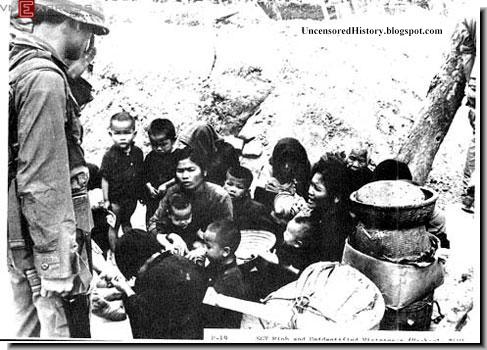
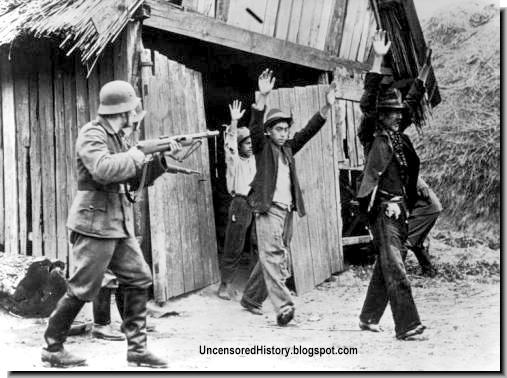
Herding away suspected guerrillas


“Did the ultimate collapse of South Vietnam signify a loss of will on the part of the American people? Or were we fighting the wrong war, in the wrong place, at the wrong time? ”

Imperialist ventures, whether by America or the Europeans, were always dressed in idealistic clothes. Spain took South America’s gold in the guise of saving souls for Christianity. The French spoke of spreading civilization. The British spoke of the “White Man’s Burden.” And the Americans always talked about spreading democracy. But in the end it was always about forcing on other countries and societies what America wanted. Yes, it could find some locals whose interests coincided with its interests, but that was always secondary.

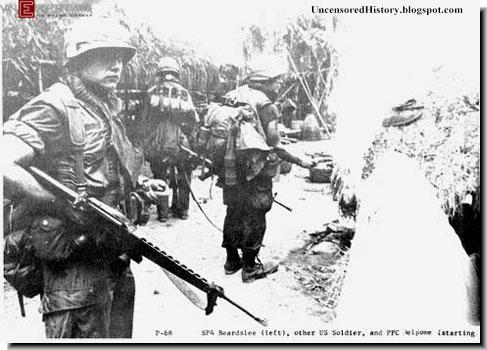
GI give water wounded Vietcong militia


America fought in Vietnam because its power elite wanted to restrict the spread of communism. The Vietcong was fighting for independence from the corrupt regimes of South Vietnam, hence it had a well-motivated fighting force. It was also more in tune with the needs and mindset of South Vietnamese masses. America was propping up unpopular corrupt rulers in South Vietnam while the North Vietnamese power elite backed the driven Vietcong fighters. The result was inevitable.

 Vietcong fighters highly motivated

The two main reasons why Vietcong defeated America in Vietnam are,
1. Self-evident. The Vietcong was guided and controlled by the North Vietnamese leaders and received massive arms and ideological support from Hanoi (Which had the support of both China and the Soviet Union).
2. The Vietcong was able to reach out to the masses. The American-backed South Vietnamese regimes were corrupt and failed utterly in connecting with the people.
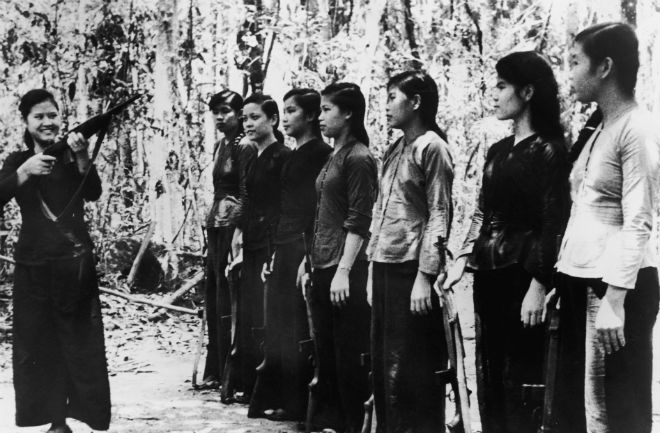
Women NLF soldiers

We shall now examine how the Viet Cong was able to connect with the masses so well.


WHY WAS THE VIETCONG SO SUCCESSFUL IN GAINING POPULAR SUPPORT?

The most popular aspect of the NLF programme was the promise to take the land from the rich and to distribute it amongst the peasants. During the Indochina War the Vietminh had taken the land from the large landowners in the territory they controlled and given it to the peasants. After Diem had gained power in South Vietnam, he forced the peasants to pay for the land they had been given. This was often more than the peasants could afford and it caused a considerable amount of suffering amongst the peasant community. The promise of the NLF to give the peasants their land free of charge was an important factor in persuading them to help the guerrillas in their fight against the Diem government.

Most peasants in South Vietnam were extremely poor. For centuries, the Vietnamese peasants had accepted this state of affairs because they believed that poverty was a punishment for crimes committed by their ancestors. The NLF educated the peasants in economics and explained how poverty was the result of the landowner's selfishness. They pointed out that fifty per cent of the agricultural land in South Vietnam was owned by only two and a half per cent of the population. Two thirds of the peasants owned no land at all and were therefore forced to work for the rich landlords.

The NLF's solution to this problem was to take the property of the large landowners and distribute it amongst the peasants. In some cases, the landowners were executed as a punishment for the way they had treated the peasants in the past.

In return for the land they had been given, the peasants agreed to help the NLF by feeding and hiding them. In some cases, the peasants also agreed to take up arms with the NLF and help 'liberate' other villages.

American soldiers interrogate Vietnamese villagers


The Vietcong code of conduct helped it gain the confidence of the Vietnamese peasants. When the NLF entered a village they obeyed a strict code of behaviour. All members were issued with a series of 'directives'. These included:"

(1) Not to do what is likely to damage the land and crops or spoil the houses and belongings of the people; (2) Not to insist on buying or borrowing what the people are not willing to sell or lend;
(3) Never to break our word;
(4) Not to do or speak what is likely to make people believe that we hold them in contempt;
(5) To help them in their daily work (harvesting, fetching firewood, carrying water, sewing, etc.)."

Guerrillas meshed well common Vietnamese people
Vietcong Dealt With The Masses In A "We Are One Family" Manner


Vietcong Dealt With The Masses In A "We Are One Family" Manner

How then did it come to pass that Vietnamese peasants joined a modern revolutionary movement? The basic approach of Vietnamese peasantry was ‘live and let live’. They expected no dramatic change in their way or quality of life, and endeavored to live a traditional life based on the rice culture. Peasants did not seek adventure, preferring financial security for their family within the community. The Viet Cong knew how to use the Vietnamese tradition as means for achieving its own goals.

Opposition to the organization or support of the South Vietnamese or American governments resulted in cruel measures, and would often end in executions. Nevertheless, enlistment in the organization was translated into traditional concepts, and even included an adoption of the Vietnamese familial model. Political cadres presented themselves as the fathers of the Vietnamese nation or as its teachers. These cadres were often older individuals, while the pool of potential recruits included the younger generation. The relationship was therefore based on fear and respect, in accordance with Vietnamese tradition. Terrorism was organized, planned, and exercised only against individuals, and rarely used as means for collective punishment. Punishment of peasants who had failed to support the Viet Cong was portrayed as the reprimand of a wayward son. The punishment itself was inflicted only after a trial was held and the offences clarified for the benefit of the defendants and the villagers. Punishments were explained through traditional rather than political-ideological concepts. The crimes of condemned individuals were explained as potentially harmful to the community rather than as reflections of political opposition to the Viet Cong. Also, individuals collaborating with government forces were accused of an intention to harm peasants through anti-traditional modernization.


Suspected guerrillas jeep blindfolded


Support of the Viet Cong was based on familial loyalty: it alone can explain why peasants whose world revolved around the family and the rice paddy would risk all and join the movement. These trends must be explained through traditional concepts and the importance accorded to the family in Vietnamese society. Few peasants joined the movement out of ideology, i.e. belief in the Communist way. Peasant support of the Viet Cong signified support of the Farmers’ Liberation Association (FLA), established by the Viet Cong, which called for comprehensive agrarian reform. The guerrilla forces offered economic opportunities for peasants and were therefore perceived as leaders of a social revolution. Success of the revolution would improve the peasants’ economic standing and turn them into landowners


Women fighters weapon training


Video: Vietcong Weapons and tactics


OTHER FACTORS IN FAVOR OF THE VIETCONG

1. Peasants often joined the ranks of the organization that had first arrived in the village. Until 1965, joining the Viet Cong and remaining close to the family was a better option than joining the Army of the Republic of Vietnam, which had been suffering severe setbacks. In addition, army recruits were often posted in faraway battlefields.

2. Peasants whose fields were situated in territories held by the Viet Cong joined the organization in order to protect their financial interests; these actions reinforced the Viet Cong claim that joining the organization protected peasant interests. 

3. Some peasants joined the organization wishing to avenge the death of a family member killed by the government or by forces allied to it. A 1967 study stated that revenge against the South Vietnamese government became more prevalent. Several individuals stated that they had joined the Viet Cong since the French harmed their families, and they could now exact their revenge. Hence, it is apparent that the governments of South Vietnam and the United States were perceived as a continuation of French rule. The government was perceived as a continuation of the hated (primarily for religious reasons) Diem regime, which had itself been perceived as a substitute for the detested French colonialists.

4. Peasants also joined the Viet Cong out of nationalist reasons. The Vietnamese sought a unification of the north and the south. However, this motivation was not based on Communist doctrine but rather on the long history of Vietnam as a nation. Cultural Vietnamese elements such as language, poetry, literature, music, and drama were more important than any political ideology or agenda.

VIDEO: The Vietcong's simple, crude but effective weapons


References

Suggested Reading

Share this PostPin ThisShare on TumblrShare on Google PlusEmail This

Was South Vietnam Police Chief Nguyen Ngoc Loan A Bad Guy?

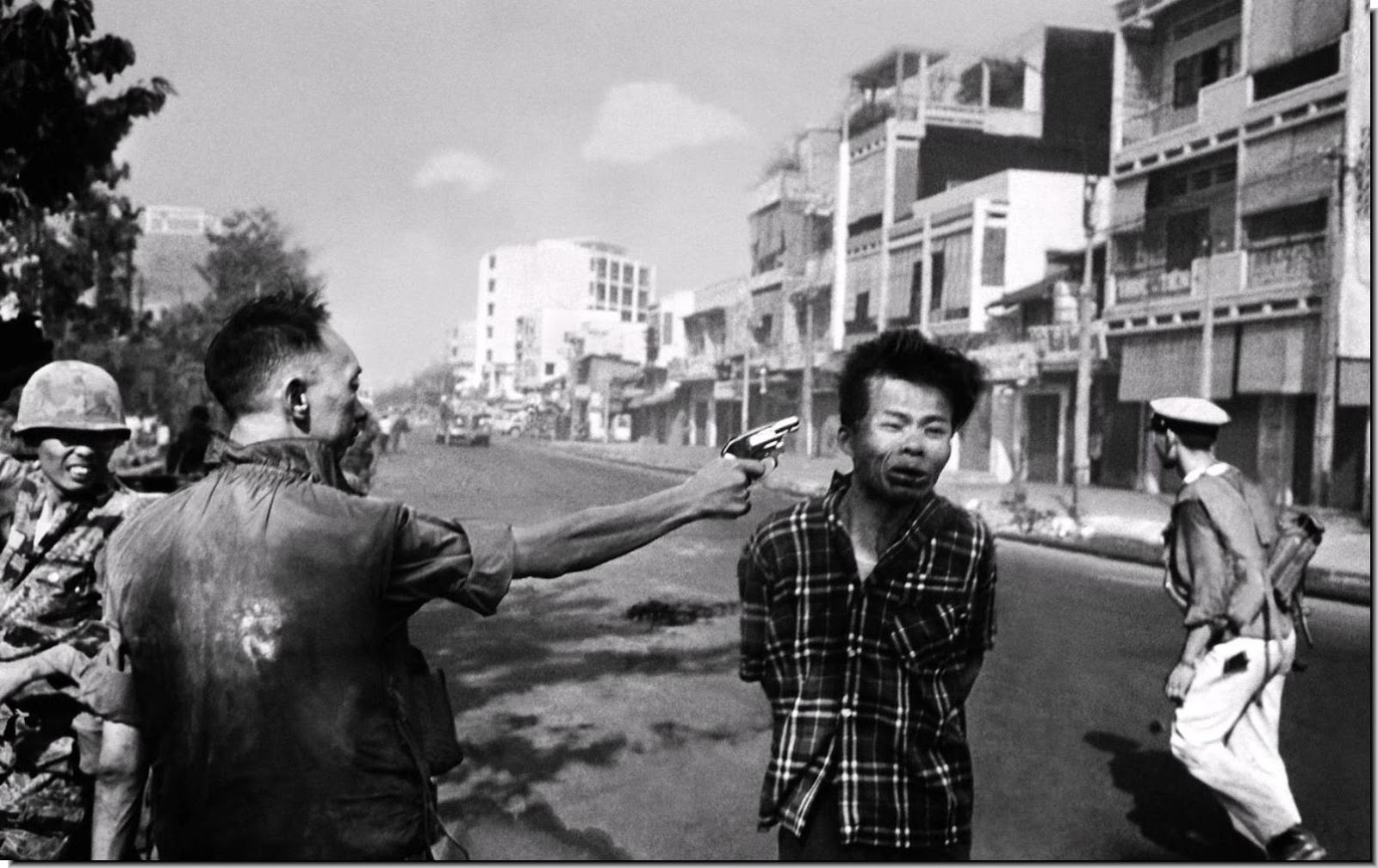
February 1, 1968 Saigon Police chief Nguyen Ngoc Loan shoots  Vietcong i
The picture that changed history. February 1, 1968. Saigon Police chief Nguyen Ngoc Loan shoots a Vietcong in the head.
One look at the image and most of say, "Of course, he was a bad guy. Shooting that poor thin Vietnamese man in cold blood". But the reality is different.....

First some background. 1968. Vietnam. With North Vietnam’s Tet Offensive beginning, Nguyen Ngoc Loan, South Vietnam’s national police chief, was doing all he could to keep Viet Cong guerrillas from Saigon. As Loan executed a prisoner who was said to be a Viet Cong captain, AP photographer Eddie Adams opened the shutter. Adams won a Pulitzer Prize for a picture that, as much as any, turned public opinion against the war.


And the so-called "poor guy" (Named Nguyen Van Lem) shaking in fear as death is seconds away was no innocent man. He was a hard-core Vietcong militiamen, member of a death squad, who had just killed the the Deputy commander of the South Vietnamese Police and his family (At least eight people) in cold blood.


moments before the shooting
Before the killing

moments after shooting
Moments after the shooting

South Vietnamese sources attested that Lem commanded a Vietcong death squad, which on that day had murdered South Vietnamese National Police officers, or in their stead, the police officers' families; these sources said that Lem was captured near the site of a ditch holding as many as thirty-four bound and shot bodies of police and their relatives, some of whom were the families of Loan's deputy, and six of whom were Nguyen's godchildren.

The photo won Adams (The man who shot the famous picture) the 1969 Pulitzer Prize for Spot News Photography, though he was later said to have regretted its impact. The image became an anti-war icon. Concerning Loan and his famous photograph, Adams wrote in Time:

The general killed the Viet Cong; I killed the general with my camera. Still photographs are the most powerful weapon in the world. People believe them, but photographs do lie, even without manipulation. They are only half-truths. What the photograph didn't say was, "What would you do if you were the general at that time and place on that hot day, and you caught the so-called bad guy after he blew away one, two or three American soldiers?"

Adams later apologized in person to General Nguyen and his family for the damage it did to his reputation. When Loan died of cancer in Virginia, Adams praised him: "The guy was a hero. America should be crying. I just hate to see him go this way, without people knowing anything about him.".


--------------------------------
MORE ABOUT THE MAN....

One of the 11 children of a prosperous mechanical engineer, Loan was born in Hue. He graduated near the top of his class at the University of Hue and begun a career as a jet pilot in the South Vietnamese Air Force. As a close friend of Nguyen Cao Ky, the swashbuckling pilot who became Premier in 1965, Loan, then a colonel, was put in charge of the national police and gained an immediate reputation among Western reporters for his temper and rages at the scenes of Viet Cong attacks on civilian targets.

Some of those who knew him said General Loan would not have carried out the prisoner execution if reporters and photographers had not been at the scene.

Loan later suggested that the execution had not been the rash act it might have appeared to be but had been carried out because a deputy commander he had ordered to shoot had hesitated. "I think, 'Then I must do it,' " he recounted. "If you hesitate, if you didn't do your duty, the men won't follow you."

Vo Suu, a cameraman at the scene for NBC News, recalled that immediately after the shooting the general had walked over to a reporter and said, "These guys kill a lot of our people, and I think Buddha will forgive me."

When General Loan was severely wounded while charging a Viet Cong hideout three months later and taken to Australia for treatment, there was such an outcry there against him that he was moved to the Walter Reed Army Medical Center in Washington, where he was repeatedly denounced in Congress.

Back in Saigon, Loan, who had been relieved of his command after having been wounded, seemed a changed man, devoting time to showering presents on orphans. At the fall of Saigon his pleas for American help in fleeing were ignored. But he and his family escaped in a South Vietnamese plane.

After his presence in the United States became known there was a move to deport him as a war criminal. But the efforts fizzled, and Loan, whose right leg had been amputated, settled in northern Virginia, where he eventually opened his pizzeria, which he operated until 1991 when publicity about his past led to a sharp decline in business. As a message scrawled on a restroom wall put it, "We know who you are."


--------------------------------------------

The 2010 book, This Time We Win: Revisiting the Tet Offensive, offers a detailed, sympathetic picture of Loan, portraying him as a relatively honest and uncorrupted officer, who cleaned up and stabilized a difficult Saigon security situation. He was also a staunch South Vietnamese nationalist, refusing to give Americans special treatment in his jurisdiction. For example, he rejected the arrest of a Vietnamese mayor by American military police and insisted that only South Vietnamese authorities could arrest and detain South Vietnamese citizens. He also insisted that U.S. civilians, including journalists, fell under South Vietnamese jurisdiction while in Saigon. Loan's uncompromising stand caused him to be regarded as a troublemaker by the Johnson administration. Loan was also skeptical of the U.S. CIA-backed Phoenix Program to attack and neutralize the clandestine Vietcong infrastructure.

This Time We Win: Revisiting the Tet Offensive by James S Robbins (Pages 94-104, 105-106)

Loan's men were also involved in the arrest of two NLF operatives, who had been engaged in peace feelers with U.S. officials, behind the back of the South Vietnamese. His stand against such "backdoor" dealing, and his opposition to releasing one of the communist negotiators, reportedly angered the Americans, and forced them to keep both him and the South Vietnamese better informed of diplomatic dealings involving their country. Loan was also an accomplished pilot, leading an airstrike on Việt Cộng forces at Bo Duc in 1967, shortly before he was promoted to permanent brigadier general rank. The Americans were displeased at his promotion, and Loan submitted his resignation shortly thereafter.

According to the 2010 book: "It was widely believed that Loan was being forced out by the Americans for exposing their dealings with the VC or that he was taking a stand on principle because the U.S. was trying to compel the government to release [communist envoy] Sau Ha." The South Vietnamese cabinet subsequently rejected Loan's resignation. The United States under the Nixon administration was to later negotiate a separate deal with the North that left communist troops in good tactical position within South Vietnam, and forced acquiescence by the South Vietnamese. Later action by the U.S. Congress was to cut off aid to South Vietnam during the final northern conquest in 1975.

-------------------------

In the morning of the second day of Tet, January 31st, 1968, when general Nguyen Ngoc Loan was leading a fierce fight near An Quang Pagoda in Saigon's Chinese quarter, two of his officers brought to him a communist cadre who had murdered many innocents in cold-blood in the past couple days. He was Captain Nguyen Van Lem, alias Bay Lop.

Minutes before he was captured, Bay Lop had killed a RVN policeman's wife and all of his family members including his children. Around 4:30 A.M., Nguyen Van Lem led a sabotage unit along with Viet Cong tanks to attack the Armor Camp in Go Vap. After communist troops took control of the base, Bay Lop arrested Lieutenant Colonel Nguyen Tuan with his family and forced him to show them how to drive tanks. When Lieutenant Colonel Tuan refused to cooperate, Bay Lop killed all members of his family including his 80-year-old mother. There was only one survivor, a seriously injured 10-year-old boy.

Nguyen Van Lem was captured near a mass grave with 34 innocent civilian bodies. Lem admitted that he was proud to carry out his unit leader's order to kill these people. Lem was in his shorts and shirt. His arms were tied from the back. The pistol was still in his possession. General Loan executed Nguyen Van Lem on the spot.


---------------------------

Suggested Reading


Share this PostPin ThisShare on TumblrShare on Google PlusEmail This

Unseen Images And First Hand Account Of The My Lai Massacre

The Massacre at My Lai changed the fortunes of the Vietnam War as nothing else. Here are some rare images and first hand accounts.


My Lai pointing gun elderly vietnamese woman

American soldiers My Lai village
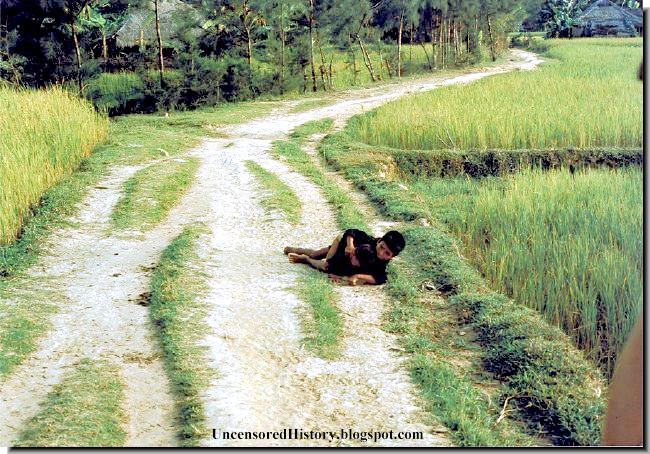
American soldiers in My Lai after the massacre. In one of the photos Ronald Haeberle recorded a scene of two children, crawling on the banks of the rice fields to avoid the bullets. A few dozen meters away, lay about 21 bodies (mostly women, children) killed by American soldiers. Another black and white photos shows  many Americans standing calmly on the banks of the rice fields after the massacre.
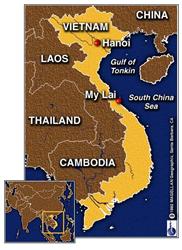
My Lai Vietnam map
43 years ago, on March 16, 1968, Ronald Haeberle a war correspondent went with American soldiers to the villages of My Son and My Lai, in Quang Ngai province. Here, U.S. soldiers killed 504 civilians, mostly women, children and the elderly. The shootings, murder and arson went on for four hours.

One year after the event, he decided to publish the images of the massacre in Life magazine.

Among the pictures he took in Son My village that fateful day, there are images that have not been released to the world before. He decided to introduce them to the world in 2011 through VnExpress a Vietnamese newspaper.
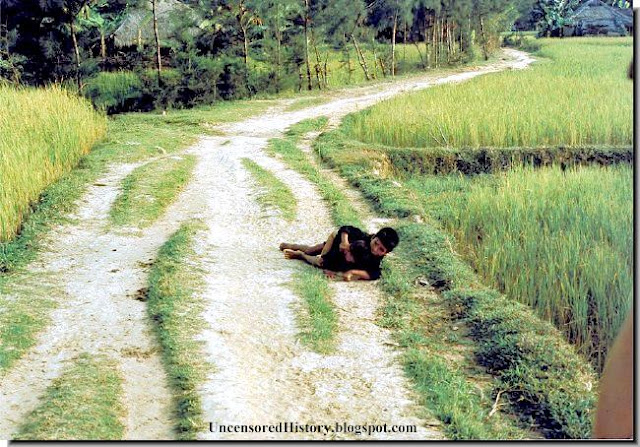

Tran Van Duc survivor  My Lai massacre injured
Tran Van Duc the survivor of the My Lai massacre lies injured. The arm of an American soldier is visible in the lower right hand side of the image.
PERSONAL ACCOUNT OF A SURVIVOR OF THE MY LAI MASSACRE


I was born Tran Van Duc in 1962, the third child and oldest son in my family. My mother sold food at a local market and my father was a tailor, selling clothes and western medicine. He had previously been held captive by the government, and as a result we were all under constant surveillance, reporting to authorities daily.

We had a large house near Son My Market. On one side, our neighbor owned a lot of coconuts and stored them in his yard, and I can still remember how refreshing they used to taste in the heat. On the other side of our house, there was a large pond, where villagers cultivated shrimp and fish. Behind us was My Khe, where the sea and endless white sand seemed to stretch far into the distance.

--------------------------------------
"My Lai massacre has haunted, tormented forever my life " 
Ronald Haeberle
--------------------------------------------------------


During my earliest memories of childhood, when the bombing raids commenced, my family became used to hiding in the ditches. Others were not so lucky, killed by collapsing tunnels as they attempted to emulate us. Many residents made the decision to flee My Son. Some went to neighboring Ly Son, others were separated and their whereabouts became unknown. Many children became orphaned and adults lost their homes. Fields and gardens were totally destroyed. Since my parents were in a fortunate position to provide help to those who had suffered losses, a number of families came to them in desperate need of food and shelter. As everybody left in search of safer grounds, we headed to Binh Duc, which due to its relative peace, seemed like paradise.
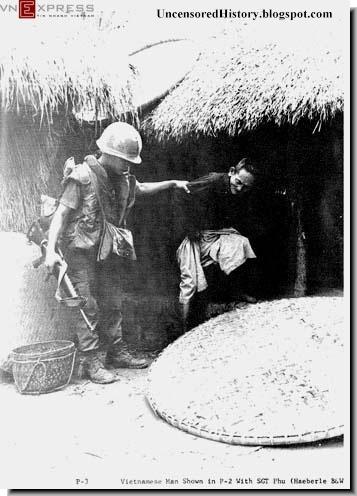

american soldier vietnamese man
An American soldier pulls out an old Vietnamese man  to the front yard. Seems like "Platoon".

With a population comprised mainly of fishermen and salt producers, Binh Duc seemed like a wonderful place. People here were very friendly and always smiled. Red and green colored boats appeared by the sea, ready for their day’s fishing. The shelling in Binh Duc was not as bad as the fighting in Son My. As the war started getting worse, our family lived with Mr and Mrs. Dong Hue for two years. My parents continued to operate their business in sewing and the wholesale market. I played with other children, waiting until the late afternoon for the sun to cool down, where we would catch crabs by the sea or play football with a plastic ball.

-------------------------------
 "I remember the villagers were friendly. I most remember the  children always  smiled and waved when photographed. This prompted me to publish the truth."
Ronald Haeberle
-------------------------------

As the bullets rained and bombs fell constantly, the local market in Binh Duc came under heavy attack and we moved again, to Thuan Yen, where my younger sister, Thi Ha, was born. My family built a small house on the property of Mrs. Bo and my father worked in nearby Ting Hiep as a nurse in the district of Son Tinh C12.

Even as a child, I understood the threat and impact of war, a reality confirmed when my family was also forced to live apart from each other. It was hard for me to accept that my grandmother, who had lived all of her life in Son Hoi, lived alone. Her children all had their own families and had since moved. My parents took it upon themselves to take care of grandmother. I loved my grandmother very much, because she reminded me of my mother in both shape and character. My sister My Hong and I often delivered money for her to buy rice, something that excited me a lot, and I can still remember how warm her hugs were. The idea of running along with my sisters was always such fun, but it would not take long before I got too tired and asked for a piggy back ride.
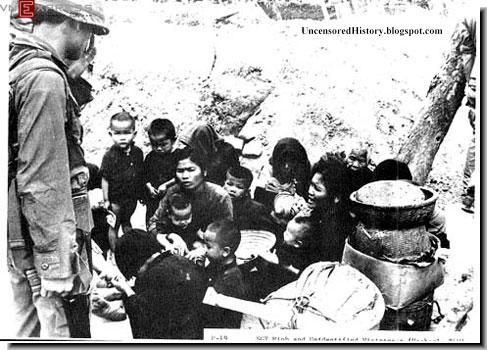


Vietnamese villagers American soldiers My Lai
A group of women and children were gathered together in one place.

There was so much to like about travelling on the B24 road through Thuan Yen, which were lined with bamboo trees with a backdrop of the mountains. The villages, surrounded by wheat fields and rice paddies, were often dotted with people toiling hard in the rice fields, planting themselves deep into the mud. This road led to My Lai, a place where everybody seemed busy working out how to best cope with bombings. The village of My Lai had become a recent target for gunfire, and the safest time to undertake all activities was either early in the morning, which is when farmers tended to their rice and vegetable plantations, and watered and spread fertilizer on their crops. The only other safe time was late at night, as this is when the fewest shots reigned over the village. Consequently, daily life was frantic. Every day, residents woke early to greet the sunrise, for this is when family meals were prepared.


Even in such a hostile environment, nobody would have predicted the events that took place on that day, March 16, 1968. American military units fired artillery shots across Thuan Yen, My Khe, and My Lai for one hour. They sounded like fireworks. Our village and neighboring hamlets were completely surrounded. At 11:00 am, helicopters started flying over My Lai, and some people in the neighborhood heard rockets being fired. My family and I learned that some residents had already been injured by the shots because the rockets were flying flow and landed in rice paddies where people were working in the fields. I could hear people scream and cry in a high-pitched wailing sound. Any civilians who were caught were marched into the center of the village. It resembled a makeshift prison yard full of men, women and children.
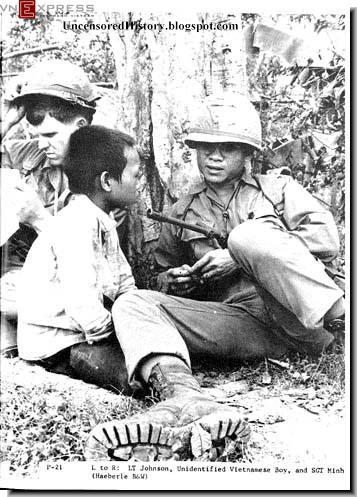

American GI chats with a Vietnamese boy
An American soldiers chats with a little Vietnamese boy before the killings started.

My father was not present in the household because he was away working in Ty Vinh Tinh Hiep, leaving my mother in charge of the household. Without any hesitation, she prepared an emergency kit for the children, fearing that we would also be taken from our hut. She hurriedly prepared a large brown canvas bag, placed some of my clothes in the bags and gave each of my siblings and myself 10,000 Vietnamese Dong, which we hid in our socks. I felt guilty about taking the money because it seemed like a fortune. We were then instructed to hide behind our house, which stored our home-made oils, medicines, textiles and fabrics. But before anybody had a chance to move, American troops stormed into our house and forced my mother, brothers and sisters to move onto the streets where everybody else was assembled. The last item my mother grabbed with her one free hand was her traditional straw hat, while desperately holding onto my baby sister, Thi Ha, with the other.

Once we were marched outside and told where to sit, my mother looked around and noticed the chaotic scenes where villagers were being pushed and shoved by soldiers. She noticed a nearby ditch near a neighboring house own by Mrs. Nhieu and told us all to move quickly, but to our dismay we found that it was already full. Crouching low, we eventually settled on a space near a tunnel opening. American troops were patrolling the area and continued to search tunnels. One old woman was struck on the lower back by a soldier’s rifle butt so hard, she fell to the ground in agonizing pain and could no longer walk. Horrified by what had just happened, I heard somebody say, “My God, we will all die.” This memory still haunts me today.
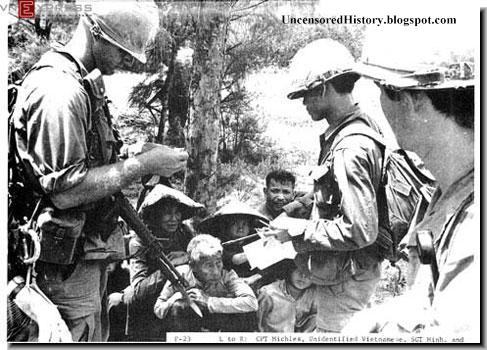

Soldiers interrogating villagers.
Soldiers interrogating the villagers. The mayhem had started.

One attribute I always remember about my mother was that no matter how hopeless the situation looked, she never accepted defeat. From our ditch, she spotted a nearby bamboo bush and hinted to us that we should head towards it immediately. The children went first and she following behind us. But no sooner had we begun to crawl through the crowd of people that a soldier saw my mother amidst the crowd, stormed into the ditch and grabbed my mother violently, ripping her clothes. I cried loudly in the hope that she would not be shot. Without warning, gun shots were fired into the ditch, hitting a number of bodies. As bullets, blood and flesh flew everywhere, my mother covered her body with her straw hat while hugging my little sister Ha close to her breast, and with her free hand, pushed me in the direction of a ditch adjacent to neighboring rice fields. She ordered me to protect my sister Ha and pretend to be dead so that the soldiers would leave us alone. We were not to move unless we knew the area was clear. For what seemed like hours, my little sister lay on her stomach and I sheltered her by doing the same.

As soon as the American troops moved out, my older sister and I searched for our mother and found her. She was seriously hurt, having been shot in the head and I knew nothing could be done to save her. However, she still had enough energy to give us one last instruction: “Hug your sister Ha, and take her to Grandma’s house. Don’t stay here any longer or they may come back and shoot you.”


These were the last words I heard my mother speak, and whenever I think about that day, it causes me great pain because I loved her very much. It saddens me to accept that among the numerous dead corpses littered the path between the village and my Grandma’s house, one of them was my own mother.


There is a famous panoramic picture of corpses amidst a green rice paddy taken by U.S. Army photographer Ronald Haeberle. But it does not include a shot of the dead women and children behind him. This is because of his position inside the helicopter where the photograph was taken.
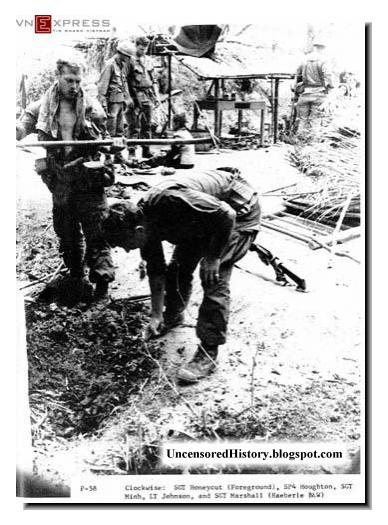

An American soldier chucks  grenade basement shelter Son My village.
An American soldier casually chucks a grenade into a basement shelter in Son My village.

When we were far away from the tower, a low-flying helicopter appeared, preparing for landing. I was very scared and hugged my sister. We lay down on the ground out to escape overhead bullets being fired in our direction. When I looked up, I saw helicopters quite clearly and there were a few American soldiers. One unarmed soldier was sitting outside the door, taking photos of the scene. If he had fired bullets, my sister and I would have been hit because the chopper was flying close to the ground. Only when the helicopter disappeared, I embraced my sister, Ha, and headed for Truong Son, in search for the road to Hoi An. We came across several dead bodies of local men on their way to work or the market.


From a distance we heard the sound of the American soldiers’ heavy gunfire. Houses were also being burned, and thick black smoke rose in the sky. I sensed that the helicopters were still patrolling the region. But all I could think about was why the inhabitants of My Son, especially innocent children, were attacked and killed. Many good friends and relatives of My Lai had their roots here, yet the village was now destroyed, and what was once a happy village was now gone. In grieving for the people who once lived here, I repeated “Why were they to blame? Why did you kill her?” over and over again.

Part II


Before my sister Ha and I reached our grandmother’s house, we arrived in Gia Hoa to greet my uncle, and asked for drinking water. He saw that we were covered in blood, from hiding in between bloodstained bodies in the ditch before our mother directed us to run away. He cried, a sign of being frightened for our well-being, and then immediately called over a village nurse, Mr. Hung. Our injuries were obvious; I was wounded in the forehead and my sister Ha in the abdomen.


It was in this time we discovered that my older sister, My, survived the slaughter by falling into a ditch and covering herself with dead bodies of people shot in rice fields. She too was covered in blood, but none of us knew the other was still alive. In fact, confusion reigned as to the fate of our mother. Although she was laying in the ditch when I last saw her, another village woman had told My that my mother had in fact escaped and began looking for her other children in the fields.

We listened to My’s story. She shared with us how she wandered the path of other adults taking a wounded child to the village of Truong for emergency treatment at a makeshift clinic. The baby was near death, having lost a lot of blood. Seeing a lost child in the village, a local family invited My to stay with them overnight. This is how Ha and I came into contact with our sole surviving older sister. I was excited to see her, but my first question was about the fate of my other two sisters, Thi Hong (11 years old) and Thi Hue (5 years old). My relayed the news I did not want to hear — they had been shot by American soldiers.
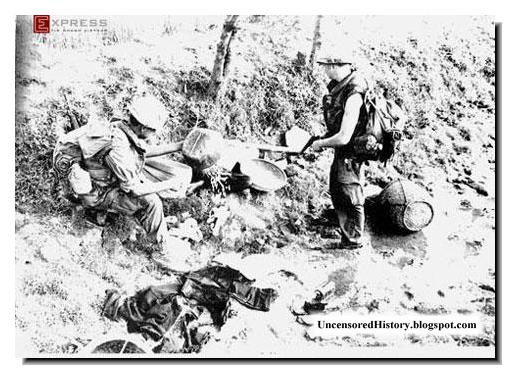

Soldiers destroyed livestock poultry food grains villagers
The soldiers not only killed villagers but killed and destroyed livestock, poultry and food grains of the villagers

I tried to imagine how my father would react upon hearing all of this. His working commitments in Ty Vinh Tinh Hiep saved his life on that day, but with Quang Ngai province in South Vietnam, not the North, the South Vietnamese government had labelled him “a revolutionary”, meaning that he would be killed on the spot if caught by either American soldiers or members of the Army of the Republic of Vietnam (ARVN).

It turned out that he had been informed of the massacre the day after it occurred and hurriedly set about returning home, but was too late to see his wife and two of his children get buried by his own cadremen. He concentrated on gathering information concerning the day’s events which led to their deaths. A few days later, he braved the drizzly conditions to see his mother (my grandmother), buoyed by the slim prospect of seeing two of my sisters and myself. Our reunion was emotional, and every month he returned to visit us and check on our condition. He dedicated his life to ensuring that his surviving offspring could have a better life and a chance at receiving an education. The task would have been impossible if some of his closest friends did not act as our guardians in his absence.

My grandmother was poor — very poor. Her bamboo house with painted walls in a village on the River Son Hoi did not feel like a permanent home. I used to have fond memories of coming here with my sisters and swimming in the river, but something seemed peculiar now. Maybe my soul had died. Grandmother was old and frail, and she relied on buying and selling fish in the market in nearby Loc. It was her main source of income, but not enough for all of us to live upon. My sisters and I asked Mrs. Bon Thuong, a family friend, to stop working at the markets and assist with making food. Since we experienced regular food shortages, I grew rice and wheat. For what was left of our family, this was the new life — no school, no fun, just struggle.

Every morning, my sisters and I would rise early to commence working on the farm and came back late. There were days when we had no food. Our skin was black and broken from toiling in the sun, and we were thin. I wore a torn hat and rags for clothing. My meager possessions included a pick-axe and a discarded Korean-made bag, which I used to hunt and gather food and anything else deemed edible. My aunts and other locals scavenged for rice, wheat, corn and fluorescent tubes. Any payment came in the form of Oi, a Vietnamese fruit, and some corn.

When I worked in the fields, my little sister Ha accompanied me. She was undernourished and cried a lot, for she missed breast milk. My grandmother improvised by getting the neighborhood children to find somebody who could provide some breast milk in the village. We struggled to survive and were avoiding starvation, but once again tragedy struck our family.

On December 19, 1969, we were informed that lines of communication with our father had been cut off because the country needed him. All I knew at that stage was that he had “been sacrificed for our nation.” I did not know what to think or do. His financial and emotional support, no matter how infrequent, is what kept our household going. The one message I recall him telling me is to always listen to my grandmother’s teachings, for she educated us in times when we had no money to attend school.


old man  child threatened
An old man and a child are threatened

This changed in 1970, for I was accepted to attend my local school. What a bittersweet moment for me — my dream had been achieved, but at a cost. How I longed for my parents to see me attend class, even though our hunger pains became inexcruciable. The worst times occurred when we literally starved because there was no rice to be found. Eventually, we resorted to stealing wheat bulbs, a kind of sweet potato, from the garden of a local resident, Mrs. Ran.

Such tactics became more commonplace. My sisters worked harder to get more food because our grandmother was no longer able to travel to the market to buy and sell goods. My two sisters and I shared responsibilities for her wellbeing. My older sister My, who by 1972 was in third grade in the local high school in Long Tang, dropped out of classes, something she did reluctantly. Ha and I worked in the fields after school and would bring back some rice and sweet potatoes, but when Ha came home one night, we were shocked by her appearance. She was dirty, looked unhealthy, and often went without meals. By contrast to the amount of rice and other foods that Ha and I consumed, my older sister took very little.

At the end of 1972, Son Hoi continued to resemble a battlefield, and my entire family in Son Tinh Hoi An had to be evacuated. When the fighting had temporarily ceased a few weeks later, the signs seemed promising — maybe the war would finally stop. However, a bomb from a U.S. fighter plane destroyed my grandmother’s house, with a large crater hole evidence of its destruction. Thankfully we were all safe and accounted for, although it took us two months to erect another bamboo house that yet again seemed far from being a home. War instills a legacy of fear, that nothing is permanent.

My siblings, grandmother and I ventured towards the coast, looking for rice seeds in the fields along the way as part of returning to a stable routine. In Soi Hon, I saw my friends enjoy their childhood, laughing together as they flew kites and played football in the fields. This life is one I could have only dreamed of, but I resigned to letting them go, thus cutting off my communication with them. Survival was my first goal. If I acted in a carefree manner, then neither my family nor myself would have food to eat.


my lai Burning the village


This war had deprived me of many things; half of my family, my childhood, and my innocence. Here I stood, a boy forcefully thrown into the life of an adult possessing only a discoloured hat and rags as clothes, a hoe in which to dig the earth and a Korean-made bag to carry whatever I owned. I had no money to buy even the smallest of items.

In the two years leading up to Vietnam’s reunification, I became obsessed with finding any long lost relatives that may have survived the war. My father’s fate was still unclear, but I guessed that having spent so long in the mountains, there must be a chance that he could still be alive, for soldiers were often away for long periods of time. I was excited when at the sight of seeing Hong, a long-time friend and son of a local man Mr. Ho. But this feeling of ecstasy was cut short when I received a visit from my father’s friend, Mr. Phan The Manh, who held a high rank in the resistance unit.

“Your father was a very brave man and sacrificed himself heroically,” he said, and immediately consoled me. These few words confirmed my worst fears. My father was shot and killed by American soldiers when his ambulance team attempted to help a wounded fighter. It was a crushing blow for me; I remembered his message about the importance of learning and making the most of every opportunity.

When I learned that I would be elevated from the sixth grade at Son Hoi school to attend a higher level in nearby Son Hoi Thanh, the pride and joy that I felt was immense. But the teacher turned me away from class on the first day because I did not wear long pants. If only she knew just how difficult life had been for me up until this point, then maybe her heart would have been kinder.  When I went home and relayed the news, it must have seemed like just another setback. But this one seemed more significant. My aunt gave me a pair of black khaki pants once owned by her late husband, and for the first time I now possessed my first pair of long pants and could attend school. After three lessons, the teacher who refused to let me into class was reduced to tears when I told her what had become of my family. What more could one do?

Part III


History books will tell you that on April 30, 1975, the tanks rolled into Saigon, signalling the end of Vietnam’s war and that my fellow people could start to rebuild their lives.  But the difficulties of years gone by were not automatically erased from my memory, like the time when I was nearly beaten to death while collecting crops.


Some of my family began moving back to our former village of Son My, ending my two year absence. This meant that I commenced attending a local school. Compared to my classmates, I was relatively large, but this did not stop my obsession with hunting for extra food to supplement our diet. One afternoon, two of my friends, Dinh and Lien, joined me in trekking into the mountains in hope of harvesting potato tubes, but our afternoon’s toiling yielded no potatoes or Oi [a Vietnamese fruit].  As the sun set in the distance, we walked down the mountain and to our good fortune, stumbled upon a dense clump of tubers, which were very good. All three of us cleared the grass to create a path and in front of us were plenty of onion bulbs to collect. Within a short time, we collected half a bag full. But up ahead we spotted a young man armed with a stick that he used to collect bags and we immediately we sensed danger.
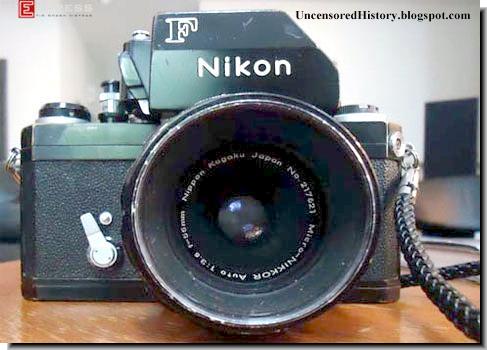

 mechanical camera Ronald Haeberle  My Lai massacre filmed
The old mechanical camera of Ronald Haeberle that captured the massacre on film for posterity

Our first instincts were to lay low in the long grass in the hope that we would not be discovered, but I was caught and without having any chance to think about what punishment awaited me, I found a hoe being pointed in my face. The man pulled me out of the grass roughly and used the hoe to beat me in the stomach, and across my shoulder and back. I cannot remember how long the beating lasted because I had passed out, but it ceased only when my body stopped twitching. All the food my friends and I had gathered was handed back to the man who inflicted the beating. My whole body was swollen and I was unable to attend school or work in the field. When my sister Mỹ and my grandmother asked what had happened, I told only half of the story. The man who inflicted the thrashing, it turned out, lived behind the house of our family friend, Mrs. Bon Thuong. My sister recognised him and other young people he associated with quite often. To this day, I believe that he feels guilty about the incident. Maybe it is because he instigated the attack and now realizes that I have no desire to seek revenge.


My pain and anger is not aimed at only those who took the lives of my family members, but at those who have covered up mistakes years after and have refused to say anything to me. Many reporters from around the world have come to My Son. They have worked with the Quang Ngai municipal staff in their offices and talked several times about the deceased. But I believe the media has been misled by authorities on certain matters. A number of survivors and their relatives have never been asked about their wishes. These include Mrs. Pham Thi Tro, daughter of Mrs. Nhieu, Le Thi Em, Pham Thi Hien, Bui Thi Ha, and Bui Sanh, the grandson of Mr. Huong Tho. They still live less than 800 yards from the memorial house, each one in dire poverty.

You only need look at photographs of the victims taken by U.S. Army officer Mr. Ronald Haeberle. These include:

Mrs. Nguyen Thi Tau, photographed with her closed mouth covered by a straw hat, may have lost her children but this certain that many soldiers have shot her children. Two of them were saved.

Mr. Nhieu’s wife and daughter escaped through the back door of their hut and hid in the rice field. They were lucky to flee, for five members of their family were killed. They also witnessed many gruesome images and experiences in their home.

Mrs. Pham Thi Thuan lost five people in her family, all killed by gunshots. I estimate that about 20 people who ran from the corner of her house sought shelter in the ditch, or other lay down in the garden. Others were hiding behind the altar where the family burned incense and gave offerings to their ancestors. They were all pulled out and shot by U.S. soldiers.

Mrs Thi Tuyet Do lives in Pleiku. She and her family were pulled out by U.S. soldiers and ordered to sit in front of the house before being instructed to enter the ditch. Of the 170 people, most in the line of fire were women and children. Many of them were killed, but you survived if you were covered by the other bodies.


Mr. Dat Pham testified that his wife was shot and injured, while a seven month-old child crawled out of a burning house and wandered towards the ditch; the child was shot by U.S. soldiers, covered in dry leaves, and burned.

Ms. Truong Thi Le lived because she lay quiet underneath two dead bodies and pretended to be dead.

Ha Thi Qui is now 83 years old and was wounded in the hip and lay there quietly, also underneath corpses. She later attempted to crawl home. On the way, she saw many injured persons and bodies of women, some of whom had been raped by U.S. soldiers and then shot.


I saw Mrs. Pham Thi Trinh, then 11 years old try to crawl out of the ditch to the top, just like Mrs. Pham Thi Muoi, whom was only 14 years old when she was found next to a house, raped and shot dead by a U.S. soldier.


A mother and 7 month old child were covered in dry leaves and set alight by U.S. soldiers.


The house of Mr Le contained 15 hidden people who were found and thrown in the trenches. Nobody was spared.

Ms. Trinh’s eight year-old daughter was shot by U.S. soldiers when attempting to escape a ditch while carrying a mouthful of rice.

Mr Tấn Huyen Tran, from Khe Thuan village, said that his grandparents, his parents, and child were shot dead by U.S. soldiers.


Many people from the international press have come with their camera crews to film stories about My Lai in the past. Authorities paid members of the press to stay about 800 yards away from areas where the poorest survivors and their families lived, to discourage any contact and prevent details being released. Film director Oliver Stone worked in Pinkville with an interpreter, dealing with the press to obtain details for making his film. But our testimony and history has been ignored. My family received no help from the community or the state. After Vietnam became a united country, I learned that my mother’s tombstone had been issued with the wrong date of birth and even worse, the incorrect picture.  When I raised this with house memorial officials, they did not take up my complaints further. Perhaps my stories of a handful of cold rice and going numerous days without food in my childhood interfered with their seemingly lavish lifestyle.


For any of the 130 American soldiers involved in the massacre, people such as Ernest Medina, William Calley, Oran K. Henderson, Samuel W. Koster, Eugene Kotouče, have you considered what impact your actions had on the children who lost their parents? Some of these children are now adults and they still live with the nightmares of being dragged out of their huts, being thrown into ditches, and watching machine guns and grenades slaughter their family members. After 42 years, you still have not come back to seek redemption. What did the innocent people of Son My and the surrounding hamlets do wrong to deserve being killed? How many screaming children can you recall crawling or lying on the ground in a puddle of blood? When you opened fire, mothers were breastfeeding children.  Elderly village women and defenceless and unarmed men died with frightened looks in their eyes. People that we respected and paid reverence to, you spat in their faces. You raped teenage girls and young women. Before committing your evil deeds, your units slowly encircled us, preventing any chance of escape.

Maybe you do not care, in which case, an apology is useless.

However, there were some soldiers who showed compassion and I would publicly like to thank them. These people include Mr. Ronald Haeberle, who took a photo of my mother and other images from his helicopter. These include the two pictures of the four young children he photographed before they were shot by U.S. soldiers, and another of two children lying on the street. The people of Son My remember him very fondly for his actions to prevent further loss of life.  I also pay my respects to Hugh Thompson, who landed his helicopter to rescue an eight-year old child and take her to a hospital after receiving a radio call from Glenn Andreotta.  Larry Colburn, Ron Ridenhour, Seymour Hersh (the investigative journalist who exposed the My Lai Massacre to the world in 1969) and William R. Peers all tried to tell the world exactly what took place, but were silenced by the U.S. government.


Although I now reside in Germany, I am speaking up on behalf of the residents who continue to live in My Lai and remain committed to seeing justice prevail for the deceased and survivors.
Share this PostPin ThisShare on TumblrShare on Google PlusEmail This

"The Phoenix Program": CIA's Killer Squads To Eliminate The Vietcong

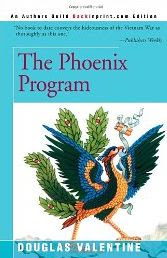
The following excerpt from The Phoenix Program, by Douglas Valentine, is from Chapter 24: “Transgressions”. It deals with the My Lai massacre and the infamous “Tiger Cages.”


On August 25, 1970, an article appeared in The New York Times hinting that the CIA, through Phoenix, was responsible for My Lai. The story line was advanced on October 14, when defense attorneys for David Mitchell — a sergeant accused and later cleared of machine-gunning scores of Vietnamese in a drainage ditch in My Lai — citing Phoenix as the CIA’s “systematic program of assassination,” named Evan Parker as the CIA officer who “signed documents, certain blacklists,” of Vietnamese to be assassinated in My Lai.


The Phoenix coordinator in Quang Ngai Province at the time of the My Lai massacre was Robert B. Ramsdell, a seventeen-year veteran of the Army CID who subsequently worked for ten years as a private investigator in Florida. Ramsdell was hired by the CIA in 1967. He was trained in the United States and sent to Vietnam on February 4, 1968, as the Special Branch adviser in Quang Ngai Province. Ramsdell, who appeared incognito before the Peers panel, told newsmen that he worked for the Agency for International Development.

In "Cover-up" Seymour Hersh tells how in February 1968 Ramsdell began “rounding up residents of Quang Ngai City whose names appeared on Phoenix blacklists.” Explained Ramsdell: “After Tet we knew who many of these people were, but we let them continue to function because we were controlling them. They led us to the VC security officer for the district. We wiped them out after Tet and then went ahead and picked up the small fish.” The people who were “wiped out,” Hersh explains, were “put to death” by the Phoenix Special Police.”

http://www.whale.to/b/ph2.html

Even less well remembered is one mission in the CIA's Phoenix Program in Vietnam in July of 1968. A team of CIA psychologists set up shop at Bien Hoa Prison outside Saigon, where NLF suspects were being held after Phoenix Program round-ups. The psychologists performed a variety of experiments on the prisoners. In one, three prisoners were anaesthetized; their skulls were opened and electrodes implanted by CIA doctors into different parts of their brains. The prisoners were revived, placed in a room with knives and the electrodes in the brains activated by the psychiatrists, who were covertly observing them. The hope was that they could be prompted in this manner to attack each other. The experiments failed. The electrodes were removed, the patients were shot and their bodies burned.


Phoenix program vietnam war

The Phoenix Program was a CIA creation in Vietnam. It was not unlike the Einsatzgruppen. It consisted basically of killer squads. Eliminating selectively Vietcong leaders.

Phoenix Program Badge
Operation Phoenix was designed with the stated objective to neutralize the NLF (National Liberation Front of South Vietnam, popularly known as the Vietcong), and it utilized infiltration, capturing, terrorizing, assassinating, converting, or killing to meet its objectives. More than 80,000 suspects were neutralized by the Phoenix operatives, killing more than 25,000 Vietnamese, and leaving the others disabled due to extreme torture. According to an internal communication, the intent of Operation Phoenix was to attack the NLF with a rifle rather than a shotgun to target the Vietnamese political leaders, command and control elements of the NLF activists.
http://famous101.com/famous-cia-operations

According to MACV Directive 381-41, the intent of Phoenix was to attack the NLF with a "rifle shot rather than a shotgun approach to target key political leaders, command/control elements and activists in the VCI."

Under the Phoenix Program, the CIA created and directed a secret police ostensibly run by the South Vietnamese. Its objective was to destroy the Viet Cong’s infrastructure. During the course of the program’s existence, the secret police units, operating as virtual death squads, were implicated in burnings, garroting, rape, torture, and sabotage. As many as 50,000 Vietnamese were killed. [PILGER, 1986, PP. 274VALENTINE, 2000] The most decorated American soldier of the war, Lieutenant Colonel Anthony Herbert, later recaledl in his book, Soldier, “They wanted me to take charge of execution teams that wiped out entire families and tried to make it look as though the VC themselves had done the killing.” [PILGER, 1986, PP. 274]


WHAT WAS THE PHOENIX PROGRAM?

The Phoenix, legendary animal that comes to symbolize what rises from the ashes.

Covert paramilitary operations by the CIA in Vietnam began early in the sixties, but it was not until 1965, that the U.S. began developing terrestrial deployment, when the station was established at the headquarters of the American Embassy in Saigon. It was called OSA ("Office of Special Assistace"). Throughout the 44 provinces of South Vietnam, nearly thousand OSA agents would conduct various intelligence collection programs, political and covert operations.

Although some sources cite 1967 as the year when the Phoenix program was launched, it was not until January 1968,  William Colby was sent to Vietnam by President Johnson and the CIA director Richard Helms with direct order from his office (in theory Colby came as ambassador) CORDS program ("Civil Operations and Rural Development Support"), the predecessor of Phoenix, and created by MACV ("Military Assistance Command Vietnam") in July 1967.


William Colby CIA chief Vietnam
William Colby in Vietnam

Nelson H. Brickham, Chief of Field Operations Section intelligence liaison, and authentic creator of Phoenix, was the man who launched the following projects within CORDS:

- HIP ("Hamlet Informant Project"): The CIA and Special Branch (Vietnamese officials not operating as intelligence agents but as detectives) were engaged in recruiting informants throughout South Vietnam. The CIA informants paid only if the accused confessed that he was part of the Vietcong infrastructure (IVC).

- PIC ("Province Interrogation Center"): The CIA abducted political leaders, students, trade unionists and journalists close to the communist ideologies and recruit PIC centers that were built torture chambers in all provinces of South Vietnam by the architectural firm specializing in the construction of bunkers and prisons "Pacific Architects & Enginners".


 Vietcong torture chamber
A PIC: The place where Vietcong were tortured

- PVI ("Vietcong Infrastructure Penetrations"): The IVC was attacked putting pressure on family members or on their people. Once arrested a member of VC, was tortured until he gave the name of his people and their families. Once done, the members of the Special Division conducted a raid, the captured (most were usually women) and were raped in front of the detainee This program was directed personally by Brickham.


 Nelson Brickham
"The bad guy". Nelson Brickham

Meanwhile, the head of the CIA station in Saigon, John Limond Hart, had its own covert action program, which was coordinated by his deputy, Tom Donahue. This program clashed often with that of Brickham, despite having much larger budget was less effective, partly because Hart used  paramilitary Cubans from the Bay of Pigs, rather than South Vietnamese staff.


captured Vietcong Phoenix program
A captured Vietcong squeaks on his comrades

To end this competition, Colby decided on arrival to unify all covert CIA operations programs in South Vietnam under the name of PHOENIX. It was necessary to unite the efforts of the CIA, the FAS of the U.S., South Vietnamese Special Branch, and the Central Intelligence Organization of Vietnam.

The Phoenix program  in its infancy  was called ICEX ("Intelligence Coordination and Explotation"), and although it was under command of the army, it had its own chain of command,  directed by William Colby himself.

The first step by the CIA was the creation of the PRU ("Provincial Reconnaissance Units") paramilitary units comprising of volunteers  South Vietnamese soldiers and Americans SEALS , whose mission was to attack the enemy in their territory, in rural areas.


Delta Phoenix adviser John Wilbur  Kien Hoa Province PRU team  1967
Delta PRU adviser John Wilbur with the Kien Hoa Province PRU team in 1967

There were also special units operating independently called CT ("Counter-Terror Teams") consisting of a sniper, an observer and a transmission specialist. These teams closely guarded suspects filtered by the HIP, and if they met with members of the VC, they were eliminated. It is estimated that these units "removed" upto 3,000 civilians. Given its effectiveness, CT Colby received authorization to go into North Vietnamese territory to target high ranking Communist military or administration officials. 


 Phoenix tattoo
Member of  a special Phoenix team, displaying Phoenix tattoo

One of the biggest successes of Phoenix was a program called "Chieu Hoi" or "open arms Programme", which was to provide money to middle and high ranking communists to become South Vietnamese allies. It is believed that some 159,000 members of the Communist organization joined the program, 15,000 of them were members of the NVA ("North Vietnamese Army")

Intelligence was gathered and transmitted by PIOCC ("Province Intelligence and Operations Coordination Centers") or its subordinate DIOCC ("District Intelligence and Operations Coordination Centers")

With the goal of transferring control to the South Vietnamese PHOENIX because of the growing "Vietnamization" of the conflict, members of the CIA were gradually replaced by elements of the U.S. military, mostly from the Special Forces. The handover took place in August 1971, taking the reins of the regular army, special forces and the South Vietnamese police. The program then became known by its Vietnamese name, "Hoang Pjung".

The Phoenix program was widely criticized by groups opposed to the war, considering it was a program of murders with indiscriminate brutality and constant violation of international law.

It is believed that the program was active until December 1972, although in some respects it was alive until the day of the fall of Saigon on 30 April 1975.


----------------------------------------------
The Phoenix Program  Douglas Valentine
By Douglas Valentine

Extract: Introduction

It was well after midnight. Elton Manzione, his wife, Lynn, and I sat at their kitchen table, drinking steaming cups of coffee. Rock 'n' roll music throbbed from the living room. A lean, dark man with large Mediterranean features, Elton was chain-smoking Pall Malls and telling me about his experiences as a twenty-year-old U.S. Navy SEAL in Vietnam in 1964. It was hot and humid that sultry Georgia night, and we were exhausted; but I pressed him for more specific information. "What was your most memorable experience?" I asked.

Elton looked down and with considerable effort, said quietly, "There's one experience I remember very well. It was my last assignment. I remember my last assignment very well.

"They," Elton began, referring to the Navy commander and Special Forces colonel who issued orders to the SEAL team, "called the three of us [Elton, Eddie Swetz, and John Laboon] into the briefing room and sat us down. They said they were having a problem at a tiny village about a quarter of a mile from North Vietnam in the DMZ. They said some choppers and recon planes were taking fire from there. They never really explained why, for example, they just didn't bomb it, which was their usual response, but I got the idea that the village chief was politically connected and that the thing had to be done quietly.


Phoenix Program torture


"We worked in what were called hunter-killer teams," Elton explained. "The hunter team was a four-man unit, usually all Americans, sometimes one or two Vietnamese or Chinese mercenaries called counterterrorists -- CTs for short. Most CTs were enemy soldiers who had deserted or South Vietnamese criminals. Our job was to find the enemy and nail him in place -- spot his position, then go back to a prearranged place and call in the killer team. The killer team was usually twelve to twenty-five South Vietnamese Special Forces led by Green Berets. Then we'd join up with the killer team and take out the enemy."


But on this particular mission, Elton explained, the SEALs went in alone. "They said there was this fifty-one-caliber antiaircraft gun somewhere near the village that was taking potshots at us and that there was a specific person in the village operating the gun. They give us a picture of the guy and a map of the village. It's a small village, maybe twelve or fifteen hooches. 'This is the hooch,' they say. 'The guy sleeps on the mat on the left side. He has two daughters.' They don't know if he has a mama-san or where she is, but they say, 'You guys are going to go in and get this guy. You [meaning me] are going to snuff him.' Swetz is gonna find out where the gun is and blow it. Laboon is gonna hang back at the village gate covering us. He's the stoner; he's got the machine gun. And I'm gonna go into the hooch and snuff this guy

"'What you need to do first,' they say, 'is sit alongside the trail [leading from the village to the gun] for a day or two and watch where this guy goes. And that will help us uncover the gun.' Which it did. We watched him go right to where the gun was. We were thirty yards away, and we watched for a while. When we weren't watching, we'd take a break and go another six hundred yards down the trail to relax. And we did that for maybe two days -- watched him coming and going -- and got an idea of his routine: when he went to bed; when he got up; where he went. Did he go behind the hooch to piss? Did he go into the jungle? That sort of thing.

"They told us, 'Do that. Then come back and tell us what you found out.' So we went back and said, 'We know where the gun is,' and we showed them where it was on the map. We were back in camp for about six hours, and they said, 'Okay, you're going out at o-four-hundred tomorrow. And it's like we say, you [meaning me] are going to snuff the guy, Swetz is going to take out the gun, and Laboon's going to cover the gate.'"

Elton explained that on special missions like this the usual procedure was to "snatch" the targeted VC cadre and bring him back to Dong Ha for interrogation. In that case Elton would have slipped into the hooch and rendered the cadre unconscious, while Swetz demolished the antiaircraft gun and Laboon signaled the killer team to descend upon the village in its black CIA-supplied helicopters. The SEALs and their prisoner would then climb on board and be extracted.

In this case, however, the cadre was targeted for assassination.

"We left out of Cam Lo," Elton continued. "We were taken by boat partway up the river and walked in by foot -- maybe two and a half, three miles. At four in the morning we start moving across an area that was maybe a hundred yards wide; it's a clearing running up to the village. We're wearing black pajamas, and we've got black paint on our faces. We're doing this very carefully, moving on the ground a quarter of an inch at a time -- move, stop, listen; move, stop, listen. To check for trip wires, you take a blade of grass and put it between your teeth, move your head up and down, from side to side, watching the end of the blade of grass. If it bends, you know you've hit something, but of course, the grass never sets off the trip wire, so it's safe.

"It takes us an hour and a half to cross this relatively short stretch of open grass because we're moving so slowly. And we're being so quiet we can hardly hear each other, let alone anybody else hearing us. I mean, I know they're out there -- Laboon's five yards that way, Swetz is five yards to my right -- but I can't hear them.

"And so we crawl up to the gate. There's no booby traps. I go in. Swetz has a satchel charge for the fifty-one-caliber gun and has split off to where it is, maybe sixty yards away. Laboon is sitting at the gate. The village is very quiet. There are some dogs. They're sleeping. They stir, but they don't even growl. I go into the hooch, and I spot my person. Well, somebody stirs in the next bed. I'm carrying my commando knife, and one of the things we learned is how to kill somebody instantly with it. So I put my hand over her mouth and come up under the second rib, go through the heart, give it a flick; it snaps the spinal cord. Not thinking! Because I think 'Hey!' Then I hear the explosion go off and I know the gun is out. Somebody else in the corner starts to stir, so I pull out the sidearm and put it against her head and shoot her. She's dead. Of course, by this time the whole village is awake. I go out, waiting for Swetz to come, because the gun's been blown. People are kind of wandering around, and I'm pretty dazed. And I look back into the hooch, and there were two young girls. I'd killed the wrong people."

Elton Manzione and his comrades returned to their base at Cam Lo. Strung out from Dexedrine and remorse, Elton went into the ammo dump and sat on top of a stack of ammunition crates with a grenade, its pin pulled, between his legs and an M-16 cradled in his arms. He sat there refusing to budge until he was given a ticket home.

***
In early 1984 Elton Manzione was the first person to answer a query I had placed in a Vietnam veterans' newsletter asking for interviews with people who had served in the Phoenix program. Elton wrote to me, saying, "While I was not a participant in Phoenix, I was closely involved in what I think was the forerunner. It was part of what was known as OPLAN 34. This was the old Leaping Lena infiltration program for LRRP [long-range reconnaissance patrol] operations into Laos. During the time I was involved it became the well-known Delta program. While all this happened before Phoenix, the operations were essentially the same.Our primary function was intelligence gathering, but we also carried out the 'undermining of the infrastructure' types of things such as kidnapping, assassination, sabotage, etc.

"The story needs to be told," Elton said, "because the whole aura of the Vietnam War was influenced by what went on in the 'hunter-killer' teams of Phoenix, Delta, etc. That was the point at which many of us realized we were no longer the good guys in the white hats defending freedom -- that we were assassins, pure and simple. That disillusionment carried over to all other aspects of the war and was eventually responsible for it becoming America's most unpopular war."

***

The story of Phoenix is not easily told. Many of the participants, having signed nondisclosure statements, are legally prohibited from telling what they know. Others are silenced by their own consciences. Still others are professional soldiers whose careers would suffer if they were to reveal the secrets of their employers. Falsification of records makes the story even harder to prove. For example, there is no record of Elton Manzione's ever having been in Vietnam. Yet, for reasons which are explained in my first book, The Hotel Tacloban, I was predisposed to believe Manzione. I had confirmed that my father's military records were deliberately altered to show that he had not been imprisoned for two years in a Japanese prisoner of war camp in World War II. The effects of the cover-up were devastating and ultimately caused my father to have a heart attack at the age of forty-five. Thus, long before I met Elton Manzione, I knew the government was capable of concealing its misdeeds under a cloak of secrecy, threats, and fraud. And I knew how terrible the consequences could be.

Then I began to wonder if cover-ups like the one concerning my father had also occurred in the Vietnam War, and that led me in the fall of 1983 to visit David Houle, director of veteran services in New Hampshire. I asked Dave Houle if there was a part of the Vietnam War that had been concealed, and without hesitation he replied, "Phoenix." After explaining a little about it, he mentioned that one of his clients had been in the program, then added that his client's service records -- like those of Elton Manzione's and my father's -- had been altered. They showed that he had been a cook in Vietnam.

I asked to meet Houle's client, but the fellow refused. Formerly with Special Forces in Vietnam, he was disabled and afraid the Veterans Administration would cut off his benefits if he talked to me.

That fear of the government, so incongruous on the part of a war veteran, made me more determined than ever to uncover the truth about Phoenix, a goal which has taken four years to accomplish. That's a long time to spend researching and writing a book. But I believe it was worthwhile, for Phoenix symbolizes an aspect of the Vietnam War that changed forever the way Americans think about themselves and their government.

Developed in 1967 by the Central Intelligence Agency (CIA), Phoenix combined existing counterinsurgency programs in a concerted effort to "neutralize" the Vietcong infrastructure (VCI). The euphemism "neutralize" means to kill, capture, or make to defect. The word "infrastructure" refers to those civilians suspected of supporting North Vietnamese and Vietcong soldiers like the one targeted in Elton Manzione's final operation. Central to Phoenix is the fact that it targeted civilians, not soldiers. As a result, its detractors charge that Phoenix violated that part of the Geneva Conventions guaranteeing protection to civilians in time of war. "By analogy," said Ogden Reid, a member of a congressional committee investigating Phoenix in 1971, "if the Union had had a Phoenix program during the Civil War, its targets would have been civilians like Jefferson Davis or the mayor of Macon, Georgia."

Under Phoenix, or Phung Hoang, as it was called by the Vietnamese, due process was totally nonexistent. South Vietnamese civilians whose names appeared on blacklists could be kidnapped, tortured, detained for two years without trial, or even murdered, simply on the word of an anonymous informer. At its height Phoenix managers imposed quotas of eighteen hundred neutralizations per month on the people running the program in the field, opening up the program to abuses by corrupt security officers, policemen, politicians, and racketeers, all of whom extorted innocent civilians as well as VCI. Legendary CIA officer Lucien Conein described Phoenix as "A very good blackmail scheme for the central government. 'If you don't do what I want, you're VC."'

Because Phoenix "neutralizations" were often conducted at midnight while its victims were home, sleeping in bed, Phoenix proponents describe the program as a "scalpel" designed to replace the "bludgeon" of search and destroy operations, air strikes, and artillery barrages that indiscriminately wiped out entire villages and did little to "win the hearts and minds" of the Vietnamese population. Yet, as Elton Manzione's story illustrates, the scalpel cut deeper than the U.S. government admits. Indeed, Phoenix was, among other things, an instrument of counterterror -- the psychological warfare tactic in which VCI members were brutally murdered along with their families or neighbors as a means of terrorizing the neighboring population into a state of submission. Such horrendous acts were, for propaganda purposes, often made to look as if they had been committed by the enemy.

This book questions how Americans, who consider themselves a nation ruled by laws and an ethic of fair play, could create a program like Phoenix. By scrutinizing the program and the people who participated in it and by employing the program as a symbol of the dark side of the human psyche, the author hopes to articulate the subtle ways in which the Vietnam War changed how Americans think about themselves. This book is about terror and its role in political warfare. It will show how, as successive American governments sink deeper and deeper into the vortex of covert operations --  ostensibly to combat terrorism and Communist insurgencies -- the American people gradually lose touch with the democratic ideals that once defined their national self-concept. This book asks what happens when Phoenix comes home to roost.

-----------------------------------


Common methods of torture used at the interrogation centers included:

"Rape, gang rape, rape using eels, snakes, or hard objects, and rape followed by murder; electric shock ('the Bell Telephone Hour') rendered by attaching wires to the genitals or other sensitive parts of the body, like the tongue; the 'water treatment'; the 'airplane' in which the prisoner's arms were tied behind the back, and the rope looped over a hook on the ceiling, suspending the prisoner in midair, after which he or she was beaten; beatings with rubber hoses and whips; the use of police dogs to maul prisoners."


Military intelligence officer K. Milton Osborne witnessed the following use of torture:


"The use of the insertion of the 6-inch dowel into the canal of one of my detainee's ears, and the tapping through the brain until dead. The starvation to death (in a cage), of a Vietnamese woman who was suspected of being part of the local political education cadre in one of the local villages ... The use of electronic gear such as sealed telephones attached to ... both the women's vaginas and men's testicles [to] shock them into submission."


The torture was usually carried out by South Vietnamese with the CIA and special forces playing a supervisory role.


----------------------------


Suggesting Reading

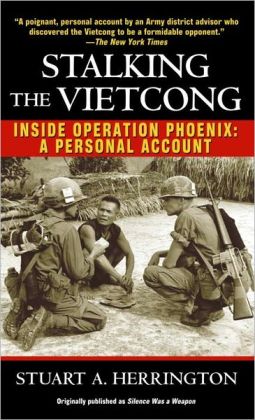
Stalking the Vietcong: Inside Operation Phoenix: A Personal Account   Stuart Herrington
By Stuart Herrington

---------------------------------


Ashes to Ashes: The Phoenix Program and the Vietnam War Dale Andrade
Ashes to Ashes: The Phoenix Program and the Vietnam War
Dale Andrade

----------------------------------------


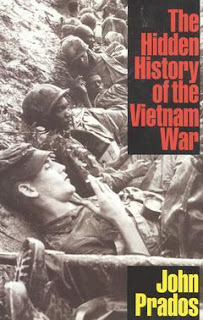
The Hidden History of the Vietnam War John Prados
The Hidden History of the Vietnam War
John Prados

-------------------------------------


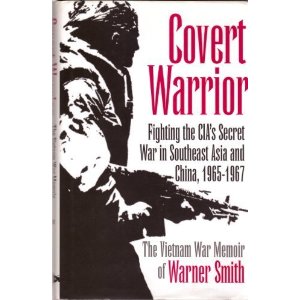
Covert Warrior: Fighting the CIA's Secret War in Southeast Asia and China, 1965-1967 Warner Smith
Covert Warrior: Fighting the CIA's Secret War in Southeast Asia and China, 1965-1967
Warner Smith

Share this PostPin ThisShare on TumblrShare on Google PlusEmail This
Related Posts Plugin for WordPress, Blogger...
Advertisement

Popular Articles On This Site

UncensoredHistory.blogspot.com

UncensoredHistory.blogspot.com